


caps provide voltage boost to
#voltage boost
#capacitors
#diodes
#transformer
#series regulator
#low line voltage
#power adapter
#regulation
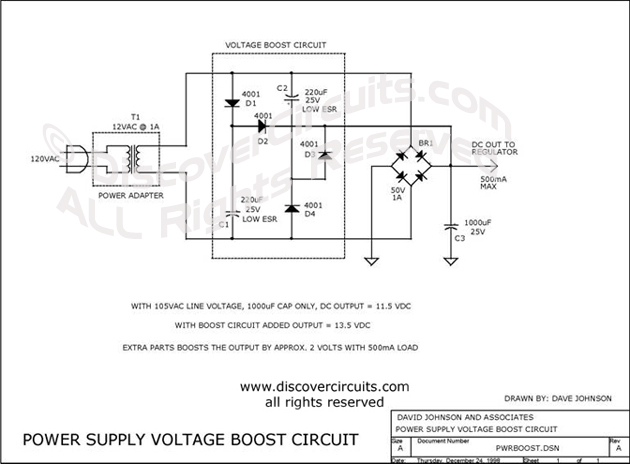
Description: This circuit incorporates capacitors and diodes into a conventional transformer-based series regulator circuit to enhance its operational range. It ensures regulation under low line voltage conditions and can extract additional power from a standard plug-in power supply.
The described circuit modification enhances the performance of a traditional transformer-based series regulator by integrating additional components such as capacitors and diodes. The primary function of the series regulator is to maintain a stable output voltage despite variations in input voltage or load current. By introducing capacitors, the circuit can better filter out voltage fluctuations, thereby improving the overall stability and response time of the regulator.
Diodes are utilized in this configuration to protect against reverse polarity and to allow for better current flow regulation. They can also serve to clamp voltage spikes that may occur in the circuit, further safeguarding sensitive components. The inclusion of these components allows the circuit to maintain regulation even under low line voltage conditions, which is particularly beneficial in scenarios where the input voltage may drop below the expected levels.
Moreover, this enhanced design is capable of extracting additional power from standard wall-mounted power supplies. This is achieved by optimizing the voltage drop across the regulator, enabling it to deliver slightly higher wattage without compromising the integrity of the output voltage. Such enhancements make this circuit suitable for applications requiring reliable power delivery in varying conditions, thus extending the usability and efficiency of conventional transformer-based power supplies.
Overall, this circuit modification represents a significant improvement over standard designs, offering greater flexibility and reliability in power regulation applications.This circuit adds some capacitors and diodes to a traditional transformer type series regulator circuit to extend the normal operating range. It can insure regulation during low line voltage conditions or it can squeeze a few more watts out of a plug-in-the-wall power adapter power supply.
The described circuit modification enhances the performance of a traditional transformer-based series regulator by integrating additional components such as capacitors and diodes. The primary function of the series regulator is to maintain a stable output voltage despite variations in input voltage or load current. By introducing capacitors, the circuit can better filter out voltage fluctuations, thereby improving the overall stability and response time of the regulator.
Diodes are utilized in this configuration to protect against reverse polarity and to allow for better current flow regulation. They can also serve to clamp voltage spikes that may occur in the circuit, further safeguarding sensitive components. The inclusion of these components allows the circuit to maintain regulation even under low line voltage conditions, which is particularly beneficial in scenarios where the input voltage may drop below the expected levels.
Moreover, this enhanced design is capable of extracting additional power from standard wall-mounted power supplies. This is achieved by optimizing the voltage drop across the regulator, enabling it to deliver slightly higher wattage without compromising the integrity of the output voltage. Such enhancements make this circuit suitable for applications requiring reliable power delivery in varying conditions, thus extending the usability and efficiency of conventional transformer-based power supplies.
Overall, this circuit modification represents a significant improvement over standard designs, offering greater flexibility and reliability in power regulation applications.This circuit adds some capacitors and diodes to a traditional transformer type series regulator circuit to extend the normal operating range. It can insure regulation during low line voltage conditions or it can squeeze a few more watts out of a plug-in-the-wall power adapter power supply.

Classic car battery charging circuit diagram
The circuit operates after a transformer, utilizing a bridge rectifier and conditioning for battery charging. The charging current transformer can be easily adjusted to provide approximately 12V at 100Ah battery charging. The required charging current is 10A, and a 150VA...

Series DC power supply
A power supply typically consists of a transformer, rectifier, filter, adjustment components, and reference power supply and sampling circuits. Additionally, it may include overload or short circuit protection devices. The circuit begins with a 220V step-down transformer (T) that converts...
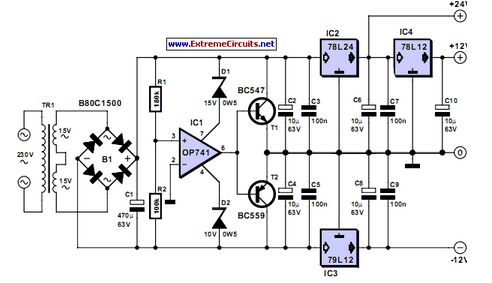
Triple Power Supply
Inexpensive miniature transformers typically offer one or two secondary voltages, which are adequate for producing a set of positive and negative supply voltages.
Miniature transformers are compact devices commonly utilized in various electronic applications, particularly in power supply circuits. These transformers...
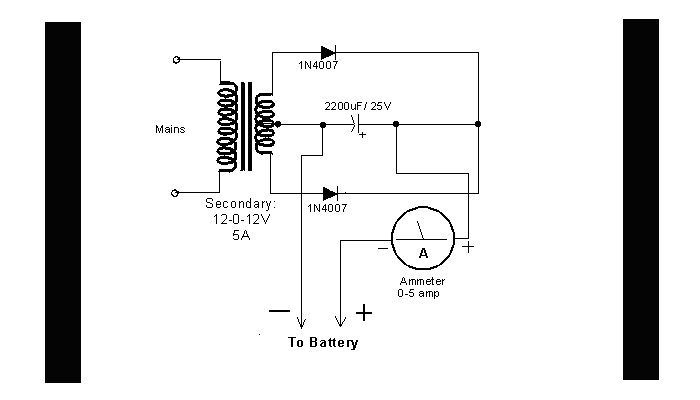
DIY Circuit Car Battery Charger
This simple circuit consists of a transformer, two diodes, a capacitor, and an ammeter. To charge a battery, connect the positive and negative terminals of the circuit to the corresponding terminals of the battery. When the battery is not charged,...

Car battery charging circuit diagram
The circuit operates on the principle of a transformer, bridge rectifier, and conditioning for battery charging. The charging current can be adjusted to approximately 12V at 100A. For battery charging, a charging rate of 10 hours requires a charging current...

how to build inexpensive frequency
Capacitors are major electronic components classified as passive components. They are extensively used in electronic circuits, and virtually no circuit can be constructed without these essential parts. The primary function of a capacitor is to block direct current (DC) while...
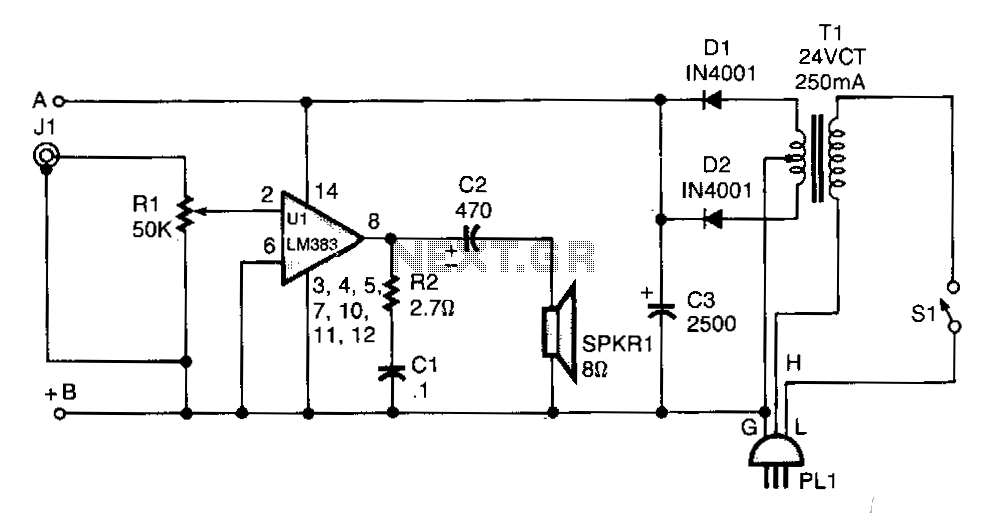
Line-operated-amplifier
T1 isolates the unit from the line and has a 24-V, center-tapped secondary. The output of the transformer is rectified by diodes D1 and D2 and filtered by capacitor C3 to provide 15 to 18 Vdc. The LM383 has built-in...

PF Test Equipment
A transformer ratio-arm bridge circuit is utilized as depicted in the simplified diagram of Figure 1. The circuit comprises a standard reference capacitor (CS) and the insulation under test (CX). A distinctive feature of the circuit is a specialized multi-winding...
Capacitors
Capacitor types, their uses, formulas for common capacitance calculations, descriptions of charge pumps, information on dielectric soakage, and how to repair.
Capacitors are essential components in electronic circuits, serving various functions depending on their type and application. The primary types of...