


Current Limiting Power Supply
#variable voltage
#current limiting
#PSU
#1-amp
#3v-24v
#soak-test
#power supply
#adjustable
#project power

Description: This is a 1-amp variable-voltage PSU. It adjusts from about 3v to 24v and has the added feature that you can limit the maximum output current. This is invaluable when, for example, you power-up a project for the first time or soak-test a piece of equipment. More: SW3 is the on/off switch. It also lets you choose between the output with the current limit and the one without. SW2 provides a selection of three different limits. You can increase or decrease this number if you wish. The limits are fixed by R4, R5.
The described power supply unit (PSU) is a versatile device designed for various applications requiring adjustable voltage and current limiting features. The PSU operates within a voltage range of approximately 3 volts to 24 volts, making it suitable for powering a wide range of electronic devices and projects.
The current limiting feature is particularly critical during initial power-up or testing phases, where excessive current draw could potentially damage sensitive components. This feature allows users to set a maximum current limit, providing an added layer of protection for both the power supply and the connected load.
The operation of the PSU is controlled by two switches: SW3 and SW2. SW3 functions as the main on/off switch, enabling or disabling the power supply. Additionally, it allows users to toggle between two output modes: one with current limiting enabled and the other without. This dual-output capability offers flexibility in usage scenarios, allowing users to choose the appropriate mode based on the requirements of their specific application.
SW2 is responsible for selecting one of three predefined current limits. This switch provides the user with the ability to customize the maximum current output according to the needs of the connected circuit. The current limits are established through the resistors R4 and R5. By adjusting these resistors, users can modify the current limit settings to suit different testing or operational requirements. This adaptability makes the PSU an invaluable tool for engineers and hobbyists alike, facilitating safe experimentation and development with various electronic circuits.
Overall, this 1-amp variable-voltage PSU combines flexibility, safety, and ease of use, making it an essential component in any electronics laboratory or workspace.This is a 1-amp variable-voltage PSU. It adjusts from about 3v to 24v: and has the added feature that you can limit the maximum output current. This is invaluable when (for example) you power-up a project for the first time or soak-test a piece of equipment.
SW3 is the on/off switch. It also lets you choose between the output with the current limit and the one without. SW2 provides a selection of three different limits. You can increase or decrease this number if you wish. The limits are fixed by R4, R5 &
The described power supply unit (PSU) is a versatile device designed for various applications requiring adjustable voltage and current limiting features. The PSU operates within a voltage range of approximately 3 volts to 24 volts, making it suitable for powering a wide range of electronic devices and projects.
The current limiting feature is particularly critical during initial power-up or testing phases, where excessive current draw could potentially damage sensitive components. This feature allows users to set a maximum current limit, providing an added layer of protection for both the power supply and the connected load.
The operation of the PSU is controlled by two switches: SW3 and SW2. SW3 functions as the main on/off switch, enabling or disabling the power supply. Additionally, it allows users to toggle between two output modes: one with current limiting enabled and the other without. This dual-output capability offers flexibility in usage scenarios, allowing users to choose the appropriate mode based on the requirements of their specific application.
SW2 is responsible for selecting one of three predefined current limits. This switch provides the user with the ability to customize the maximum current output according to the needs of the connected circuit. The current limits are established through the resistors R4 and R5. By adjusting these resistors, users can modify the current limit settings to suit different testing or operational requirements. This adaptability makes the PSU an invaluable tool for engineers and hobbyists alike, facilitating safe experimentation and development with various electronic circuits.
Overall, this 1-amp variable-voltage PSU combines flexibility, safety, and ease of use, making it an essential component in any electronics laboratory or workspace.This is a 1-amp variable-voltage PSU. It adjusts from about 3v to 24v: and has the added feature that you can limit the maximum output current. This is invaluable when (for example) you power-up a project for the first time or soak-test a piece of equipment.
SW3 is the on/off switch. It also lets you choose between the output with the current limit and the one without. SW2 provides a selection of three different limits. You can increase or decrease this number if you wish. The limits are fixed by R4, R5 &

250 Watt PC power Supply
Up to 10 A continuous output current, or operation with 50 % ESD and 18 A peak current are possible without a fan if sufficient natural air flow is present and the ambient temperature does not exceed 30 °C. A...

Current Limiting Power Supply
This is a 1-amp variable-voltage power supply unit (PSU) that can adjust output voltage from approximately 3V to 24V. It features a maximum output current limit, which is particularly useful when powering up a project for the first time or...
adjustable current limit for dual power
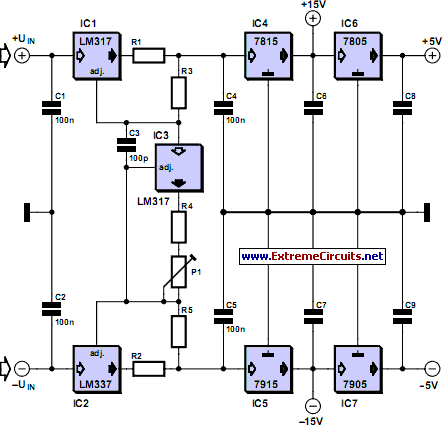
This current-limiting circuit, illustrated as part of a small bench power supply, can be utilized with any dual-rail current source. The section of the circuit on the left limits the current entering the dual voltage regulator (IC4 to IC7) to...

Designing Multiple Output Power Supplies With Topswitch
This application note describes a digital blood pressure meter concept that utilizes integrated pressure sensor analog signal-conditioning circuitry, microcontroller hardware/software, and a liquid crystal display. The sensing system measures cuff pressure (CP) and extracts pulses for analysis to determine systolic...
Adjustable 1.3-22V Regulated Power Supply
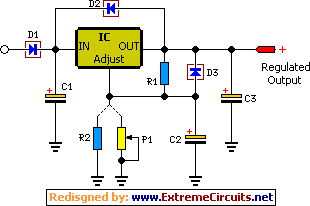
A regulated voltage that can be adjusted to suit various applications is desired. This Adjustable Power Supply is compact, simple to construct, and can be modified to produce different output voltages.
The Adjustable Power Supply circuit typically utilizes a linear voltage...
switching power supply 2
This circuit is designed to double nearly any DC input voltage while handling a substantial amount of current. For instance, it can work with input voltages ranging from 12 to 24V. With minor modifications, it can also provide any desired...

How to Boost Efficiency at Low Loads
Small additional circuitry during standby can significantly enhance efficiency. In a modern vehicle, multiple microcontrollers are required to support safety, navigation, entertainment, and comfort electronics.
The integration of additional circuitry during standby mode in automotive applications is crucial for optimizing power...

Adjustable output voltage regulator circuit diagram
The circuit consists of resistors R1, R2, and RP, where the resistance values play a critical role in determining the magnitude of the current I. This current must exceed the input current of the operational amplifier, which is approximately I...

Remote tracking circuit schematics
The circuit consists of two main components: (1) a power supply circuit featuring a transformer (T) that steps down AC 220V to 33V, followed by a full-wave rectifier, a filter, and a three-terminal regulator that outputs +24V. This circuit also...