


High Current Power Supply
#high current
#linear supply
#simple design
#huge currents
#electronics
#DIY
#power electronics
#voltage regulation

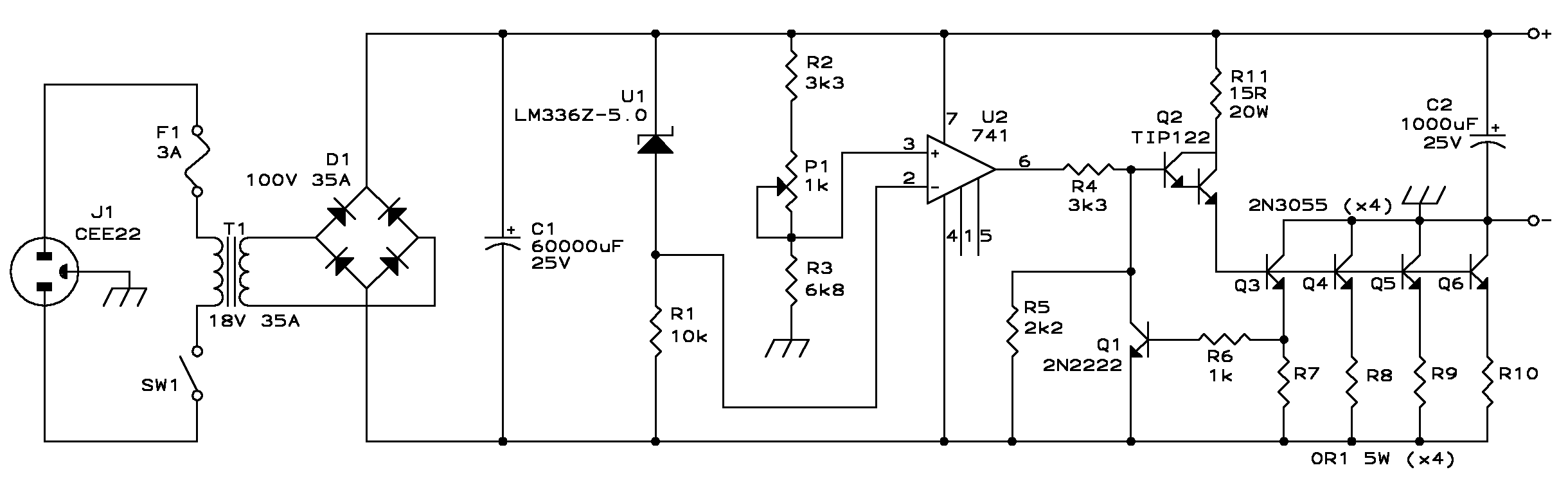
Description: Since my page was first posted, I have received a number of emails asking about a high current power supply. I looked around, but couldn’t find one that was suitable. So, I designed this. It is a linear supply, which might have a few of you rolling your eyes, but it takes very few parts, is simple to build and can supply huge currents.
The described high current linear power supply is designed to deliver substantial current while maintaining simplicity and ease of assembly. The circuit typically consists of a transformer, rectifier, filter capacitor, and a linear voltage regulator.
The transformer is the first critical component, stepping down the AC mains voltage to a lower voltage suitable for the desired output. It is essential to select a transformer that can handle the required current output while providing an adequate voltage drop. A toroidal transformer is often preferred for its efficiency and reduced electromagnetic interference.
Following the transformer, a bridge rectifier is employed to convert the AC voltage into pulsating DC. The rectifier should be rated for the maximum current that the power supply is expected to deliver, ensuring it can handle peak currents without overheating.
The output of the rectifier is then smoothed using a large filter capacitor. This capacitor is vital for reducing the ripple voltage in the output and should be selected based on the load current and the acceptable ripple voltage. Larger capacitance values will yield lower ripple but will need to be rated for the maximum voltage output of the rectifier.
The linear voltage regulator is responsible for providing a stable output voltage. Common choices include the LM317 or the LM7805 series, depending on the desired output voltage. The regulator must be capable of handling the maximum output current while dissipating heat effectively. Adequate heatsinking is crucial, as linear regulators can generate significant heat when dropping voltage.
Additional components such as fuses or circuit breakers may be included for safety, protecting the circuit from overcurrent conditions. Output terminals should be robust enough to handle high currents, and proper wire gauge must be used to minimize voltage drop and heating.
This high current power supply design, while straightforward, requires careful consideration of component ratings and thermal management to ensure reliable operation under load conditions.Since my page was first posted, I have received a number of emails asking about a high current power supply. I looked around, but couldn`t find one that was suitable. So, I designed this. It is a linear supply, which might have a few of you rolling your eyes, but it takes very few parts, is simple to build and can supply huge currents.
The described high current linear power supply is designed to deliver substantial current while maintaining simplicity and ease of assembly. The circuit typically consists of a transformer, rectifier, filter capacitor, and a linear voltage regulator.
The transformer is the first critical component, stepping down the AC mains voltage to a lower voltage suitable for the desired output. It is essential to select a transformer that can handle the required current output while providing an adequate voltage drop. A toroidal transformer is often preferred for its efficiency and reduced electromagnetic interference.
Following the transformer, a bridge rectifier is employed to convert the AC voltage into pulsating DC. The rectifier should be rated for the maximum current that the power supply is expected to deliver, ensuring it can handle peak currents without overheating.
The output of the rectifier is then smoothed using a large filter capacitor. This capacitor is vital for reducing the ripple voltage in the output and should be selected based on the load current and the acceptable ripple voltage. Larger capacitance values will yield lower ripple but will need to be rated for the maximum voltage output of the rectifier.
The linear voltage regulator is responsible for providing a stable output voltage. Common choices include the LM317 or the LM7805 series, depending on the desired output voltage. The regulator must be capable of handling the maximum output current while dissipating heat effectively. Adequate heatsinking is crucial, as linear regulators can generate significant heat when dropping voltage.
Additional components such as fuses or circuit breakers may be included for safety, protecting the circuit from overcurrent conditions. Output terminals should be robust enough to handle high currents, and proper wire gauge must be used to minimize voltage drop and heating.
This high current power supply design, while straightforward, requires careful consideration of component ratings and thermal management to ensure reliable operation under load conditions.Since my page was first posted, I have received a number of emails asking about a high current power supply. I looked around, but couldn`t find one that was suitable. So, I designed this. It is a linear supply, which might have a few of you rolling your eyes, but it takes very few parts, is simple to build and can supply huge currents.

100v / 10ma regulator circuit
The circuit features no-load and short circuit protection mechanisms. To accommodate short circuit conditions, it is necessary to increase resistors R1 and R2 to allow for power dissipation; for example, R1 can be set to 1.2kΩ with a power rating...

high current 10 to 20 amp automatic
This design is intended for charging high-capacity lead-acid batteries in the range of 100 to 200 Ah. The system operates automatically, disconnecting power from both the battery and itself once the battery is fully charged. For simplicity, a filter capacitor...

psu
The Chameleon II Power Supply Circuits convert the raw input supply into stable voltage outputs necessary for the Chameleon interfaces. The outputs provided are +5V, +12V, and -12V.
The Chameleon II Power Supply Circuits are designed to ensure reliable operation of...
Build A 20 Amp 13.8 Volt Power Supply
Build a 20 Amp 13.8 Volt Power Supply. There are some electronic applications where it may be necessary to run relatively high current circuits, such as transformers.
To construct a 20 Amp, 13.8 Volt power supply, the following components and steps...

Variable Voltage Regulation
Controlling the output voltage from a regulator can be made variable in three ways:
1. Using a fixed reference zener diode to increase the output by the value of the zener
2. A variable resistor for variable output, note that...

5 Minute Signal
For the past year and a half, a group based in Ann Arbor, Michigan, named GO-Tech has been formed, uniting individuals interested in creating projects using technology, such as hardware, software, metal, and wood. This initiative is referred to as...

Variable Voltage and Current Power Supply circuit
An alternative approach to utilizing operational amplifiers (op-amps) for power supply regulation is presented. This method necessitates an additional winding on the power transformer to provide the op-amps with a bipolar voltage of +/- 8 volts. The negative voltage generated...
DIY kinetic energy harvester
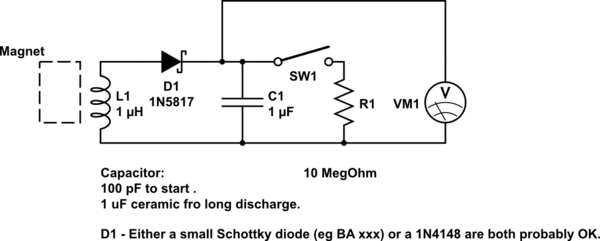
A DIY kinetic energy harvester utilizing the electromagnetic method to generate electricity. The materials that will be used are currently known.
The project involves creating a kinetic energy harvester that converts mechanical energy from motion into electrical energy through electromagnetic induction....

power supply design
The more one understands about any subject, the more interesting it becomes. As this article is read, it will be found that the subject of...
A comprehensive electronic schematic typically involves various components, each serving a specific function in the overall...