


Power Supply Adjustable 0V-30V DC/2A
#LM723
#2N3055
#adjustable
#voltage regulator
#DC power supply
#transistor
#heatsink
#potentiometer
#30V

Description: It is a simple circuit regulated power supply, based on the known LM 723, that drives a transistor Q1 [2N3055]. The regulation of voltage, of expense becomes with potentiometer R1 from 0v-30v DC roughly. In order to achieve 30 V, the transformer of supply TR1 must provide all the current that the load requests; otherwise, the output voltage will be found at levels of roughly 26 V. Essential is the use of a good heatsink for transistor Q1, as well as good quality of potentiometer in the place of R1.
The described circuit is a linear voltage regulator power supply utilizing the LM723 integrated circuit, which is known for its versatility in providing stable output voltage. The LM723 regulates the output voltage by controlling the base current of the power transistor Q1, a 2N3055, which is capable of handling high currents. The configuration allows for output voltage adjustments from 0V to approximately 30V DC, depending on the setting of the potentiometer R1.
The power supply design requires a transformer (TR1) that can deliver sufficient current to meet the load's demands. It is crucial that the transformer is rated appropriately; if it does not provide adequate current, the output voltage may drop to around 26V under load conditions. This drop indicates that the transformer is not fully supporting the circuit's demands, which can lead to unstable operation.
Thermal management is a significant consideration in this design. The 2N3055 transistor must be equipped with an adequate heatsink to dissipate the heat generated during operation, particularly when supplying higher currents. Failure to provide sufficient cooling can lead to thermal overload and potential failure of the transistor.
The potentiometer R1 should be of good quality to ensure stable voltage adjustment and should be rated to handle the power requirements of the circuit. Selecting a potentiometer with a suitable power rating is essential for reliable performance.
Overall, this simple regulated power supply circuit is effective for various applications requiring adjustable DC voltage, provided that the components are selected and configured correctly to handle the expected load and thermal conditions.It is a simple circuit regulated power supply, based on the known LM 723, that drive a transistor Q1 [2N3055]. The regulation of voltage, of expense becomes with potentiometer R1 from 0v-30v DC roughly. In order to we achieve 30 V, will should the transformer of supply TR1, it gives all the current that it asks the load, differently the output voltage it will be found in the levels of 26 V roughly.
Essential is the use of a good heatsink for transistor Q1, as well as good quality of potentiometer in the place of R1.
The described circuit is a linear voltage regulator power supply utilizing the LM723 integrated circuit, which is known for its versatility in providing stable output voltage. The LM723 regulates the output voltage by controlling the base current of the power transistor Q1, a 2N3055, which is capable of handling high currents. The configuration allows for output voltage adjustments from 0V to approximately 30V DC, depending on the setting of the potentiometer R1.
The power supply design requires a transformer (TR1) that can deliver sufficient current to meet the load's demands. It is crucial that the transformer is rated appropriately; if it does not provide adequate current, the output voltage may drop to around 26V under load conditions. This drop indicates that the transformer is not fully supporting the circuit's demands, which can lead to unstable operation.
Thermal management is a significant consideration in this design. The 2N3055 transistor must be equipped with an adequate heatsink to dissipate the heat generated during operation, particularly when supplying higher currents. Failure to provide sufficient cooling can lead to thermal overload and potential failure of the transistor.
The potentiometer R1 should be of good quality to ensure stable voltage adjustment and should be rated to handle the power requirements of the circuit. Selecting a potentiometer with a suitable power rating is essential for reliable performance.
Overall, this simple regulated power supply circuit is effective for various applications requiring adjustable DC voltage, provided that the components are selected and configured correctly to handle the expected load and thermal conditions.It is a simple circuit regulated power supply, based on the known LM 723, that drive a transistor Q1 [2N3055]. The regulation of voltage, of expense becomes with potentiometer R1 from 0v-30v DC roughly. In order to we achieve 30 V, will should the transformer of supply TR1, it gives all the current that it asks the load, differently the output voltage it will be found in the levels of 26 V roughly.
Essential is the use of a good heatsink for transistor Q1, as well as good quality of potentiometer in the place of R1.

Water Activated Relay
In this circuit, two transistors are configured as a high-gain compound pair. Transistor T1 is likely a 2N2222A, while T2 is identified as a BC108. The current gain is calculated as the product of the beta values of each transistor,...
Adjustable Power Supply
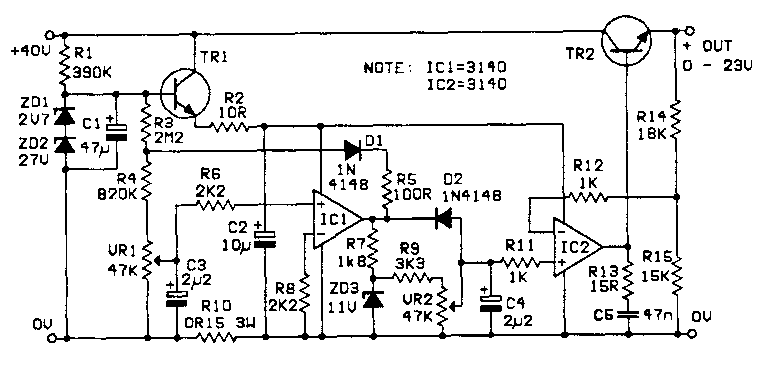
A variable power supply is required for repairs on CB and audio equipment, featuring excellent current limiting and protection. The designed circuit delivers a current from zero to approximately 4.25A at a voltage range of zero to about 23V. The...

0-15 Volt 0-1A Power supply
TR1 provides a constant current to a bank of three zener diodes, thus maintaining a constant voltage independent of supply voltage variations. The resistor Rx is used to sense the PSU output current and to switch off the current to...

transistors Controlling LED with 300mV AC signal
Control an LED with an audio signal; however, the output signal is only 150 mV peak-to-peak (with a 150 mV positive offset). It is understood that a higher voltage than 0.6 V is required to activate the transistor, leading to...
Micro Inverter by 2N6121
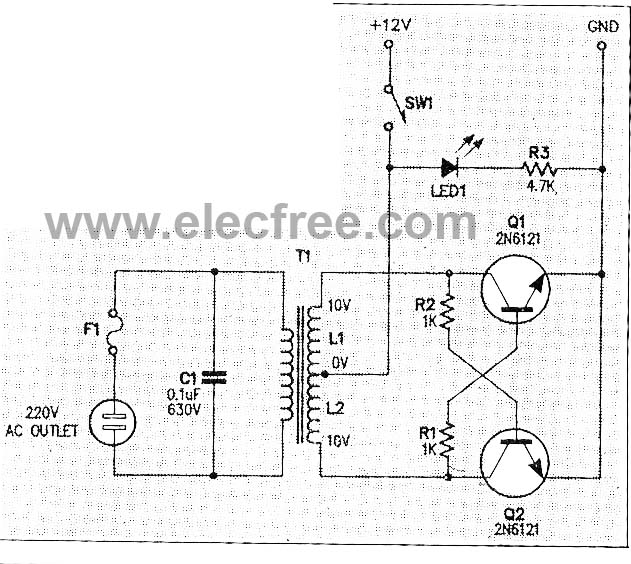
This micro inverter is a small-sized device that modifies energy from a battery, producing an output voltage of approximately 220V AC at 50Hz. The circuit comprises two transistors that function as a pulse oscillator or square wave generator, driving a...

led How do I amplify a dc voltage that is too weak to trigger the base in a transistor
The goal is to take the voltage output from a 3.5mm audio jack and use it to light up an LED based on the audio voltage levels. The left audio channel will be connected to the base of a 2222N...

Shortcircuit protected voltage regulator
At this voltage regulator prototype the maximum current, with output shortcircuited it was only 0.5 A, so no overheating occurred. In this DC voltage regulator circuit, T1 is for current limitation. As soon as the voltage on the R2 +...
lm723 variable power supply circuit
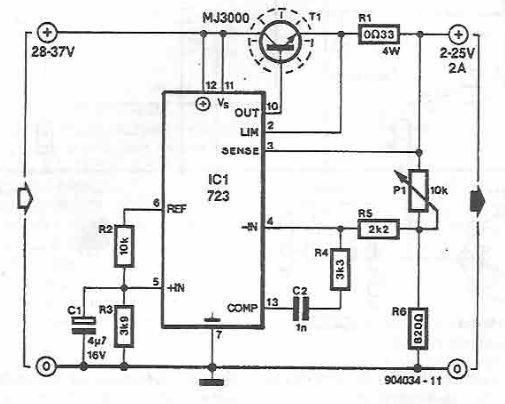
A simple variable power supply circuit can be designed using the LM723 regulator, which provides a maximum current of up to 2A and a variable voltage range between 2 and 25 volts.
The LM723 voltage regulator is an integrated circuit capable...

Transistor Tutorial Power Amplifiers Part 4
An audio power amplifier can enhance weak signals from devices like tuners, CD players, or tape decks to fill a room with sound. This article emphasizes the operating principles and circuitry of low-frequency power amplifiers utilizing bipolar junction transistors (BJTs)....