


Predictive Energy Balancing for Agile Control of Switched-Mode Power Converters
#switched-mode
#energy balancing
#power converters
#agile control
#compensation
#electronics
#circuit design
#power management
#voltage regulation
#efficiency

Description: The lack of compensation facilitates the processes of development and testing. The figure of 6 billion frequently appears as the estimated number of cell phones in use globally. Published estimates indicate an average.
The discussion of compensation in electronic circuits often pertains to the adjustments made to ensure that the performance of a system meets specified requirements under varying conditions. In the context of circuit design, the absence of compensation can lead to simpler development and testing phases, as designers may not need to implement additional components or algorithms to correct for performance deviations.
The reference to 6 billion cell phones highlights the extensive scale of mobile communication technology, underscoring the importance of reliable and efficient circuit designs. With such a vast number of devices in operation, it becomes crucial for engineers to develop circuits that can operate under a wide range of conditions without the need for complex compensation mechanisms.
This scenario emphasizes the need for robust design principles that prioritize simplicity and reliability. For example, circuits may be designed with inherent stability through the selection of appropriate components, such as resistors and capacitors, which can mitigate variations in temperature and supply voltage without requiring external compensation.
Furthermore, the trend of increasing mobile device usage suggests a growing demand for efficient power management solutions within these circuits. Engineers may focus on optimizing power consumption while maintaining performance, which can be achieved through techniques such as dynamic voltage scaling or the use of low-power components.
In summary, the absence of compensation can streamline the design process, particularly in the context of the rapidly expanding mobile phone market, where efficiency, reliability, and simplicity are paramount.The absence of compensation simplifies development and testing. The number 6 billion turns up often as the number of cell phones in use worldwide. Published estimates average..
The discussion of compensation in electronic circuits often pertains to the adjustments made to ensure that the performance of a system meets specified requirements under varying conditions. In the context of circuit design, the absence of compensation can lead to simpler development and testing phases, as designers may not need to implement additional components or algorithms to correct for performance deviations.
The reference to 6 billion cell phones highlights the extensive scale of mobile communication technology, underscoring the importance of reliable and efficient circuit designs. With such a vast number of devices in operation, it becomes crucial for engineers to develop circuits that can operate under a wide range of conditions without the need for complex compensation mechanisms.
This scenario emphasizes the need for robust design principles that prioritize simplicity and reliability. For example, circuits may be designed with inherent stability through the selection of appropriate components, such as resistors and capacitors, which can mitigate variations in temperature and supply voltage without requiring external compensation.
Furthermore, the trend of increasing mobile device usage suggests a growing demand for efficient power management solutions within these circuits. Engineers may focus on optimizing power consumption while maintaining performance, which can be achieved through techniques such as dynamic voltage scaling or the use of low-power components.
In summary, the absence of compensation can streamline the design process, particularly in the context of the rapidly expanding mobile phone market, where efficiency, reliability, and simplicity are paramount.The absence of compensation simplifies development and testing. The number 6 billion turns up often as the number of cell phones in use worldwide. Published estimates average..
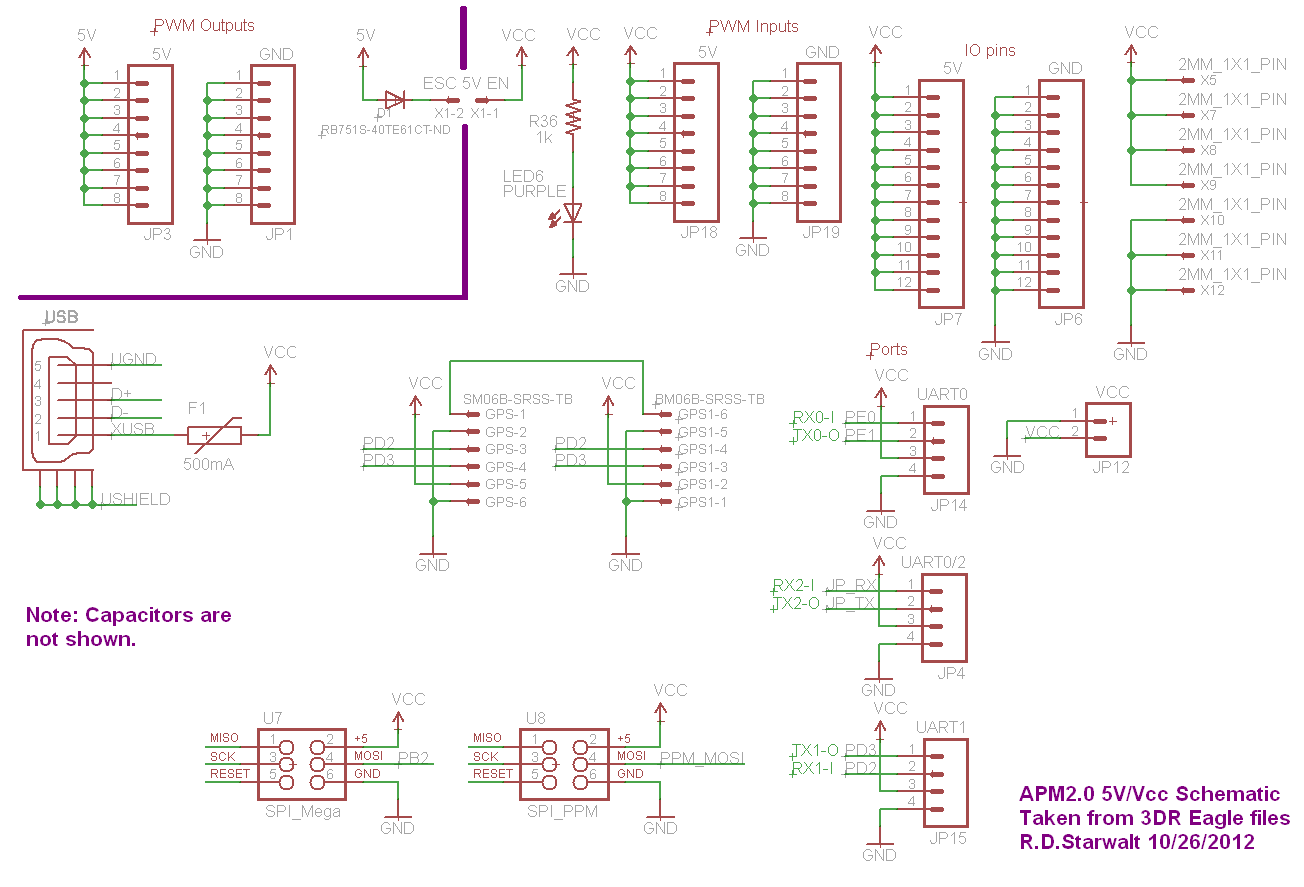
APM2.0 5V/Vcc Schematic
The PWM Output section has been separated into the upper left corner, delineated by a heavy purple line that is bridged by jumper JP1 on the APM2.0. This design choice highlights that diode D1 allows current to pass through JP1,...

psu
The Chameleon II Power Supply Circuits convert the raw input supply into stable voltage outputs necessary for the Chameleon interfaces. The outputs provided are +5V, +12V, and -12V.
The Chameleon II Power Supply Circuits are designed to ensure reliable operation of...

Electronics Projects Circuits
Over 1400 top electronics projects and electronic circuits with photos, datasheets, and easy-to-read schematics, along with explanations of how they work and how to build them.
The collection comprises a vast array of electronics projects suitable for enthusiasts and professionals alike....

Effective Load Resistance
This article presents an alternative method for evaluating power supplies that reduces dependency on output voltage and temperature. Traditionally, power supplies have been assessed based on their conversion efficiency, often calculated using commonly used equations. While efficiency serves as a...

Voltage Regulator
Neither term describes a regulator, only its placement within a circuit or system. Any voltage regulator could meet the requirements, depending on its placement. A listing of Analog Voltage Regulator IC manufacturers. The types of products or devices they produce...

A Power Management Interface Circuit For Telecom Hot Swap With Local Dc/dc Conve
New cellular phones have incorporated high-resolution cameras that require bright illumination of the surrounding area to achieve high-quality pictures. Traditional xenon-filled photo flashes cannot be used due to the limited space available in cellular phone cameras. Instead, design engineers utilize...

Power Supply 0-30V / 0-2A
The basic requirements for a laboratory power supply are to provide the necessary voltages and currents with low output resistance, low noise, minimal ripple, and good stabilization. These requirements are addressed within the circuit design. Many power supplies incorporate electronic...
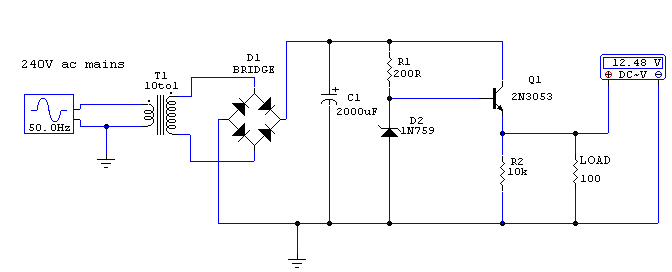
Regulated 12 Volt Supply
This circuit utilizes a 13-volt zener diode (D2) for voltage regulation. Approximately 0.7 volts are dropped across the base-emitter junction of the transistors, resulting in a higher current output of 12.3 volts. The circuit is capable of supplying loads up...

power Voltage supply clipping to <=3.3V
Supply it with a Li-Ion cell, which has a voltage range of 2.7 to 4.2V. The complexity of a buck/boost converter is not desired. While it is possible to regulate the voltage down to anything below 2.5V, it would be...