


Quad Power Supply For Hybrid Amplifier circuit
#hybrid amplifier
#LT1074CT
#voltage regulator
#switch mode supply
#series regulator
#cascade generator
#filament supply
#high efficiency
#power loss
#linear voltage regulator

Description: This power supply was designed for use with the Simple hybrid amplifier published elsewhere in this issue. It is suitable for various applications as well. A cascade generator is utilized for the 170 V output, a switch-mode supply provides the 16 V, a series regulator is employed for the 12 V, and a separate transformer is used for the 6.3 V filament supply. An LT1074CT (IC1) has been selected for the regulator, allowing the circuit to be constructed with relatively standard components while achieving high efficiency. The power loss is reduced with this device compared to a linear voltage regulator.
The power supply circuit integrates multiple voltage outputs tailored for specific operational requirements. The 170 V output is generated using a cascade generator, which provides a stable high voltage necessary for the functioning of the hybrid amplifier. This design choice enhances the overall performance by ensuring that the high voltage is generated efficiently, minimizing ripple and noise.
For the 16 V output, a switch-mode power supply (SMPS) is implemented. This type of supply is known for its efficiency and compact design, making it ideal for applications where space and thermal management are critical. The switch-mode topology allows for reduced power losses compared to traditional linear power supplies, which is particularly beneficial in minimizing heat generation.
The 12 V output is regulated using a series voltage regulator, specifically the LT1074CT. This component is advantageous due to its high efficiency, which is essential for maintaining a low thermal profile. It can handle significant load currents while providing a stable output voltage, making it suitable for powering sensitive electronics within the amplifier.
Lastly, the 6.3 V filament supply is derived from a separate transformer. This dedicated supply is crucial for powering the filaments of vacuum tubes or other components that require a specific filament voltage. Using a transformer ensures that this supply is isolated from the other voltage outputs, enhancing safety and reducing the risk of interference.
Overall, this power supply circuit exemplifies a well-thought-out design that prioritizes efficiency, reliability, and versatility. The choice of components and topologies ensures that it can meet the demands of the hybrid amplifier while remaining applicable to a range of other electronic applications.This power supply was designed for use with the ˜Simple hybrid amp published elsewhere in this issue. It is of course suitable for use in other applications as well. We ve used a cascade generator for the 170 V, a switch mode supply for the 16 V, a series regulator for the 12 V and a separate transformer for the 6.3 V filament supply.
We ve chosen an LT1074CT (IC1) for the regulator, which means that the circuit can be built with relatively standard components and will have a high efficiency. The power loss is less with this device compared to a linear voltage regulator..
The power supply circuit integrates multiple voltage outputs tailored for specific operational requirements. The 170 V output is generated using a cascade generator, which provides a stable high voltage necessary for the functioning of the hybrid amplifier. This design choice enhances the overall performance by ensuring that the high voltage is generated efficiently, minimizing ripple and noise.
For the 16 V output, a switch-mode power supply (SMPS) is implemented. This type of supply is known for its efficiency and compact design, making it ideal for applications where space and thermal management are critical. The switch-mode topology allows for reduced power losses compared to traditional linear power supplies, which is particularly beneficial in minimizing heat generation.
The 12 V output is regulated using a series voltage regulator, specifically the LT1074CT. This component is advantageous due to its high efficiency, which is essential for maintaining a low thermal profile. It can handle significant load currents while providing a stable output voltage, making it suitable for powering sensitive electronics within the amplifier.
Lastly, the 6.3 V filament supply is derived from a separate transformer. This dedicated supply is crucial for powering the filaments of vacuum tubes or other components that require a specific filament voltage. Using a transformer ensures that this supply is isolated from the other voltage outputs, enhancing safety and reducing the risk of interference.
Overall, this power supply circuit exemplifies a well-thought-out design that prioritizes efficiency, reliability, and versatility. The choice of components and topologies ensures that it can meet the demands of the hybrid amplifier while remaining applicable to a range of other electronic applications.This power supply was designed for use with the ˜Simple hybrid amp published elsewhere in this issue. It is of course suitable for use in other applications as well. We ve used a cascade generator for the 170 V, a switch mode supply for the 16 V, a series regulator for the 12 V and a separate transformer for the 6.3 V filament supply.
We ve chosen an LT1074CT (IC1) for the regulator, which means that the circuit can be built with relatively standard components and will have a high efficiency. The power loss is less with this device compared to a linear voltage regulator..
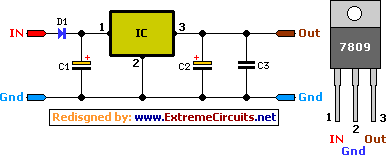
9 Volt 2 Ampere DC Power SupplyCircuit
A simple 9 Volt, 2 amp power supply utilizing a single integrated circuit (IC) regulator. This circuit is straightforward, as the regulator handles the majority of the work. The component used is the 7809 voltage regulator.
The circuit consists primarily of...
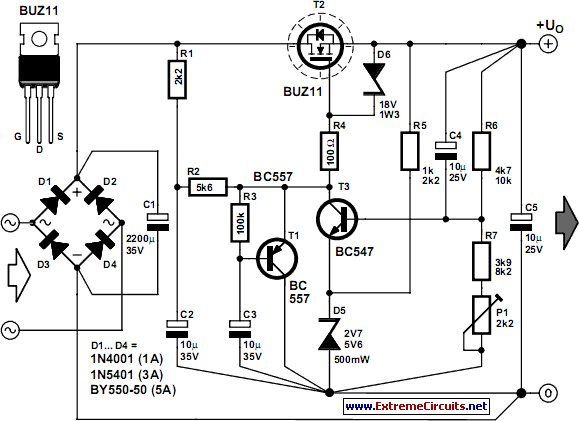
Stable Filament Supply
Valves are increasingly popular in audio systems. The European E series of valves, such as the ECC83 (12AX7) and EL84 (6BQ5), operate at a filament voltage of 6.3 V. Depending on the circuit configuration, the ECC81 and ECC83 series of...

3 Volts Car Adapter Circuit
This 3-volt car adapter circuit is based on a standard LT1074CT switching regulator IC. The schematic shows the LT1074CT used as a positive step-down regulator.
The 3-volt car adapter circuit employs the LT1074CT, which is a high-efficiency switching regulator capable of...

Stable Filament Power Supply Circuit
The circuit diagram illustrates a voltage regulator designed from discrete components to meet specific voltage requirements. It provides two sets of component values for output voltages of 6.3 V (upper) and 12.6 V (lower). The components used include BC547 and...

Effective output 50W distortion rate of 0.003% thick film hybrid amplifier
The main component of the circuit has been achieved using an integrated circuit (IC) with a significant number of bulk components, primarily capacitors. The internal circuit is designed to output from the differential amplifier using a PNP unipolar configuration, achieving...

5G14D + 24V 1.9A power supply
The circuit illustrated in the figure is a +24V, 1.9A power supply design. It employs the 5G14D domestic integrated voltage regulator as the core component, supported by three external power transistors. While the 5G14D voltage regulator has a rated current...
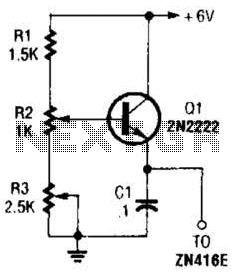
+1.5V Supply For Zn416E circuits
This regulator can be used with a +6-V source to supply the ZN416E low-voltage TRF radio receiver IC with the necessary +1.5 V. R3 sets the output voltage.
The circuit utilizes a voltage regulator designed to convert a +6 V input...

Dual Regulated Power Supply
The 7815 regulates the positive supply, while the 7915 regulates the negative supply. The transformer should have a primary rating of 240/220 volts for Europe or 120 volts for North America. The center-tapped secondary coil should be rated approximately 18...

STABILIZER POWER SUPPLY 0-30 VDC CIRCUIT
This is an aerial current power supply with a continuously adjustable stabilized output ranging from 0 to 30VDC. The circuit also incorporates an electronic current limiter that effectively controls the output current from a few milliamperes (2 mA) to a...