


RT9179CB management chip power supply circuit
#RT9179CB
#power management
#voltage regulation
#chip
#circuit design
#electronics
#PCB
#embedded systems
#low power
#DC supply

Description: The RT9179CB is a power management chip utilized in power supply circuits. It serves as a linear regulator power management chip. This circuit is commonly employed in various products, such as computer motherboards, LCD monitors, and others. It is composed of the SMD chip RT9179CB along with a few external components.
The RT9179CB is designed to provide a stable output voltage with high efficiency, making it suitable for applications that require precise voltage regulation. This chip operates with a wide input voltage range, typically from 4.5V to 20V, and can deliver output currents up to 1A. Its low dropout voltage characteristic enables it to maintain a stable output even when the input voltage is close to the desired output voltage.
The typical application circuit for the RT9179CB includes several key external components: input and output capacitors, a feedback resistor network, and optional components for improved transient response and stability. The input capacitors are essential for filtering the input voltage and minimizing voltage spikes, while the output capacitors help to smooth the output voltage and improve load transient performance.
To configure the output voltage, a feedback resistor divider can be implemented, allowing the user to set the desired output voltage level. The RT9179CB features built-in thermal protection and current limiting, ensuring safe operation under various load conditions.
Overall, the RT9179CB is an effective solution for power management in electronic devices, providing reliable power supply with minimal noise and efficient thermal performance. Its compact design and integration capabilities make it a preferred choice for modern electronic applications, particularly in consumer electronics and computing devices.RT9179CB use power management chip power supply circuit Shown the way for the introduction of RT9179 linear regulator power management chip power supply circuit. This circuit commonly used in several yards in products, such as computer motherboards, LCD monitors and other products, it is integrated by the SMD chip RT9179CB and a few external components constructed.
The RT9179CB is designed to provide a stable output voltage with high efficiency, making it suitable for applications that require precise voltage regulation. This chip operates with a wide input voltage range, typically from 4.5V to 20V, and can deliver output currents up to 1A. Its low dropout voltage characteristic enables it to maintain a stable output even when the input voltage is close to the desired output voltage.
The typical application circuit for the RT9179CB includes several key external components: input and output capacitors, a feedback resistor network, and optional components for improved transient response and stability. The input capacitors are essential for filtering the input voltage and minimizing voltage spikes, while the output capacitors help to smooth the output voltage and improve load transient performance.
To configure the output voltage, a feedback resistor divider can be implemented, allowing the user to set the desired output voltage level. The RT9179CB features built-in thermal protection and current limiting, ensuring safe operation under various load conditions.
Overall, the RT9179CB is an effective solution for power management in electronic devices, providing reliable power supply with minimal noise and efficient thermal performance. Its compact design and integration capabilities make it a preferred choice for modern electronic applications, particularly in consumer electronics and computing devices.RT9179CB use power management chip power supply circuit Shown the way for the introduction of RT9179 linear regulator power management chip power supply circuit. This circuit commonly used in several yards in products, such as computer motherboards, LCD monitors and other products, it is integrated by the SMD chip RT9179CB and a few external components constructed.

Control a processor`s power supply in real time
In battery-powered applications in which power management is key, a microprocessor may adjust its core voltage corresponding to an increase or a decrease in clock speed, allowing full processing power when necessary but not wasting excess power when idle. The...
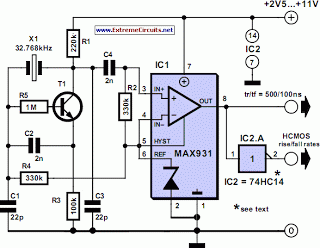
Very Low Power 32kHz Oscillator
The 32-kHz low-power clock oscillator provides several advantages compared to traditional oscillator circuits that utilize a CMOS inverter. These inverter circuits often exhibit issues such as significant fluctuations in supply currents across a 3V to 6V supply range, making it...

ALTIUM DESIGNER
The PCB is at the center of any electronic product. Literally, the enclosure surrounds the board, and figuratively, all the mathematics, the science, the software, these all run on the board. That’s why the PCB is at the center of...

Variable charger circuit Schematic Diagram
The accumulator charger circuit must provide a voltage that matches the specifications of the batteries being charged. For a 12-volt accumulator, the output voltage should not exceed 12 volts, nor should it fall significantly below this threshold. Failure to maintain...

Low power regulator reference
This simple reference circuit provides a stable voltage reference that is nearly free from supply voltage noise. Typical power supply rejection exceeds 100 dB.
The described voltage reference circuit is designed to deliver a consistent output voltage while minimizing the influence...

Free-PCB
FreePCB is a free, open-source printed circuit board layout editor for Microsoft Windows, released under the GNU General Public License. It was designed to be easy to learn and easy to use, yet capable of professional-quality work. More: It does...

Bridge voltage regulator circuit diagram using the
The circuit depicted in Figures A, B, and C demonstrates a high voltage coefficient. When the regulator resistance \( r_z \) is held constant, the bridge configuration achieves an infinite voltage coefficient. In Figure A, the load circuit is connected...

Step Variable Dc Supply
Intended as a replacement for poorly regulated "wall-type" AC/DC adapters, this circuit provides superior performance compared to simple, unregulated adapters. Available output voltages include 3, 6, 9, and 12 V. The DPDT switch functions as a polarity-reversal switch. Resistors R2...
ALTIUM DESIGNER
The PCB is at the center of any electronic product. Literally, the enclosure surrounds the board, and figuratively, all the mathematics, the science, the software, these all run on the board. That’s why the PCB is at the center of...