


Sequencing with the MAX16046 System-Management IC
#MAX16046
#power management
#sequencing
#voltage regulator
#configuration software
#system management
#tolerance
#sequence order
#IC
#tutorial

Description: The power-supply sequencing tutorial utilizes the MAX16046 system-management integrated circuit (IC). The configuration software facilitates the setup of tolerances and the sequence order.
The MAX16046 is a versatile system-management IC designed to manage power-supply sequencing in complex electronic systems. It is particularly useful in applications requiring precise voltage regulation and timing to ensure that various power rails are activated and deactivated in a predetermined sequence, thereby preventing damage to sensitive components.
The configuration software associated with the MAX16046 allows users to easily set specific tolerances for voltage levels and define the order in which power supplies are engaged. This capability is essential for systems where multiple voltage rails are present, as it ensures that each rail reaches its target voltage before the next rail is enabled. This prevents issues such as voltage overshoot or undershoot, which can lead to malfunction or damage of electronic components.
In practical applications, the MAX16046 can be interfaced with microcontrollers or other system management devices to provide real-time monitoring and control of power supply voltages. The IC supports various sequencing configurations, allowing for flexibility in design and implementation. Furthermore, the integrated fault detection features enhance system reliability by providing alerts for out-of-tolerance conditions.
The schematic design typically includes the MAX16046 connected to multiple power regulators, each responsible for generating a specific voltage level. Feedback loops from the output of these regulators to the MAX16046 allow for precise monitoring of voltage levels, ensuring that the IC can effectively manage the sequencing process. The configuration software can also generate a graphical representation of the power-up sequence, enabling engineers to visualize the timing and relationships between different power supplies.
Overall, the MAX16046 provides a robust solution for power-supply sequencing, with user-friendly configuration tools that streamline the design process and enhance system reliability.Power-supply sequencing tutorial uses the MAX16046 system-management IC. Configuration software simplifies the configuration of the tolerances and the sequence order..
The MAX16046 is a versatile system-management IC designed to manage power-supply sequencing in complex electronic systems. It is particularly useful in applications requiring precise voltage regulation and timing to ensure that various power rails are activated and deactivated in a predetermined sequence, thereby preventing damage to sensitive components.
The configuration software associated with the MAX16046 allows users to easily set specific tolerances for voltage levels and define the order in which power supplies are engaged. This capability is essential for systems where multiple voltage rails are present, as it ensures that each rail reaches its target voltage before the next rail is enabled. This prevents issues such as voltage overshoot or undershoot, which can lead to malfunction or damage of electronic components.
In practical applications, the MAX16046 can be interfaced with microcontrollers or other system management devices to provide real-time monitoring and control of power supply voltages. The IC supports various sequencing configurations, allowing for flexibility in design and implementation. Furthermore, the integrated fault detection features enhance system reliability by providing alerts for out-of-tolerance conditions.
The schematic design typically includes the MAX16046 connected to multiple power regulators, each responsible for generating a specific voltage level. Feedback loops from the output of these regulators to the MAX16046 allow for precise monitoring of voltage levels, ensuring that the IC can effectively manage the sequencing process. The configuration software can also generate a graphical representation of the power-up sequence, enabling engineers to visualize the timing and relationships between different power supplies.
Overall, the MAX16046 provides a robust solution for power-supply sequencing, with user-friendly configuration tools that streamline the design process and enhance system reliability.Power-supply sequencing tutorial uses the MAX16046 system-management IC. Configuration software simplifies the configuration of the tolerances and the sequence order..

5v 1a power supply using lm2575
A power transistor with a voltage drop of 4 volts and a current of 3 amps may dissipate approximately 12 watts of heat, presenting a challenge in series regulators. In contrast, a saturated transistor or MOSFET with a voltage drop...

High- Or Low-Input Regulator
This regulator provides 12 V at 1 A output with an input voltage range of 8 to 20 V. The output voltage can be adjusted by changing the values of the resistors ll-kii and 2.49 kΩ to achieve 2.21 V...
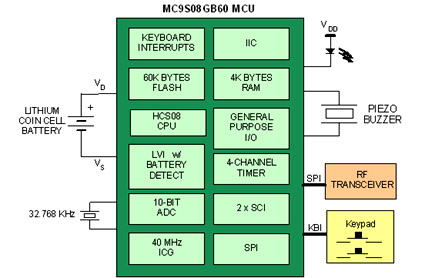
How to extend the battery life of your microcontroller based design
Battery-powered devices, such as electric toothbrushes, shavers, cell phones, PDAs, MP3 players, and remote controls, are integral to daily life. Consequently, power management has become a critical consideration for embedded designers. Microcontrollers (MCUs) provide various methods for managing power requirements...

Three-terminal voltage regulator integrated fixed a typical wiring circuit
A fixed three-terminal integrated voltage regulator can be directly employed in various electronic devices as a voltage regulator. It features internal protections such as overcurrent protection, thermal protection, and safe operating area protection, making the circuit easy to use, safe,...

Three-rail-power-supply
This circuit generates three supply voltages using a minimal number of components. Diodes D2 and D3 perform full-wave rectification, alternately charging capacitor C2 during both halves of the AC cycle. Meanwhile, diode D1 in conjunction with capacitor C1, and diode...

12 Volt 30 Amp PSU
Using a single 7812 IC voltage regulator and multiple outboard pass transistors, this power supply can deliver output load currents of up to 30 amps. The input transformer is likely to be the most expensive part of the entire project....

General-purpose-power-supply
The supply 6-66 can be utilized for output voltages ranging from 1 to 35 V. The line transformer must be selected to provide approximately 1.4 times the desired output voltage from the positive side of filter capacitor C1 to ground....

Easy exchange of magnetic saturation voltage regulator circuit
Easy exchange of magnetic saturation voltage regulator circuit
The magnetic saturation voltage regulator circuit is designed to stabilize output voltage levels by utilizing magnetic saturation principles. This circuit typically employs a magnetic core, which operates in saturation to regulate voltage,...

Regulator Circuit
The unique feature of this regulator is that the output voltage can be adjusted down to 0 V. The regulation is provided by an integrated regulator type LM317. Typically, in supplies that can be adjusted to 0 V, this IC...