


the microcc a microamp range constant current source
#constant current source
#voltage reference
#microamp range
#TSM6025
#MAX6025
#low power
#precision
#stability
#circuit design
#electronics

Description: The MicroCC utilizes the Touchstone Semiconductor TSM6025 voltage reference, which serves as a direct replacement for the MAX6025, offering stability of better than 15 ppm/°C.
The TSM6025 voltage reference is designed to provide a precise and stable output voltage, making it suitable for various applications in electronic circuits where accurate voltage levels are critical. With its low temperature coefficient of better than 15 ppm/°C, the TSM6025 ensures minimal variation in output voltage across a wide temperature range, enhancing the reliability of the circuits in which it is implemented.
The device features a low output noise characteristic, which is essential for sensitive analog applications. It also boasts a low dropout voltage, allowing it to maintain regulation even when the input voltage is only slightly higher than the output voltage. This makes the TSM6025 particularly useful in battery-powered devices or systems where power efficiency is paramount.
In addition to its performance specifications, the TSM6025 is packaged in a compact form factor, facilitating easy integration into various circuit designs. The pin configuration is compatible with that of the MAX6025, allowing for a straightforward swap in existing designs without necessitating significant alterations to the PCB layout.
Overall, the TSM6025 voltage reference enhances the performance of the MicroCC by providing a reliable and stable voltage source, which is critical for the accurate functioning of the electronic components connected to it.The MicroCC uses the Touchstone Semiconductor TSM6025 voltage reference, a drop-in replacement for the MAX6025, with better than 15ppm/ºC stability. This is an..
The TSM6025 voltage reference is designed to provide a precise and stable output voltage, making it suitable for various applications in electronic circuits where accurate voltage levels are critical. With its low temperature coefficient of better than 15 ppm/°C, the TSM6025 ensures minimal variation in output voltage across a wide temperature range, enhancing the reliability of the circuits in which it is implemented.
The device features a low output noise characteristic, which is essential for sensitive analog applications. It also boasts a low dropout voltage, allowing it to maintain regulation even when the input voltage is only slightly higher than the output voltage. This makes the TSM6025 particularly useful in battery-powered devices or systems where power efficiency is paramount.
In addition to its performance specifications, the TSM6025 is packaged in a compact form factor, facilitating easy integration into various circuit designs. The pin configuration is compatible with that of the MAX6025, allowing for a straightforward swap in existing designs without necessitating significant alterations to the PCB layout.
Overall, the TSM6025 voltage reference enhances the performance of the MicroCC by providing a reliable and stable voltage source, which is critical for the accurate functioning of the electronic components connected to it.The MicroCC uses the Touchstone Semiconductor TSM6025 voltage reference, a drop-in replacement for the MAX6025, with better than 15ppm/ºC stability. This is an..

Digitally-controlled-voltage-reference
This circuit demonstrates a straightforward approach to achieving a voltage reference that can be adjusted using an 8-bit Digital-to-Analog Converter (DAC) equipped with an integrated voltage reference. The analog output from the DAC controls the trim pin of the ZNREF025...
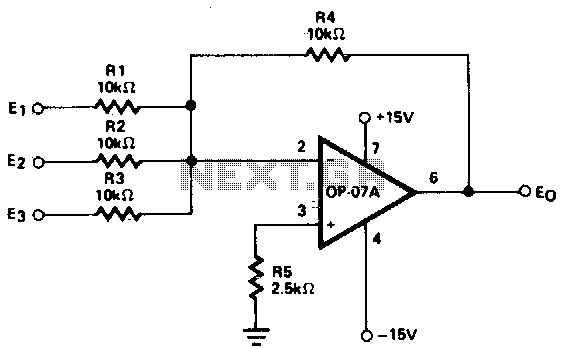
Adjustment-free precision summing amplifier
This circuit generates continuous outputs that depend on multiple input variables.
The circuit in question typically employs a combination of operational amplifiers (op-amps), resistors, and potentiometers to achieve its functionality. The outputs can be tailored based on the variations in...

Low power regulator reference
This simple reference circuit provides a stable voltage reference that is nearly free from supply voltage noise. Typical power supply rejection exceeds 100 dB.
The described voltage reference circuit is designed to deliver a consistent output voltage while minimizing the influence...

Electronics Projects Circuits
Over 1400 top electronics projects and electronic circuits with photos, datasheets, and easy-to-read schematics, along with explanations of how they work and how to build them.
The collection comprises a vast array of electronics projects suitable for enthusiasts and professionals alike....

Precision Oscillator With 20ns Switching
A precision oscillator can be constructed using a quartz crystal; however, with appropriate component selection, it is also possible to build one using an RC (resistor and capacitor) circuit.
An RC oscillator generates an oscillating signal through the use of resistors...
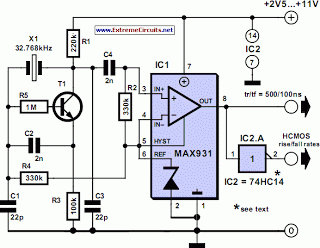
Very Low Power 32kHz Oscillator
The 32-kHz low-power clock oscillator provides several advantages compared to traditional oscillator circuits that utilize a CMOS inverter. These inverter circuits often exhibit issues such as significant fluctuations in supply currents across a 3V to 6V supply range, making it...

low power receiver serves multiple wireless standards
By combining a current-reuse amplifier and a switch-based mixer, a dual-band receiver front end offers excellent performance with extremely low power consumption.
The dual-band receiver front end integrates a current-reuse amplifier and a switch-based mixer to achieve high performance while maintaining...

Electronic Projects
This program includes circuit design CAD, simulation, and auto-routing PC layout. PSPICE is also utilized at Unisys, which offers more capabilities but costs six times as much and requires annual renewal. With these requirements and others in mind, a variation...

Low Power Regulator Reference
This is a simple circuit of a low-power voltage regulator reference. This circuit can produce a stable voltage reference.
The low-power voltage regulator reference circuit is designed to provide a consistent output voltage, which is crucial for various electronic applications requiring...