


195 KC SONAR F M MODULATOR
#sonar
#modulator
#sawtooth generator
#frequency modulation
#magnetic tape
#signal processing
#training
#electronics
#audio recording
#telecommunication

Description: This device is utilized for recording signals from active sonar onto magnetic tape, allowing for subsequent playback to manage land-based sonar systems used in the training of operators. The modulator functions as a sawtooth generator, with its repetition frequency being altered by the amplitude of the modulating input signal.
The circuit described involves a modulator that plays a crucial role in the recording of sonar signals. The active sonar system emits sound waves and captures their reflections to detect underwater objects. The signals generated are then fed into a modulator, which serves as a sawtooth waveform generator. This generator produces a linear ramp signal that rises and falls, resembling a sawtooth pattern.
The frequency of the sawtooth waveform is not fixed; instead, it is dynamically modulated by the amplitude of the input signal derived from the sonar system. When the amplitude of the input signal increases, the frequency of the sawtooth waveform also increases, allowing for a more rapid succession of recorded sonar pulses. Conversely, a decrease in the input signal amplitude results in a lower frequency of the sawtooth waveform.
The output from the modulator is then recorded onto magnetic tape. This tape serves as a medium for storing the modulated sonar signals, which can later be played back for analysis or training purposes. During playback, the recorded signals are retrieved from the tape and processed to control land-based sonar systems, facilitating the training of operators in interpreting sonar data.
The overall design requires careful consideration of the components involved, including the sawtooth generator, amplifiers, and the magnetic tape mechanism. The modulator’s performance is critical, as it directly influences the fidelity of the recorded signals and, consequently, the effectiveness of the training provided to sonar operators. Proper tuning and calibration of the circuit are essential to ensure accurate signal representation and reliable playback quality.Used in recording signals from active sonar on magnetic tape, for later playback to control land-based sonar used in training operators. Modulator is basically sawtooth generator whose repetition frequency is changed by amplitude of modulating input signal.
-M. H. Damon, Jr. , Tape Target Classifier Trains Sonar Operators, Electronics, 33:13, p 65-6 9.
The circuit described involves a modulator that plays a crucial role in the recording of sonar signals. The active sonar system emits sound waves and captures their reflections to detect underwater objects. The signals generated are then fed into a modulator, which serves as a sawtooth waveform generator. This generator produces a linear ramp signal that rises and falls, resembling a sawtooth pattern.
The frequency of the sawtooth waveform is not fixed; instead, it is dynamically modulated by the amplitude of the input signal derived from the sonar system. When the amplitude of the input signal increases, the frequency of the sawtooth waveform also increases, allowing for a more rapid succession of recorded sonar pulses. Conversely, a decrease in the input signal amplitude results in a lower frequency of the sawtooth waveform.
The output from the modulator is then recorded onto magnetic tape. This tape serves as a medium for storing the modulated sonar signals, which can later be played back for analysis or training purposes. During playback, the recorded signals are retrieved from the tape and processed to control land-based sonar systems, facilitating the training of operators in interpreting sonar data.
The overall design requires careful consideration of the components involved, including the sawtooth generator, amplifiers, and the magnetic tape mechanism. The modulator’s performance is critical, as it directly influences the fidelity of the recorded signals and, consequently, the effectiveness of the training provided to sonar operators. Proper tuning and calibration of the circuit are essential to ensure accurate signal representation and reliable playback quality.Used in recording signals from active sonar on magnetic tape, for later playback to control land-based sonar used in training operators. Modulator is basically sawtooth generator whose repetition frequency is changed by amplitude of modulating input signal.
-M. H. Damon, Jr. , Tape Target Classifier Trains Sonar Operators, Electronics, 33:13, p 65-6 9.

Electronics Projects Circuits
Over 1400 top electronics projects and electronic circuits with photos, datasheets, and easy-to-read schematics, along with explanations of how they work and how to build them.
The collection comprises a vast array of electronics projects suitable for enthusiasts and professionals alike....
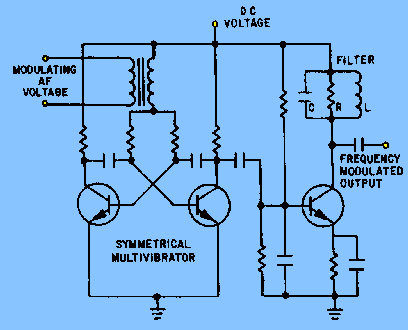
Methods of frequency modulation
The circuit depicted in figure 2-6 and discussed in previous sections serves illustrative purposes only and is not practical in real-world applications. Nevertheless, the fundamental principle involved—the variation in reactance of an oscillator circuit in response to modulating voltage—represents one...

High Performance Sawtooth Generator
This is a simple sawtooth generator circuit. The advantages of this circuit include low cost and the ability to produce an auxiliary square wave at the same frequency. This circuit can be utilized to sweep the frequency of another generator....

Sawtooth generator circuit
Sawtooth wave generators using opamp are very common. But the disadvantage is that it requires a bipolar power supply. A sawtooth wave generator can be built using a simple 555 timer IC and a transistor as shown in the circuit...
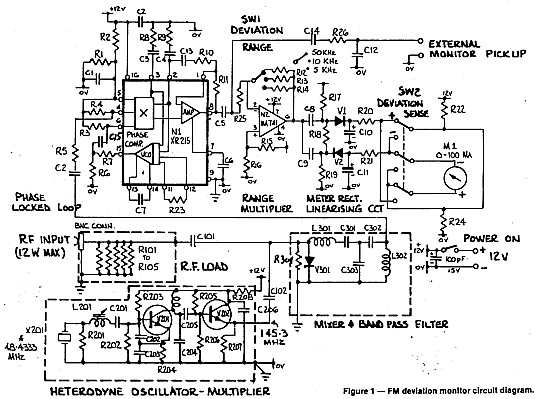
Deviation Meter
A deviation monitor can be constructed by connecting a frequency modulation (FM) detector to an AC voltmeter, calibrating the meter in units of frequency deviation. One method for detecting or demodulating the FM signal is via a phase-locked loop (PLL)....
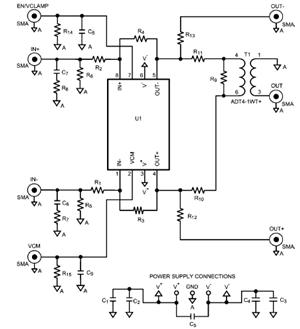
circuit diagram download
The transmitter's function is to modulate the original signal frequency of the message-carrying signal, a process known as modulation. The circuit realization of this function is referred to as a frequency modulation (FM) circuit. FM tuners are categorized into direct...

Modulator
The transconductance of an operational transconductance amplifier is directly proportional to the transconductance parameter, allowing for easy control of signal amplification. The output current is calculated as the product of transconductance and input voltage. This circuit operates effectively up to...
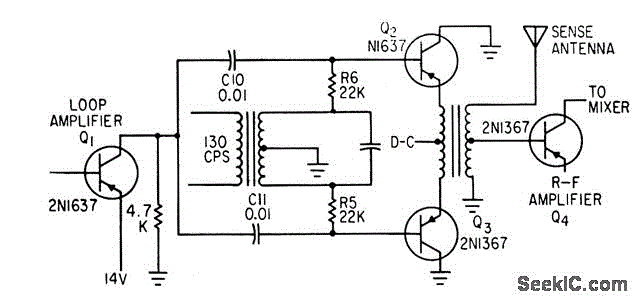
BALANCED MODULATOR FOR ADF
Combines signals from loop and sense antennas of an automatic direction finder to produce a 130-cps output with the correct phase for driving the rotor of a resolver to achieve a null position.
The circuit described is integral to the operation...

sonar
The receiving systems used with scanning-type echo-ranging equipment are dual-channel systems, which are essential in current video portrayal methods. Deviation indicators, which can be cathode-ray tubes or galvanometers, utilize either a sum-and-difference or a comparison receiving system. These systems measure...