


455-Khz Narrow-Band If Filter Circuit

Description: This filter utilizes five 455-kHz ceramic resonators. The impedance is 330 ohms, the bandwidth is 800 Hz, and the ultimate rejection is greater than 60 dB. Additionally, the ceramic resonators can be substituted with crystals.
The described filter is a highly specialized electronic component designed to operate at a frequency of 455 kHz, which is commonly used in applications such as radio frequency (RF) communication and signal processing. The use of five ceramic resonators in the design enhances the filter's selectivity and stability, allowing it to effectively isolate the desired frequency while attenuating unwanted signals.
The specified impedance of 330 ohms indicates the resistance that the filter presents to the connected circuitry, which is critical for ensuring optimal power transfer and minimizing signal reflections. The bandwidth of 800 Hz signifies the range of frequencies around the center frequency (455 kHz) that the filter allows to pass through with minimal attenuation. This relatively narrow bandwidth suggests that the filter is designed for applications requiring precise frequency discrimination.
The ultimate rejection of greater than 60 dB indicates the filter's ability to suppress signals outside its passband, providing a high level of attenuation for undesired frequencies. This characteristic is crucial in applications where signal integrity is paramount, such as in communication systems or audio processing.
The option to replace ceramic resonators with crystals offers flexibility in the design. Crystals typically provide even greater frequency stability and lower phase noise than ceramic resonators, making them suitable for applications where precision timing is essential. However, the choice between resonators and crystals will depend on the specific requirements of the application, including factors such as cost, size, and performance characteristics.
Overall, this filter design presents a robust solution for filtering applications at 455 kHz, with the potential for customization based on the components used. This filter uses five 455-kHz ceramic resonators. The impedance is 330, the bandwidth is 800 Hz, and the ultimate rejection >60 dB. The ceramic resonators could be replaced by crystals.
The described filter is a highly specialized electronic component designed to operate at a frequency of 455 kHz, which is commonly used in applications such as radio frequency (RF) communication and signal processing. The use of five ceramic resonators in the design enhances the filter's selectivity and stability, allowing it to effectively isolate the desired frequency while attenuating unwanted signals.
The specified impedance of 330 ohms indicates the resistance that the filter presents to the connected circuitry, which is critical for ensuring optimal power transfer and minimizing signal reflections. The bandwidth of 800 Hz signifies the range of frequencies around the center frequency (455 kHz) that the filter allows to pass through with minimal attenuation. This relatively narrow bandwidth suggests that the filter is designed for applications requiring precise frequency discrimination.
The ultimate rejection of greater than 60 dB indicates the filter's ability to suppress signals outside its passband, providing a high level of attenuation for undesired frequencies. This characteristic is crucial in applications where signal integrity is paramount, such as in communication systems or audio processing.
The option to replace ceramic resonators with crystals offers flexibility in the design. Crystals typically provide even greater frequency stability and lower phase noise than ceramic resonators, making them suitable for applications where precision timing is essential. However, the choice between resonators and crystals will depend on the specific requirements of the application, including factors such as cost, size, and performance characteristics.
Overall, this filter design presents a robust solution for filtering applications at 455 kHz, with the potential for customization based on the components used. This filter uses five 455-kHz ceramic resonators. The impedance is 330, the bandwidth is 800 Hz, and the ultimate rejection >60 dB. The ceramic resonators could be replaced by crystals.
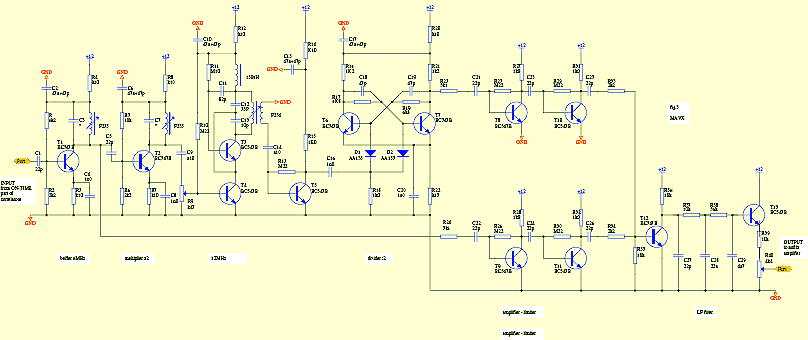
Amatorki projekt
The circuit is designed to add two identical branches to the existing despreading spectrum. The only difference between the branches is the phase of the PN sequences fed into each branch, specifically at the input of a double-balanced mixer. The...

Visual modulation indicator
The brightness of the indicator lamp changes in accordance with the modulated RF signal. Adjust resistor R2 while the transmitter is on (modulated) until the lamp flashes in sync with the modulation.
Cl = 5 pF, C2 = 100 pF, Dl...

Wireless video camera link
This high-performance video camera link transmits signals from a video camera to a VCR or from a VCR to TVs throughout a home. The initial stage of the RF chain features a crystal-controlled oscillator, Q1, operating at a frequency range...

4 order filter with a single IC project PCB
High-order circuit filters are typically designed using two or more cascaded sections. This fourth-order filter requires only one operational amplifier (OA) integrated circuit (IC), which helps achieve lower distortion and reduced intermodulation. The resistor values represent the load on the...
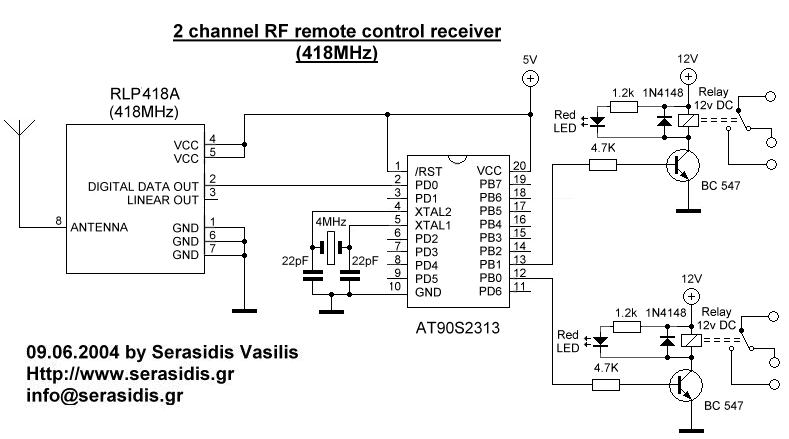
2 channel RF remote control
The basic small-range remote controls are Infrared and RF (Radio Frequency). One of the weaknesses of Infrared is that the signal cannot pass through walls. Therefore, to control a garage door, an RF remote control is necessary. The circuit (transmitter...

Variable Q Filter For 400Hz Circuit
A bootstrapped twin notch filter in this circuit can yield an effective Q of up to 10. Rs adjusts the feedback, hence the Q. Values of C1 and C2 can be changed to alter the frequency. RF is a fine-tune...
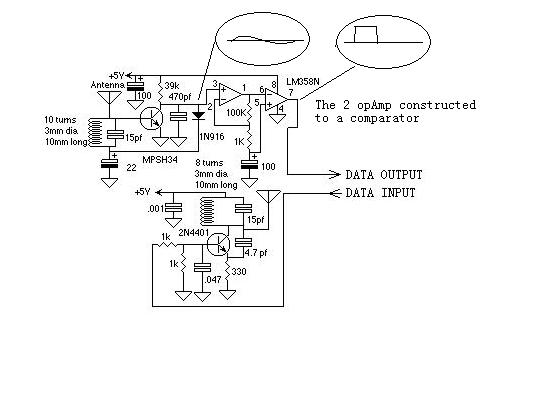
RF communication use a sample circuit(example in AVR)
Even including labor, the actual cost of purchasing, stocking, assembly, assembly errors, more expensive PCBs (with additional holes and larger sizes), and the increased difficulty in tuning would likely result in significantly higher expenses.
The analysis of costs associated with electronic...

RF Based Wireless Remote Control Switch
It is often necessary to control electrical appliances remotely, even when there is no direct line of sight between the transmitter and receiver.
In modern electronic applications, remote control systems are increasingly utilized for various purposes, including home automation, industrial control,...

DF data transmission module and the super-regenerative receiver module
The DF data transmission module operates at a frequency of 315 MHz and utilizes a surface acoustic wave (SAW) resonator for frequency stabilization, ensuring high frequency stability. The frequency drift remains minimal, at only 3 x 10^-6, across a temperature...