


50 kHz FM Optical Receiver
#FM
#optical receiver
#frequency modulation
#noise immunity
#signal transmission
#analog voltage
#RF
#receiver circuit
#wireless communication

Description: Frequency modulation (FM) can be used to transmit an analog voltage level signal with good noise immunity. The transmission itself might employ different techniques.
Frequency modulation (FM) is a method widely utilized in communication systems to encode information in a carrier wave by varying its frequency. This technique is particularly effective for transmitting analog signals due to its inherent noise immunity, which allows for clearer reception even in the presence of interference. In FM systems, the amplitude of the carrier wave remains constant while its frequency is altered in accordance with the input signal, resulting in a modulation that is less susceptible to amplitude noise.
In practical applications, FM transmission can be implemented using various techniques, including direct and indirect modulation methods. Direct FM modulation involves altering the frequency of the carrier wave directly in response to the instantaneous amplitude of the input signal. This can be achieved using voltage-controlled oscillators (VCOs) that adjust the frequency based on the input voltage levels.
Indirect FM modulation, on the other hand, typically involves phase modulation as an intermediate step, where the phase of the carrier wave is varied in response to the input signal. This phase-modulated signal is then converted to frequency modulation through a differentiator circuit. Both methods require careful design considerations to optimize bandwidth, signal-to-noise ratio, and overall system performance.
The FM transmission system also includes essential components such as filters, amplifiers, and antennas. Filters are used to eliminate unwanted frequencies and ensure that only the desired signal is transmitted. Amplifiers boost the signal strength to achieve longer transmission distances without significant loss of quality. Antennas are designed to efficiently radiate the modulated signal into the surrounding environment.
In summary, frequency modulation is a robust technique for transmitting analog signals, characterized by its resilience to noise and interference. The design of FM systems involves various modulation methods and essential components that collectively enhance signal integrity and transmission efficiency.Frequency modulation (FM) can be used to transmit analog voltage level signal with good noise immunity. The transmission itself might employs different..
Frequency modulation (FM) is a method widely utilized in communication systems to encode information in a carrier wave by varying its frequency. This technique is particularly effective for transmitting analog signals due to its inherent noise immunity, which allows for clearer reception even in the presence of interference. In FM systems, the amplitude of the carrier wave remains constant while its frequency is altered in accordance with the input signal, resulting in a modulation that is less susceptible to amplitude noise.
In practical applications, FM transmission can be implemented using various techniques, including direct and indirect modulation methods. Direct FM modulation involves altering the frequency of the carrier wave directly in response to the instantaneous amplitude of the input signal. This can be achieved using voltage-controlled oscillators (VCOs) that adjust the frequency based on the input voltage levels.
Indirect FM modulation, on the other hand, typically involves phase modulation as an intermediate step, where the phase of the carrier wave is varied in response to the input signal. This phase-modulated signal is then converted to frequency modulation through a differentiator circuit. Both methods require careful design considerations to optimize bandwidth, signal-to-noise ratio, and overall system performance.
The FM transmission system also includes essential components such as filters, amplifiers, and antennas. Filters are used to eliminate unwanted frequencies and ensure that only the desired signal is transmitted. Amplifiers boost the signal strength to achieve longer transmission distances without significant loss of quality. Antennas are designed to efficiently radiate the modulated signal into the surrounding environment.
In summary, frequency modulation is a robust technique for transmitting analog signals, characterized by its resilience to noise and interference. The design of FM systems involves various modulation methods and essential components that collectively enhance signal integrity and transmission efficiency.Frequency modulation (FM) can be used to transmit analog voltage level signal with good noise immunity. The transmission itself might employs different..

100 MHz RF oscillator with ATtiny12
A frequency reference for tuning up the RS-232 to 100 MHz RF desktop channel adapter elsewhere on this site, when I found this Saronix crystal oscillator in my junk box. A few minutes with AVRStudio produced an ATtiny12 to make...

Wide Dynamic Range Field Strength Meter
A field strength meter is a useful tool for locating a transmitter. However, a sensitive field strength meter has limitations: it responds to nearly any RF signal entering its input. This characteristic reduces the effective sensitivity of the field strength...

Bandswitched Grid Dip Meter
This circuit is designed for checking resonances in tuned circuits, antennas, and similar applications, covering a frequency range of 2 to 20 MHz. Q1 acts as an oscillator that can be tuned across this range using capacitor C1 and band-switched...

RF oscillator circuit (2N3904)
This basic RF oscillator circuit is easy to build and the components are not critical. Most of them can be found in your junk parts box. The L1 antenna coil can be made by close winding 8 to 10 turns...
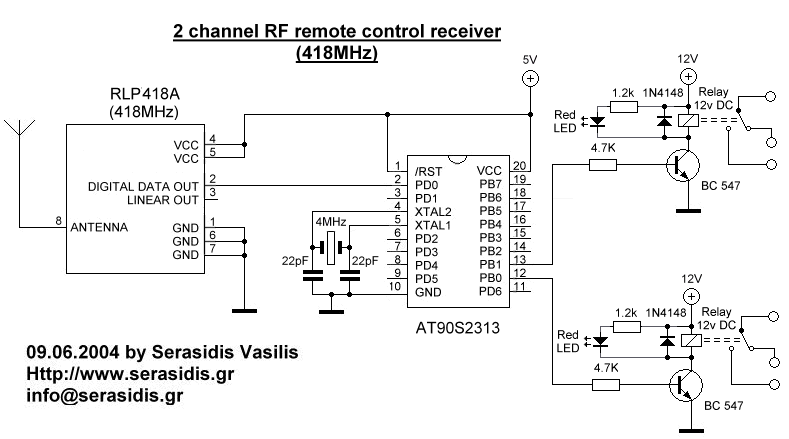
2 channel RF remote control
The basic small-range remote controls are Infrared and RF (Radio Frequency). One of the weaknesses of Infrared is that the signal cannot pass through walls. Therefore, to control a garage door, an RF remote control is necessary. The circuit (transmitter...

rf remote control encoder and decoder
This document explains two RF 433kHz remote control chips specifically designed for remote control applications. The IC TWS-434, along with its encoder chip HT-12E from Holtek, forms a high-quality transmitter circuit, while the chip RWS-434, paired with the decoder IC...

FM Bug Detector Kit
This device is designed for individuals concerned about surveillance. An essential tool for any operative is an Electronic Bug Detector, as it helps identify hidden listening devices.
The Electronic Bug Detector serves as a critical instrument for privacy protection in environments...
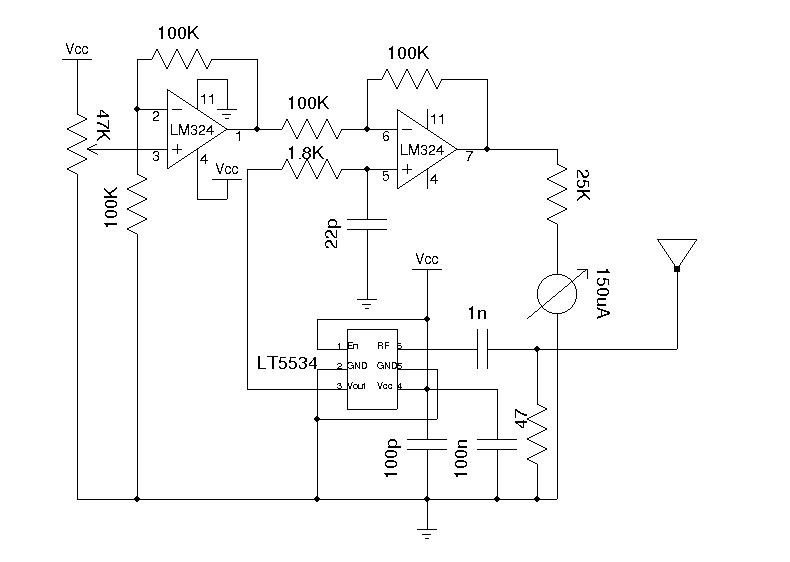
Wideband RF Field Strength Meter
A field strength meter is highly beneficial when dealing with RF devices. It allows for the rapid diagnosis of transmitter circuit functionality and can detect RF signals present in the environment. The simplest form of a field strength meter can...

FM Wireless Microphone
The frequency range for the FM broadcast band is 90 MHz (megahertz, or 90 million cycles per second). An FM microphone utilizes a variable tuned circuit, allowing it to be adjusted to a quiet frequency within the local FM broadcast...