


AM-Receiver for Aircraft comm (118.250MHz)
#AM-receiver
#aircraft communication
#118.250MHz
#VCO
#tunable
#RF
#amplitude modulation
#manual tuning
#low level output
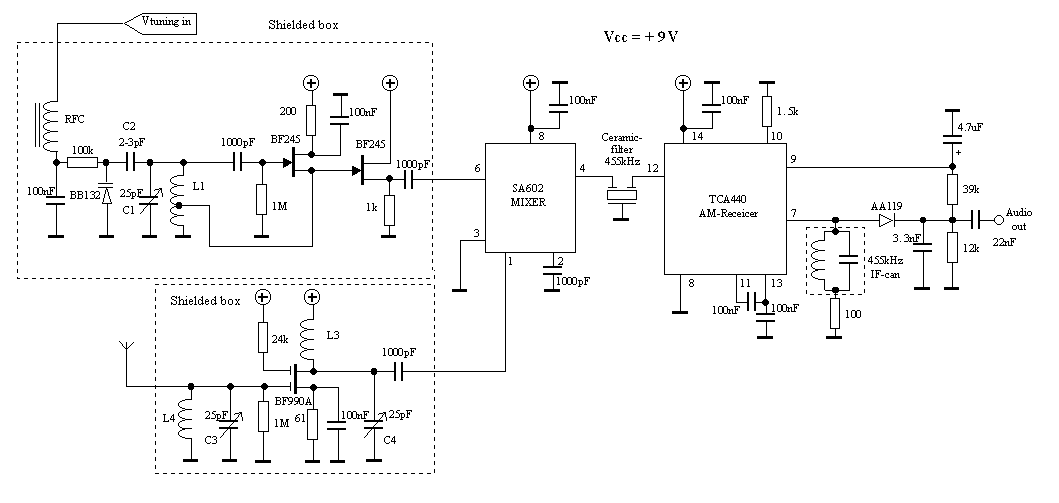
Description: The aircraft communication in Sweden is still Amplitude Modulated (AM). The local airport (Axamo) uses the frequency 118.250 MHz. The receiver is a tunable AM-receiver for this frequency. The receiver is manually tunable within approximately 100 kHz around the 118 MHz. The output from the receiver is a low-level output (100-200 mV), so it must be connected to some kind of amplifier. The heart of the receiver is the Voltage Controlled Oscillator (VCO).
The described AM receiver operates at a center frequency of 118.250 MHz, which is commonly used for aviation communications. The receiver's architecture typically includes several key components: an RF front end, a mixer, a local oscillator, a demodulator, and an audio output stage.
The RF front end is designed to capture the incoming AM signal and filter out unwanted frequencies, allowing only the desired signal to pass through. This section may incorporate a bandpass filter centered around 118.250 MHz to enhance signal quality.
The manually tunable aspect of the receiver allows the user to adjust the frequency within a range of approximately 100 kHz, providing flexibility in tuning to different AM signals. This tuning can be achieved using a variable capacitor or an inductor in conjunction with the VCO, which generates a signal that can be mixed with the incoming RF signal.
The heart of the receiver, the Voltage Controlled Oscillator (VCO), plays a crucial role by generating a local oscillator signal that is mixed with the incoming AM signal. The VCO's frequency is controlled by a voltage input, allowing for precise tuning. The output of the VCO is fed into a mixer, where it combines with the incoming RF signal to produce an intermediate frequency (IF) signal. This IF signal is easier to process and demodulate.
The demodulation stage extracts the audio information from the AM signal, typically using envelope detection. This involves rectifying the IF signal and filtering it to recover the original audio waveform. The output from this stage is a low-level audio signal, typically in the range of 100-200 mV.
Due to the low output level, an audio amplifier is necessary to boost the signal for further processing or to drive speakers or headphones. While the specifics of the audio amplifier design are not covered, it is essential to ensure that the amplifier can handle the low-level input without introducing significant noise or distortion.
Overall, the described AM receiver is a straightforward yet effective design for receiving aviation communication signals, with key components working in unison to provide clear audio output from the AM modulated signals.The aircraft communication in Sweden is still Amplitud Modulated (AM). The local airport (Axamo) use the frequency 118.250 MHz. The reveiver I will explain is a tunable AM-receiver for this frequency. The receiver is instead manually tunable with some 100kHz around the 118MHz. The output from the receiver is a low level output (100-200mV) so you must connect it to some kind of amplifier. I will not explain how to build an audio-amplifier. The hart of the receiver is the Voltage Controlled Oscillator (VCO).
The described AM receiver operates at a center frequency of 118.250 MHz, which is commonly used for aviation communications. The receiver's architecture typically includes several key components: an RF front end, a mixer, a local oscillator, a demodulator, and an audio output stage.
The RF front end is designed to capture the incoming AM signal and filter out unwanted frequencies, allowing only the desired signal to pass through. This section may incorporate a bandpass filter centered around 118.250 MHz to enhance signal quality.
The manually tunable aspect of the receiver allows the user to adjust the frequency within a range of approximately 100 kHz, providing flexibility in tuning to different AM signals. This tuning can be achieved using a variable capacitor or an inductor in conjunction with the VCO, which generates a signal that can be mixed with the incoming RF signal.
The heart of the receiver, the Voltage Controlled Oscillator (VCO), plays a crucial role by generating a local oscillator signal that is mixed with the incoming AM signal. The VCO's frequency is controlled by a voltage input, allowing for precise tuning. The output of the VCO is fed into a mixer, where it combines with the incoming RF signal to produce an intermediate frequency (IF) signal. This IF signal is easier to process and demodulate.
The demodulation stage extracts the audio information from the AM signal, typically using envelope detection. This involves rectifying the IF signal and filtering it to recover the original audio waveform. The output from this stage is a low-level audio signal, typically in the range of 100-200 mV.
Due to the low output level, an audio amplifier is necessary to boost the signal for further processing or to drive speakers or headphones. While the specifics of the audio amplifier design are not covered, it is essential to ensure that the amplifier can handle the low-level input without introducing significant noise or distortion.
Overall, the described AM receiver is a straightforward yet effective design for receiving aviation communication signals, with key components working in unison to provide clear audio output from the AM modulated signals.The aircraft communication in Sweden is still Amplitud Modulated (AM). The local airport (Axamo) use the frequency 118.250 MHz. The reveiver I will explain is a tunable AM-receiver for this frequency. The receiver is instead manually tunable with some 100kHz around the 118MHz. The output from the receiver is a low level output (100-200mV) so you must connect it to some kind of amplifier. I will not explain how to build an audio-amplifier. The hart of the receiver is the Voltage Controlled Oscillator (VCO).

Wireless Coupler
Here's a way to get a short range bidirectional RF (Radio Frequency) channel on a microcontroller, using the controller's tristatable I/O pins and on-chip comparator with a few passive components. The range with the firmware and simple I came up...

Trimless IF VCO
This paper is a tutorial discussion of intermediate frequency voltage-controlled oscillator (IF VCO) design considerations. A Colpitts topology is analyzed and used to explore performance impacts.
The discussion on IF VCO design considerations focuses on the critical aspects of voltage-controlled oscillators...

Amplitude Modulation
This device is a functionally complete, four-quadrant analog multiplier. The term "four-quadrant" indicates that both operands involved in the multiplication can assume any polarity, either positive or negative, allowing multiplication across all four quadrants. It features high-impedance differential X and...

RF Actuated Keying Monitor
Sending Morse on a rig without a sidetone is not impossible, but is not particularly pleasant either. This battery-powered monitor has been designed to provide an audible indication of keying for those whose rigs lack a CW sidetone. Its sensor...

Broadband Colpitts VCO for TV Tuner
The high performance of modern set-top DBS TV tuners necessitates the development of broadband voltage control oscillator (VCO) designs that are cost-effective. Design engineers face the challenge of creating high-performance, low-cost VCOs. The traditional Colpitts oscillator design is commonly employed...

Field Strength Meter
This circuit is a wideband signal strength meter designed to respond to small variations in RF energy within the VHF spectrum. It is capable of detecting AM or FM modulation as well as a simple carrier wave. The circuit measures...

Voltage Controlled Oscillator for Commercial FM Band
A voltage-controlled oscillator (VCO) is an electronic signal generator that produces a signal with a variable frequency, which is dependent on an input voltage level.
A voltage-controlled oscillator is a fundamental component in various electronic applications, including phase-locked loops (PLLs), frequency...

RF Decibel Meter Circuit
A DIY RF decibel (or power) meter is an essential instrument in any radio workshop. However, accurate, wideband models can be quite costly.
A DIY RF decibel meter serves as a valuable tool for measuring the power levels of radio frequency...

Single injector-tracer
In the "Trace" mode, the non-linear operation of the amplifier will detect modulated RF signals, which will be filtered by the 0.001 µF capacitor and heard in the headphones. In the "Inject" mode, this circuit will provide a nominal square...