


APRS GPS Controller
#APRS
#GPS
#Yaesu FT-7900E
#power control
#PTT
#tracker
#auto-power-off
#radio transmission
#ham radio

Description: The Yaesu FT-7900E radio's power status can be utilized to manage the power status of the GPS and Tracker without requiring additional cabling. If implemented correctly, this would enable the radio's Auto-Power-Off feature to also turn off the GPS and Tracker, preventing them from remaining powered on inadvertently. However, a significant issue arises when the radio transmits; the PTT voltage would drop, signaling that the radio has powered off, and the 9K6 line would also be silent during transmission, indicating the same. A straightforward solution involves using a monostable circuit, such as an NE 555 timer, to smooth out these silent periods for a brief duration, approximately one minute. This setup would keep the GPS and Tracker powered for one minute after the radio turns off, allowing for a buffer period. Keying the radio from the microphone does not significantly affect the PTT line voltage, and the signal changes when the radio is powered off. The proposed solution is a retriggerable monostable timer. A monostable timer is unstable in only one state and returns to its stable state after a predetermined time. In the case of the NE 555 IC, this stable state occurs when the capacitor is charged to over two-thirds of the supply voltage. By incorporating a 2N7000 MOSFET, the capacitor can be kept from charging, maintaining the 555 timer in its unstable state. When the PTT line drops, the MOSFET ceases to short the capacitor, allowing the 555 timer to operate normally. If the radio transmits an APRS frame, the PTT voltage will reappear after a few seconds, causing the MOSFET to reconnect and short the capacitor again, preventing the capacitor from reaching the two-thirds threshold and keeping the GPS powered. Conversely, if the PTT voltage disappears because the radio is powered off, the PTT line may not return within the designed ten-second window, resulting in the GPS being powered off. The schematic of the circuit designed for the APRS GPS Controller is provided below. Although the idle power consumption has increased to 10 mA, it remains significantly lower than the 160 mA required to operate the GPS. The circuit functions as intended.
The circuit design integrates a NE 555 timer configured as a retriggerable monostable multivibrator. The timer is set up to maintain its unstable state until the PTT line voltage drops significantly, at which point the timer begins its timing cycle. The 2N7000 MOSFET plays a crucial role in controlling the capacitor's charging state; it effectively prevents the capacitor from charging when the radio is transmitting, ensuring that the timer does not inadvertently trigger the GPS shutdown.
The design includes a capacitor connected to the threshold pin of the NE 555 timer, which charges until it reaches a voltage level of two-thirds of the supply voltage. The timing period can be adjusted by changing the resistor and capacitor values in the circuit. When the PTT line is active, the MOSFET keeps the capacitor shorted, maintaining the timer in its unstable state. Once the PTT line goes low, the timer begins its countdown, and the capacitor starts to charge. If the PTT signal returns before the timer reaches its threshold, the MOSFET will reactivate, preventing the GPS from powering off. However, if the radio is powered off, the PTT line will not return, allowing the timer to complete its cycle and subsequently power down the GPS.
This design ensures that the GPS and Tracker remain operational during brief transmission interruptions, effectively utilizing the radio's power management capabilities while minimizing unnecessary power consumption. The overall circuit efficiency and functionality make it suitable for applications in APRS systems, where maintaining GPS operation during radio use is essential.the Yaesu FT-7900E (radio)`s power status to guide the power status of the GPS and Tracker would be ideal - this doesn`t require any additional cabling and, if done properly, would allow for the radio`s Auto-Power-Off to turn the GPS and Tracker off should I forget to do so myself! Excellent! There is of course one blatant issue; when the radio transmits the PTT voltage would be low, as to signal the radio had powered
off, and; the 9K6 line would also be silent while transmitting, as to indicate once again the radio was off. A simple monostable circuit, perhaps using a NE 555 timer would allow for these `silent` periods to be smoothed out for a short time, say 1 minute.
This way, the GPS & Tracker would stay on for 1 minute after the radio powered off; after a minute the GPS & Tracker would power down also. As you can see, keying the radio from the microphone does not effect the PTT line voltage enough to matter, and the signal is indeed changed when the radio is powered off.
The solution is what is called a retriggerable monostable. A monostable timer is a timer that has a fixed time element to it; it is unstable in only one state and after a specific time (hear this time is a parameter we can choose) it returns to it`s one stable state. With the NE 555 IC, this stable state is once the capacitor is charged to over 2/3rds of the supply voltage.
By using a 2N7000 MOSFET, we can short this capacitor preventing it from charging at all, therefore holding the 555 in it`s unstable state. When the PTT line drops, the MOSFET stops shorting the capacitor, and the 555 starts timing as usual.
If the radio was transmitting an APRS frame, then after a few seconds, the PTT voltage will reappear, the MOSFET reconduct and short out the capacitor once more - the net effect is that the capacitor never got to 2/3rds of the supply voltage and so the GPS was never turned off. If on the other hand the PTT voltage disappears due to the radio being powered off, then the PTT line may not appear within the 10 second window designed, and the GPS will be powered off.
The schematic below is of the circuit I designed and used for my APRS GPS Controller. Although now the idle powered off current as risen to 10 mA, is is still much lower than the 160 mA required to run the GPS. The circuit works exactly as I had hoped.
The circuit design integrates a NE 555 timer configured as a retriggerable monostable multivibrator. The timer is set up to maintain its unstable state until the PTT line voltage drops significantly, at which point the timer begins its timing cycle. The 2N7000 MOSFET plays a crucial role in controlling the capacitor's charging state; it effectively prevents the capacitor from charging when the radio is transmitting, ensuring that the timer does not inadvertently trigger the GPS shutdown.
The design includes a capacitor connected to the threshold pin of the NE 555 timer, which charges until it reaches a voltage level of two-thirds of the supply voltage. The timing period can be adjusted by changing the resistor and capacitor values in the circuit. When the PTT line is active, the MOSFET keeps the capacitor shorted, maintaining the timer in its unstable state. Once the PTT line goes low, the timer begins its countdown, and the capacitor starts to charge. If the PTT signal returns before the timer reaches its threshold, the MOSFET will reactivate, preventing the GPS from powering off. However, if the radio is powered off, the PTT line will not return, allowing the timer to complete its cycle and subsequently power down the GPS.
This design ensures that the GPS and Tracker remain operational during brief transmission interruptions, effectively utilizing the radio's power management capabilities while minimizing unnecessary power consumption. The overall circuit efficiency and functionality make it suitable for applications in APRS systems, where maintaining GPS operation during radio use is essential.the Yaesu FT-7900E (radio)`s power status to guide the power status of the GPS and Tracker would be ideal - this doesn`t require any additional cabling and, if done properly, would allow for the radio`s Auto-Power-Off to turn the GPS and Tracker off should I forget to do so myself! Excellent! There is of course one blatant issue; when the radio transmits the PTT voltage would be low, as to signal the radio had powered
off, and; the 9K6 line would also be silent while transmitting, as to indicate once again the radio was off. A simple monostable circuit, perhaps using a NE 555 timer would allow for these `silent` periods to be smoothed out for a short time, say 1 minute.
This way, the GPS & Tracker would stay on for 1 minute after the radio powered off; after a minute the GPS & Tracker would power down also. As you can see, keying the radio from the microphone does not effect the PTT line voltage enough to matter, and the signal is indeed changed when the radio is powered off.
The solution is what is called a retriggerable monostable. A monostable timer is a timer that has a fixed time element to it; it is unstable in only one state and after a specific time (hear this time is a parameter we can choose) it returns to it`s one stable state. With the NE 555 IC, this stable state is once the capacitor is charged to over 2/3rds of the supply voltage.
By using a 2N7000 MOSFET, we can short this capacitor preventing it from charging at all, therefore holding the 555 in it`s unstable state. When the PTT line drops, the MOSFET stops shorting the capacitor, and the 555 starts timing as usual.
If the radio was transmitting an APRS frame, then after a few seconds, the PTT voltage will reappear, the MOSFET reconduct and short out the capacitor once more - the net effect is that the capacitor never got to 2/3rds of the supply voltage and so the GPS was never turned off. If on the other hand the PTT voltage disappears due to the radio being powered off, then the PTT line may not appear within the 10 second window designed, and the GPS will be powered off.
The schematic below is of the circuit I designed and used for my APRS GPS Controller. Although now the idle powered off current as risen to 10 mA, is is still much lower than the 160 mA required to run the GPS. The circuit works exactly as I had hoped.

RXM-GPS-SG-X SG SERIES GPS RECEIVER MODULE DATA GUIDE
The CD-ROM 48X RF AMP Chip serves as an RF pre-signal processor, handling signals from the optical pick-up. This chip processes the primary signal through a summing amplifier, an automatic gain control (AGC) block, and an equalization (EQ) block, ultimately...

Mic wiring Servicing and alignment
The FDK Multi-750e was introduced in the UK in 1981. This 2-meter ham radio multimode transceiver is offered at an attractive price and includes a matching 70cm transverter that can be controlled directly from the front panel. While many units...

GPS receiver
This GPS receiver is powered by 2 AA batteries. They are only strong enough for the GPS to stay on for about two hours, and this seems like quite a waste. I would like to be able to use a...

Pal decoder
After several years, the NMS8280 was utilized again for HAM radio purposes. When transmitting a signal, radio amateurs must always identify themselves by providing their callsign, which also applies to video signal transmission. A program was created using the WBASS...

UPB1008K NECs LOW POWER GPS RF RECEIVER
The PB1009K is a silicon monolithic integrated circuit (IC) designed for GPS receivers. This IC incorporates a complete voltage-controlled oscillator (VCO), a second intermediate frequency (IF) filter, a 4-bit analog-to-digital converter (ADC), and a digital control interface, all aimed at...

dry model 1 isca tracker
This is a handmade prototype research project designed to demonstrate the components of a tracker and to assist in the development of tracker-related magnetic-field models. It is not intended as a commercial product. Functions that are necessary for a product...

vehicle tracking system using gps
An embedded system designed for tracking and positioning vehicles utilizes the Global Positioning System (GPS) and the Global System for Mobile Communication (GSM). This project employs the AT89S52 microcontroller to interface with various hardware peripherals. The system continuously monitors a...
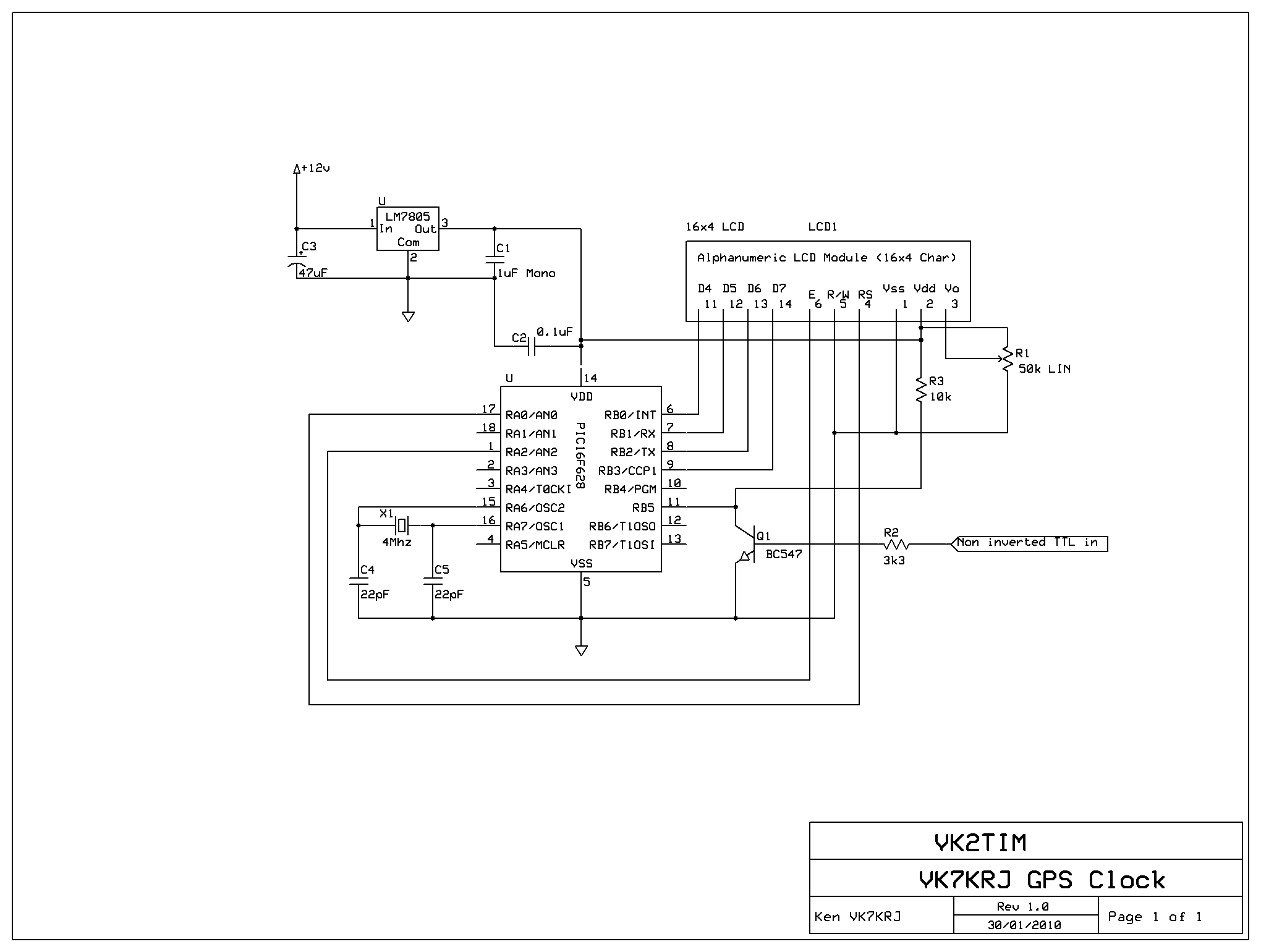
gps driven clock compasss peedo
This project is a GPS-based clock that displays the current date, automatically adjusts for daylight saving time, shows current speed, maximum speed, and present heading in degrees relative to true north. The original firmware and concept were developed by Ken,...

GPS datalogging shield for Arduino
The SD library integrated into the Arduino IDE has replaced this code. Its only advantage is that it can fit and operate on an ATmega168 Arduino, making it potentially useful for users unable to upgrade. For all other cases, it...