


Automatic Tr Switch Circuit
#TR switch
#diodes
#quarter-wave transmission line
#RF circuits
#transmit-receive
#scanner input
#short-circuit
#open circuit
#automatic switching

Description: A pair of diodes and a quarter-wave transmission line are utilized as an automatic TR switch. D1 and D2 conduct during transmit periods, short-circuiting the scanner input. In this mode, the quarter-wave line appears as an open circuit. In receive mode, the circuit functions as a Wilkinson power divider.
The circuit design employs two diodes, D1 and D2, configured in a manner that allows them to operate effectively as a transmit-receive (TR) switch. During the transmit phase, both diodes are forward-biased, creating a low-resistance path that short-circuits the scanner input. This configuration prevents any incoming signals from interfering with the transmission process. The quarter-wave transmission line plays a critical role in this setup. When active, it behaves as an open circuit, effectively isolating the scanner input from the output during transmission.
In the receive mode, the circuit transitions to operate as a Wilkinson power divider. This is achieved by the inherent properties of the quarter-wave transmission line, which allows for the division of power between multiple outputs without introducing significant loss. The Wilkinson power divider is known for its ability to maintain impedance matching, ensuring that reflections are minimized and the power is efficiently distributed among the outputs. This dual functionality of the circuit allows for seamless switching between transmitting and receiving modes, making it suitable for applications in communication systems where rapid transitions between states are necessary.
The design must ensure that the diodes are selected based on their switching speed and reverse recovery time to minimize any delay during the transition between transmit and receive modes. Additionally, careful consideration of the quarter-wave line's characteristic impedance is crucial to maintain the desired performance in both operational states. Overall, this circuit exemplifies a compact and efficient solution for automatic TR switching in RF applications. A pair of diodes and a quarter-wave transmission line are used as an automatic TR switch. D1 and D2 conduct during transmit periods, short- circuiting the scanner input. In this mode,-the K-wave line appears as an open circuit. In receive, the circuit acts as a Wilkinson power divider.
The circuit design employs two diodes, D1 and D2, configured in a manner that allows them to operate effectively as a transmit-receive (TR) switch. During the transmit phase, both diodes are forward-biased, creating a low-resistance path that short-circuits the scanner input. This configuration prevents any incoming signals from interfering with the transmission process. The quarter-wave transmission line plays a critical role in this setup. When active, it behaves as an open circuit, effectively isolating the scanner input from the output during transmission.
In the receive mode, the circuit transitions to operate as a Wilkinson power divider. This is achieved by the inherent properties of the quarter-wave transmission line, which allows for the division of power between multiple outputs without introducing significant loss. The Wilkinson power divider is known for its ability to maintain impedance matching, ensuring that reflections are minimized and the power is efficiently distributed among the outputs. This dual functionality of the circuit allows for seamless switching between transmitting and receiving modes, making it suitable for applications in communication systems where rapid transitions between states are necessary.
The design must ensure that the diodes are selected based on their switching speed and reverse recovery time to minimize any delay during the transition between transmit and receive modes. Additionally, careful consideration of the quarter-wave line's characteristic impedance is crucial to maintain the desired performance in both operational states. Overall, this circuit exemplifies a compact and efficient solution for automatic TR switching in RF applications. A pair of diodes and a quarter-wave transmission line are used as an automatic TR switch. D1 and D2 conduct during transmit periods, short- circuiting the scanner input. In this mode,-the K-wave line appears as an open circuit. In receive, the circuit acts as a Wilkinson power divider.
Whats the purpose of the diodes in this circuit
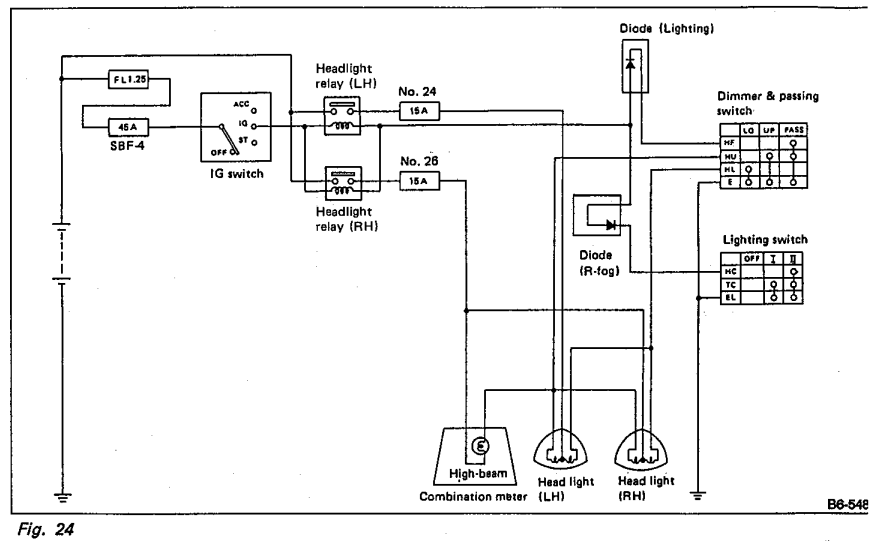
Understanding the headlight wiring in a car involves examining the purpose of two diodes in the circuit diagram. The circuit allows for two independent methods of activating the light relays: through the light switch or by flashing the high beams....

Uplifter Switches
A +12V switched wire was routed back to the camera wiring and connected at the same point as the reverse lights. This configuration allows either the reverse lights or the switch to activate the camera. The critical component in this...

Diodes for crystal receivers
Diodes with a low voltage drop also exhibit a high reverse current (leakage current), which places a heavier load on the detector circuit, reducing the quality factor (Q) of the circuit and consequently lowering the voltage across the LC circuit....

diodes on electromechanical vane display
A newcomer to electronics has recently acquired several electromechanical seven-segment vane displays and seeks assistance.
Electromechanical seven-segment vane displays are devices commonly used for visual representation of numerical data. They consist of a series of segments arranged in a figure-eight pattern,...

pcb Need help with identifying diodes in a 1970s automotive circuit
An old ignition module from a 1978 W116 model Mercedes-Benz is being reverse-engineered. The original circuit diagram is not available, so a new one has been created based on the printed circuit board (PCB). The circuit has been assessed to...

Automatic lighting control telephone signals
Diodes VD8 to VDI1 function as part of the main circuit isolation, with SCR serving as a composition control switch. The buck regulator circuit is composed of a stable orbital tube VD6 and a simple resistor-capacitor combination (C4). The circuit...
Simple Short-Circuit Detection
This circuit is designed for applications where over-current protection is necessary. An example can be found in the model train hobby. Experienced model train enthusiasts understand that troubleshooting a short-circuit can be quite challenging. While it is relatively easy to...