


Basic Crystal Radio ReceiverCircuit by Elmer G. Osterhoudt
#crystal radio
#receiver
#radio waves
#passive circuit
#AM radio
#tuner
#antenna
#detector
#coil
#diode

Description: A crystal radio receiver is a very simple radio receiver that requires no battery or external power source, operating solely on the energy harvested from radio waves through a long antenna.
A crystal radio receiver is a passive radio receiver that utilizes the energy from radio waves to produce audible sound without the need for an external power supply. This type of receiver typically consists of an antenna, a tuning circuit, a detector, and a headphone or speaker. The antenna captures radio frequency signals, which are then tuned to a specific frequency using a variable capacitor and an inductor in the tuning circuit.
The detector, often a crystal diode, rectifies the modulated radio signals, converting them into audio signals. The audio output can be heard through high-impedance headphones or a small speaker, which is connected to the output of the detector. The simplicity of the crystal radio receiver lies in its minimal components and the absence of active components, making it an excellent project for beginners in electronics and radio technology.
To enhance performance, factors such as the length of the antenna, the quality of the tuning circuit, and the type of detector used can be optimized. Longer antennas generally improve reception, while a higher quality diode can lead to better signal detection. Overall, the crystal radio receiver serves as an educational tool for understanding the principles of radio communication and the basic operation of radio circuits.A crystal radio receiver is a very simple radio receiver which needs no battery or power source and runs on the power received from radio waves by a long..
A crystal radio receiver is a passive radio receiver that utilizes the energy from radio waves to produce audible sound without the need for an external power supply. This type of receiver typically consists of an antenna, a tuning circuit, a detector, and a headphone or speaker. The antenna captures radio frequency signals, which are then tuned to a specific frequency using a variable capacitor and an inductor in the tuning circuit.
The detector, often a crystal diode, rectifies the modulated radio signals, converting them into audio signals. The audio output can be heard through high-impedance headphones or a small speaker, which is connected to the output of the detector. The simplicity of the crystal radio receiver lies in its minimal components and the absence of active components, making it an excellent project for beginners in electronics and radio technology.
To enhance performance, factors such as the length of the antenna, the quality of the tuning circuit, and the type of detector used can be optimized. Longer antennas generally improve reception, while a higher quality diode can lead to better signal detection. Overall, the crystal radio receiver serves as an educational tool for understanding the principles of radio communication and the basic operation of radio circuits.A crystal radio receiver is a very simple radio receiver which needs no battery or power source and runs on the power received from radio waves by a long..

Simple AM Radio Receiver circuit and explanation
This circuit is an amplified crystal set. The inductor can be a standard AM radio ferrite rod antenna, while the tuning capacitor is a variable plastic dielectric gang designed for small AM radios. The aerial tuned circuit feeds diode D1,...

Four Foot Box Loop Antenna
Please find attached your copy of my four foot unamplified box loop. It will tune from 525 kHz to about 1710 kHz covering the entire Broadcast Band. The umbrella stand described in the article is the type you would use...

Sensitive envelope detector circuit diagram
This is a highly sensitive envelope detector designed for AM radio applications. The circuit, illustrated in Figure 1, enables linear detection of weak signals with a modulation depth of 80-85%. The first stage (VT1) functions as a common-emitter amplifier for...
6 meter vertical antenna
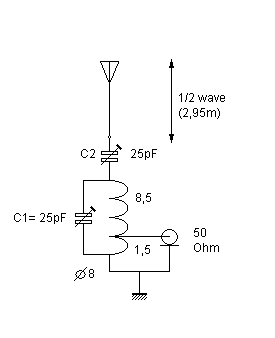
Easy to build homemade 50 MHz (6-meter band) vertical half-wave antenna. Omnidirectional, high gain, low SWR.
The proposed design for a 50 MHz vertical half-wave antenna is intended for amateur radio applications, specifically within the 6-meter band. This antenna configuration is...

Crystal radio schematics
The fundamentals of crystals have not changed since this article appeared in a 1960 edition of Popular Electronics. The methods for growing, cutting, and packaging crystals have evolved significantly. Understanding their operation at the atomic level has also advanced considerably....

Active AM Radio Antenna Amplifier / Preamplifier Circuit
The antenna amplifier circuit comprises approximately 40 components, featuring two NPN transistors (BC548), one MOSFET (BF981), two varicap diodes (KV1235), and a 6.2V zener diode. It includes a 330µH inductor/coil, which can be modified for operation on different frequency bands....

Simple AM radio
This is a straightforward AM radio circuit utilizing only two transistors. The coil L1 and variable capacitor C1 create the tank circuit. Transistor Q1 is responsible for demodulation, and the demodulated signal is accessible at the base of Q1. This...

Cat / Dog Detector
This can be used to control entry on a Cat or Dog Door. NOTE: There may be some changes and improvements coming. However, this circuit does work and you can build it as shown. The PCB shown below is available...

Loudspeaking crystal radio receivers
Many radio amateurs are interested in powering simple radio receivers using "free energy," which refers to energy obtained directly from the air via the receiver antenna. The circuits described can facilitate radio reception through a loudspeaker. However, questions remain regarding...