


Carrier current receiver

Description: A 60 kHz transformer is constructed using an 18 x 11 mm ungapped pot core (such as those from Siemens or Fer-rocube). It employs magnetics of type "F" material and is wound with SOV2 turns of No. 5 wire for the secondary winding and additional turns for the primary winding. This configuration results in a turns ratio of approximately 15:1.
The 60 kHz transformer is designed for efficient energy transfer at high frequencies, making it suitable for applications in power electronics, signal processing, and RF circuits. The choice of an ungapped pot core allows for improved magnetic coupling and reduced losses, which is critical in high-frequency operations. The use of type "F" magnetic material enhances the core's performance by providing low core losses and high saturation flux density, ensuring reliable operation within the specified frequency range.
The winding configuration, with SOV2 turns for the secondary and a calculated number of turns for the primary, is essential for achieving the desired voltage transformation. The turns ratio of approximately 15:1 indicates that the primary winding has 15 times more turns than the secondary winding, which allows for stepping down the voltage efficiently. This transformer can be used in various applications, including power supplies, inverters, and signal isolation, where voltage transformation and impedance matching are required.
In designing the circuit around this transformer, attention must be given to the selection of components that can handle the operating frequency and the corresponding power levels. Proper insulation and thermal management should also be considered to ensure optimal performance and longevity of the transformer in its intended application.60 kHz transformer consists of a 18 x 11mm ungapped pot core (Siemens, Fer-rocube, etc), utilizing magnetics incorporated type "F" material wound with SOV2 turns of No5 wire for the secondary and turns for the primary This gives a turns ratio of approximately 15 to 1.
The 60 kHz transformer is designed for efficient energy transfer at high frequencies, making it suitable for applications in power electronics, signal processing, and RF circuits. The choice of an ungapped pot core allows for improved magnetic coupling and reduced losses, which is critical in high-frequency operations. The use of type "F" magnetic material enhances the core's performance by providing low core losses and high saturation flux density, ensuring reliable operation within the specified frequency range.
The winding configuration, with SOV2 turns for the secondary and a calculated number of turns for the primary, is essential for achieving the desired voltage transformation. The turns ratio of approximately 15:1 indicates that the primary winding has 15 times more turns than the secondary winding, which allows for stepping down the voltage efficiently. This transformer can be used in various applications, including power supplies, inverters, and signal isolation, where voltage transformation and impedance matching are required.
In designing the circuit around this transformer, attention must be given to the selection of components that can handle the operating frequency and the corresponding power levels. Proper insulation and thermal management should also be considered to ensure optimal performance and longevity of the transformer in its intended application.60 kHz transformer consists of a 18 x 11mm ungapped pot core (Siemens, Fer-rocube, etc), utilizing magnetics incorporated type "F" material wound with SOV2 turns of No5 wire for the secondary and turns for the primary This gives a turns ratio of approximately 15 to 1.
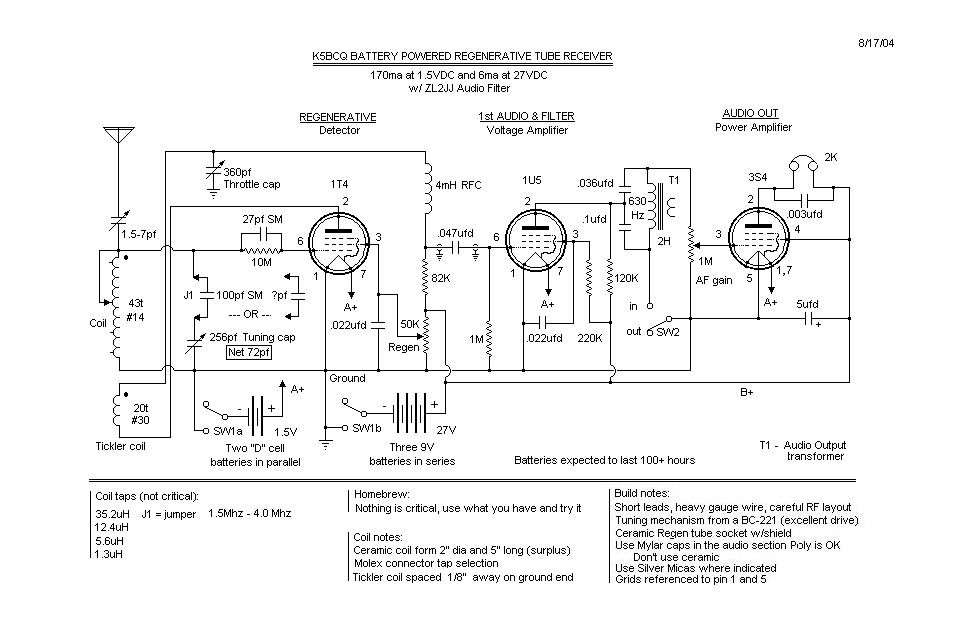
Battery Powered Tube Regenerative Receiver
The basic regenerative design is quite common. Before the schematic is created, there is a "concept stage," followed by the "available components stage," returning to the "concept stage," then moving on to the "mechanical/electrical layout stage," and finally sketching a...

EI30 Transformer board
Every DAC board and decoder includes a power supply component. The only missing part is the power transformer. A toroidal transformer can be utilized, featuring a power switch and fuse holder mounted on the chassis. This document presents one of...

signal Can someone break down how this receiver works
The circuit described is a toy car receiver, which operates similarly to the transmitter but in reverse and with additional filtering. The receiver is tuned to a frequency of 27.145 MHz to capture signals at this frequency. Following the initial...

The R2 Single Sideband Direct Conversion Receiver
The old common-base audio preamp, which has a noise figure of 5 dB, is a clear candidate for improvement in noise performance. A common-emitter configuration with shunt feedback provides an input resistance of 50 ohms, which is preferred by the...

3-Wire Receiver/Message Demuxer
This 3-wire receiver verifies the initial four data bits of 16 received bits against a predetermined address. If the two match, the remaining 12 bits are stored in two 6-bit flip-flop registers. The design can utilize either CMOS or TTL...

Simple receiver with microvolt sensitivity
The three-transistor circuit costs less than $10 to build, uses commonly available components, and consumes less than 10 mA from a single 9V battery. By winding coil L1 as shown, the circuit can receive signals in the 5 to 15...
80M
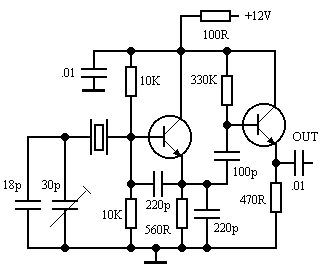
This 80M receiver design incorporates the necessary switching mechanisms to enable the SSB filter and first intermediate frequency (I.F.) amplifier to function for transmission purposes. The receiver stages, from the radio frequency (R.F.) input to the speaker output, will be...

Energy losses in modem
A toroidal transformer (2x12V 15VA) is utilized due to its significantly lower energy losses compared to an E-I core transformer, which was employed in the original mains adapter.
The toroidal transformer is a type of transformer that features a doughnut-shaped core...

SW Receiver Using MK414
The tuned circuit consists of a variable capacitor and fixed air spaced coil. For the coil, wound between 10 and 20 turns of wire on an empty tube of around 1.5 inches diameter. The turns were spaced so that the...