


Dual-Band Loop Antenna For 80-160 M Circuit
#dual-band
#loop antenna
#80-160 meter
#preamplifier
#RF shielding
#noise reduction
#ham radio
#Q1 Q2 transistors
#frequency selection

Description: This antenna may assist in minimizing power-line noise. It consists of a plastic hula hoop or conduit with a diameter of 3 feet, which is covered with aluminum foil to serve as a shield for LI and L2. LI consists of two turns, while L2 has one turn, both threaded through the loop. SI is used to select between 160-meter or 80-meter operation. Q1 and Q2 comprise a preamplifier for the loop antenna. It is important to note that this antenna is designed solely for receiving and should not be used for transmission.
The described antenna system utilizes a conductive loop to enhance reception capabilities while mitigating interference from power-line noise. The loop, constructed from a plastic hula hoop or similar conduit, serves as a resonant structure that captures radio frequency signals effectively. The use of aluminum foil as a shield not only provides a conductive surface for signal enhancement but also helps to block unwanted electromagnetic interference.
The configuration of the inductors LI and L2 is critical for tuning the antenna to the desired frequency range. LI, with two turns, and L2, with one turn, create a resonant circuit that can be adjusted to optimize performance for either the 160-meter or 80-meter amateur radio bands, selectable via the switch SI. This capability allows users to adapt the antenna to different operating conditions and frequency requirements.
The preamplifier stage, consisting of Q1 and Q2, is an essential component of the system. This transistor-based amplifier boosts the weak signals received by the loop antenna, enhancing overall sensitivity and improving the quality of the received audio. The design must ensure that the preamplifier operates within the frequency range of interest while minimizing noise introduced by the amplifier itself.
Given the antenna's design for receiving only, it is imperative to adhere to operational guidelines that prevent transmission, thereby ensuring compliance with amateur radio regulations. The loop antenna, when properly constructed and utilized, can significantly improve reception quality in environments plagued by electrical noise, making it a valuable tool for radio enthusiasts and operators. This antenna might help to reduce power-line noise. A plastic hula hoop or conduit 3 feet in diameter, covered with aluminum foil as a shield is used for LI and L2. LI is two turns and L2 is one turn, threaded through the loop. SI selects 160- or 80-m operation. Ql and Q2 form a preamplifier for the loop antenna. Do not transmit with this antennait is for receiving only.
The described antenna system utilizes a conductive loop to enhance reception capabilities while mitigating interference from power-line noise. The loop, constructed from a plastic hula hoop or similar conduit, serves as a resonant structure that captures radio frequency signals effectively. The use of aluminum foil as a shield not only provides a conductive surface for signal enhancement but also helps to block unwanted electromagnetic interference.
The configuration of the inductors LI and L2 is critical for tuning the antenna to the desired frequency range. LI, with two turns, and L2, with one turn, create a resonant circuit that can be adjusted to optimize performance for either the 160-meter or 80-meter amateur radio bands, selectable via the switch SI. This capability allows users to adapt the antenna to different operating conditions and frequency requirements.
The preamplifier stage, consisting of Q1 and Q2, is an essential component of the system. This transistor-based amplifier boosts the weak signals received by the loop antenna, enhancing overall sensitivity and improving the quality of the received audio. The design must ensure that the preamplifier operates within the frequency range of interest while minimizing noise introduced by the amplifier itself.
Given the antenna's design for receiving only, it is imperative to adhere to operational guidelines that prevent transmission, thereby ensuring compliance with amateur radio regulations. The loop antenna, when properly constructed and utilized, can significantly improve reception quality in environments plagued by electrical noise, making it a valuable tool for radio enthusiasts and operators. This antenna might help to reduce power-line noise. A plastic hula hoop or conduit 3 feet in diameter, covered with aluminum foil as a shield is used for LI and L2. LI is two turns and L2 is one turn, threaded through the loop. SI selects 160- or 80-m operation. Ql and Q2 form a preamplifier for the loop antenna. Do not transmit with this antennait is for receiving only.

using virtual serial ports for ham radio dahdidah cw keyer
This video demonstrates how to initiate multiple instances of QsoNet's Dahdidah CW Software Keyer using FABULATECH's Virtual Serial Port Splitter. Four separate...
The QsoNet Dahdidah CW Software Keyer is a sophisticated tool designed for amateur radio operators, allowing them to send...

Stereo Preamplifier with balance and loudness
The preamplifier circuit utilizes the 5533 chip and incorporates a combination of balance and volume controls. Given the nonlinearity of the human auditory system, low frequencies are required to be amplified at lower listening levels. Additionally, level and LOUDNESS controls...

High-quality preamplifier
The circuit illustrated in Figure 3-10 is a multi-function input configuration that includes a preamplifier. It features several input types, including a tuner input, a magnetic tape playback input, a magnetic phono input, and a phono equalizer input. The input...

Modular Preamplifier with IC Class A
The original description discusses an application that is reputed for its high-quality sound. This superior sound quality is attributed to the operation of the entrance transistors at Class A. The sound quality is largely dependent on IC1, which needs to...

Mixer preamplifier with tone control
A general-purpose preamplifier/mixer accepts up to four inputs, has a gain of 1600, and provides bass and treble controls that can be varied ± 10 dB at 100 Hz and 10 kHz respectively. More: IC1 and IC2 = LM301A.
This circuit...

SW Loop Antenna
The small single turn magnetic loop (SSTML) antenna consists of a single winding inductor, about 3 feet (1 meter) in diameter, and a tuning capacitor. A second loop, which is one fifth of the diameter of the large loop, is...

Very Low Noise Pick-up Preamplifier
The preamplifier is designed for signal sources such as low-impedance moving coil cartridges (MC) used in high-fidelity turntables. The amplifier has an impedance of 100 ohms. To maintain low noise levels, three double-type transistors, either MAT03 or SSM2220, are connected...
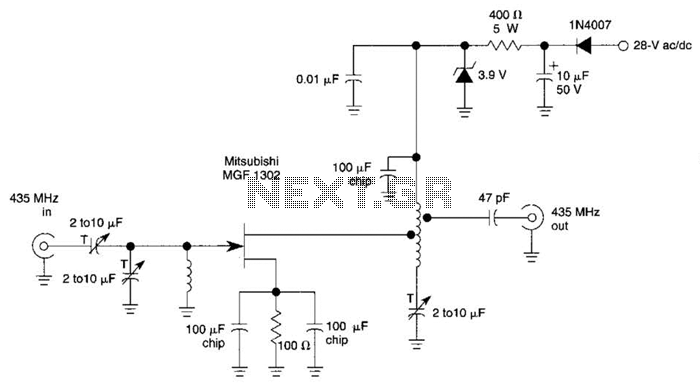
Gasfet Preamp For 435Mhz Circuit
This circuit is a low-noise preamplifier designed for the 435-MHz amateur satellite frequencies. It utilizes a Mitsubishi MGF1302 transistor. A 28-Vdc power source is indicated; however, lower voltages can be employed by adjusting the 400-5-W resistor.
The low-noise preamplifier circuit operates...

Selectable sensitivity Preamplifier
Most audio amplifier systems must have preamplifiers with many different characteristics. These include high-gain linear response for magnetic microphones, low-gain linear response for tuners, and high-gain RIAA equalization for magnetic phone cartridges. To meet this broad requirement, most amplifier designers...