


Fox Hunting
#radio direction finding
#fox hunt
#transmitter hunting
#HAM radio
#RDF
#treasure hunting
#wireless
#communication
#scientific game
#SWLs

Description: This is a new device for Radio Direction Finding (RDF), referred to as FOX HUNT, Transmitter Hunting (T-Hunting), or Treasure Hunting. HAM clubs worldwide occasionally conduct this scientific game, which is considered the only interesting game in the HAM community. This activity helps amateur radio operators (HAMs) and shortwave listeners (SWLs) gain knowledge about radio direction finding, attenuation techniques, and related concepts such as direct signal and reflected signal detection and orientation. When the hidden transmitter (FOX) is located 30 kilometers away, it can be located using a 2-element or 3-element beam antenna (Yagi) as a direction finder to determine the direction of the FOX HOWL (transmitted signal) and achieve precise orientation. However, when in close proximity to the FOX (hidden transmitter), the S-Meter reading on a handheld rig displays full-scale readings, even if the transmitter operates at low power. This prevents accurate orientation due to poor shielding of the handheld rig. Typically, hunters use resistive attenuators (passive attenuators) to reduce the signal level to the handheld device. However, these passive attenuators are ineffective at shorter distances, as the handheld rig will show full S-Meter readings even without an antenna. This innovative design shifts the exact FOX HOWL receiving frequency and controls the signal level, preventing direct signal penetration into the handheld device. The circuit consists of two main sections: a Local Oscillator (LO) and a diode mixer with level control. By selecting an LO frequency of 2 MHz and a FOX HOWL frequency of 145 MHz, the circuit output can be at either 147 MHz or 143 MHz. This circuit was assembled by Pre-college Science Academy students of NASA at Pasadena City College in California, who built twenty attenuators and steel tape Yagis during a Saturday morning session for their spring 2001 radio-orienteering project in August. The circuit's origin is attributed to PA0ZR and K0OV. Their design utilized crystal-controlled CMOS oscillator modules for LO frequency generation, which can be costly and not readily available in the market. A few months ago, VU2ESH-Rajesh provided the original article for reference. The LO frequency generation section has been simplified, made more flexible, and cost-effective. The LO frequency module was changed to a Pierce oscillator with a 2 MHz crystal. The entire circuit is mounted on a small PCB (2 cm x 8 cm) that can be attached to the boom of a direction-finding antenna. A 9V battery (6F22) powers the circuit. By integrating this circuit into the RDF antenna, users can effectively control the signal level even when just one foot away from the FOX.
The RDF circuit incorporates a Local Oscillator (LO) that generates a stable frequency, which is critical for mixing with the incoming signal from the hidden transmitter. The diode mixer then combines the LO frequency with the FOX HOWL frequency to produce an intermediate frequency (IF) that is easier to manage and process. This IF can be adjusted to avoid saturation of the handheld rig's receiver, allowing for more accurate direction finding.
The design emphasizes compactness and efficiency, utilizing a printed circuit board (PCB) for easy assembly and integration into existing antenna systems. The choice of a Pierce oscillator for the LO frequency generation enhances the simplicity of the circuit while maintaining reliability. The use of a 2 MHz crystal provides a stable reference for the oscillator, ensuring consistent performance during operation.
Powering the circuit with a standard 9V battery ensures portability and ease of use in field conditions. The circuit's ability to control signal levels effectively allows users to pinpoint the direction of the FOX transmitter with greater accuracy, especially in close-range scenarios where traditional methods may fail due to signal overload.
Overall, this innovative RDF circuit design represents a significant advancement in the field of amateur radio direction finding, providing users with a practical tool to enhance their skills in T-Hunting and related activities.This is a new gear for Radio Direction Finding (RDF) known as FOX HUNT or called Transmitter Hunting (T-Hunting) or Treassure Hunting. HAM clubs, all over the world, are conducting this SCIENTIFIC GAME occasionally, being which is the only one interesting game in HAM World.
This game helps every HAMs and SWLs to get knowledge about radio direction finding, attenuation techniques and associated things like direct signal and reflected signal detection, orientation etc. When the hidden transmitter (FOX) is at a distance of 30 Kms, we can able to find its direction by using 2-element or 3-element beam antenna (Yagi) as a direction finder to get FOX HOWL (Transmitted Signal - Direction) and we get the exact orientation.
But when we are in close to the FOX (Hidden Transmitter), the `S-Meter` reading on your hand held rig shows full scale reading even if the transmitter is running in low power. Due to this we can`t get the proper orientation of the pin-point to the fox and it is because of the poor shielding (case) of the hand held rig.
Normally every hunter using resistive attenuators (passive attenuators) to reduce the signal level to the hand held. But these passive attenuators can`t work in shorter distance. In close distance the hand held rig will shows full s meter reading without any antenna ! In this clever design we are shifting the exact fox howl - receiving frequency and then controlling the signal level.
So there is no direct penetration of signals into the hand held. In this circuit, there are two major sections, one is the Local Oscillator (LO) and the other is a diode mixer with a level control, if we are selecting a LO frequency of 2 MHz and the fox howl frequency of 145 MHz, then the output from the circuit can be at 147 MHz or in 143 MHz. This circuit is assembled by Pre-college Science Academy Students of NASA at Pasadena city College in California, built twenty attenuators and steel tape yagis during Saturday - morning session for their spring 2001 radio-orienteering project in August.
The origin of the circuit is from PA0ZR. and K0 OV. In their design they used crystal controlled CMOS oscillator modules for LO frequency generation. These module oscillators are little bit costly and different types can`t available in our market. Few months back, VU2ESH-Rajesh had provided me the original article for the reference. I reworked the LO frequency generating section lo be simple, flexible and coast effective. I changed the LO frequency module to pierce oscillator with 2MHz crystal. The entire circuit is made on a small PCB (I have made 2 cm / 8 cm PCBs) which can mounted on boom of a direction finding antenna. For power supply put a 9V battery (6F 22). Attaching this circuit in your RDF antenna you can easily control the signal level even one feet nearer to the fox.
So guys, try this new weapon in the next FOXHUNT.
The RDF circuit incorporates a Local Oscillator (LO) that generates a stable frequency, which is critical for mixing with the incoming signal from the hidden transmitter. The diode mixer then combines the LO frequency with the FOX HOWL frequency to produce an intermediate frequency (IF) that is easier to manage and process. This IF can be adjusted to avoid saturation of the handheld rig's receiver, allowing for more accurate direction finding.
The design emphasizes compactness and efficiency, utilizing a printed circuit board (PCB) for easy assembly and integration into existing antenna systems. The choice of a Pierce oscillator for the LO frequency generation enhances the simplicity of the circuit while maintaining reliability. The use of a 2 MHz crystal provides a stable reference for the oscillator, ensuring consistent performance during operation.
Powering the circuit with a standard 9V battery ensures portability and ease of use in field conditions. The circuit's ability to control signal levels effectively allows users to pinpoint the direction of the FOX transmitter with greater accuracy, especially in close-range scenarios where traditional methods may fail due to signal overload.
Overall, this innovative RDF circuit design represents a significant advancement in the field of amateur radio direction finding, providing users with a practical tool to enhance their skills in T-Hunting and related activities.This is a new gear for Radio Direction Finding (RDF) known as FOX HUNT or called Transmitter Hunting (T-Hunting) or Treassure Hunting. HAM clubs, all over the world, are conducting this SCIENTIFIC GAME occasionally, being which is the only one interesting game in HAM World.
This game helps every HAMs and SWLs to get knowledge about radio direction finding, attenuation techniques and associated things like direct signal and reflected signal detection, orientation etc. When the hidden transmitter (FOX) is at a distance of 30 Kms, we can able to find its direction by using 2-element or 3-element beam antenna (Yagi) as a direction finder to get FOX HOWL (Transmitted Signal - Direction) and we get the exact orientation.
But when we are in close to the FOX (Hidden Transmitter), the `S-Meter` reading on your hand held rig shows full scale reading even if the transmitter is running in low power. Due to this we can`t get the proper orientation of the pin-point to the fox and it is because of the poor shielding (case) of the hand held rig.
Normally every hunter using resistive attenuators (passive attenuators) to reduce the signal level to the hand held. But these passive attenuators can`t work in shorter distance. In close distance the hand held rig will shows full s meter reading without any antenna ! In this clever design we are shifting the exact fox howl - receiving frequency and then controlling the signal level.
So there is no direct penetration of signals into the hand held. In this circuit, there are two major sections, one is the Local Oscillator (LO) and the other is a diode mixer with a level control, if we are selecting a LO frequency of 2 MHz and the fox howl frequency of 145 MHz, then the output from the circuit can be at 147 MHz or in 143 MHz. This circuit is assembled by Pre-college Science Academy Students of NASA at Pasadena city College in California, built twenty attenuators and steel tape yagis during Saturday - morning session for their spring 2001 radio-orienteering project in August.
The origin of the circuit is from PA0ZR. and K0 OV. In their design they used crystal controlled CMOS oscillator modules for LO frequency generation. These module oscillators are little bit costly and different types can`t available in our market. Few months back, VU2ESH-Rajesh had provided me the original article for the reference. I reworked the LO frequency generating section lo be simple, flexible and coast effective. I changed the LO frequency module to pierce oscillator with 2MHz crystal. The entire circuit is made on a small PCB (I have made 2 cm / 8 cm PCBs) which can mounted on boom of a direction finding antenna. For power supply put a 9V battery (6F 22). Attaching this circuit in your RDF antenna you can easily control the signal level even one feet nearer to the fox.
So guys, try this new weapon in the next FOXHUNT.
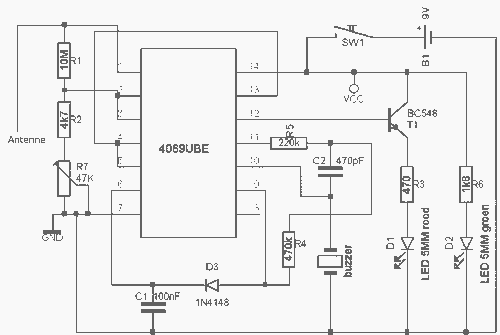
Wireless Bug detector
This fairly simple circuit makes it possible to place such a wall as a conduit to locate. It is a conduit for power, no water or gas-seeker. The only requirement is that there is tension on the line. The antenna...

Carport wireless alarm circuit a
The alarm circuit is composed of two main components: the transmitter and the receiver. The transmitter circuit, as illustrated in Figure A, features a smoke break reed switch labeled GT. When a magnet approaches the GT, the internal contacts open....

6m wireless remote control switch circuit
This example describes a wireless remote control switch featuring reliable operation and practical characteristics, capable of remotely controlling a 6-channel device within a 6-meter range for household electricity. The wireless remote control switch circuit consists of a wireless transmitter and...

Composed of TDC1808/TDC1809 digital coding control circuit diagram
The TDC1808/TDC1809 is a pair of wireless remote control transmitter and receiver components. They utilize an internal antenna to transmit both digital and analog signals. These components are suitable for various wireless remote control devices. Key features include compact size,...
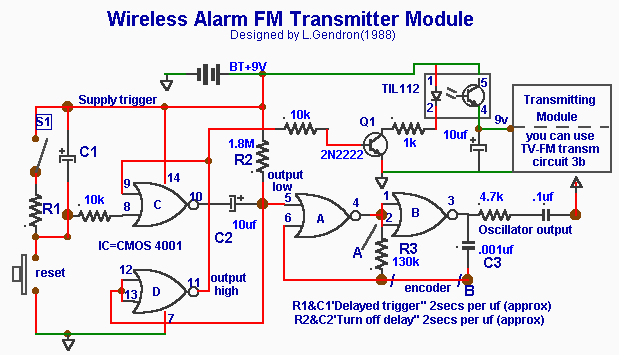
Wireless alarm FM transmitter module
There are many alarm systems available, but building a custom one may be appealing. This project can be assembled using affordable components that are easily accessible. The alarm transmitter module features a delayed trigger and an automatic turn-off function, operating...

Video/Audio Wireless Transmitter
In this fast-paced world, there is little time for inconveniences and a greater need for portability and adaptability. The idea for an Audio/Video transmitter stems from this need. There may have been times when you’ve wanted to hook up your...

Building a Wireless Temperature Sensor
A wireless temperature sensor allows temperature measurements to be taken anywhere within the range of the transmitter and receiver. One straightforward approach to achieve this is by utilizing a voltage-to-frequency conversion chip in conjunction with an analog temperature sensor, such...

Simple Ham Radio Circuit Audio Filter With 741 IC
This circuit will filter out interference signals and ensure that the signal received from the Morse code station stands out.
The described circuit functions as a signal processing system specifically designed to enhance the clarity of Morse code transmissions by minimizing...

Wireless Color Sensor
Close to human perception and stable color sensing is a pervasive challenge encountered in various disciplines, such as machine vision for classification and recognition, as well as in intelligent systems like smart illumination systems in home or workplace environments. In...