


Foxhole Radio tuning
#foxhole radio
#tuning
#radio circuit
#DIY
#first project
#RF
#receiver
#crystal radio
#amateur radio
#electronics

Description: A user is seeking assistance with tuning a radio circuit they are building independently for the first time, outside of a classroom setting.
The process of tuning a radio circuit involves adjusting various components to ensure proper reception of radio signals. Key elements in a typical radio circuit include the antenna, tuning capacitor, variable resistor, and the radio frequency (RF) amplifier.
To begin, the antenna captures the radio waves, converting them into electrical signals. The tuning capacitor is crucial for selecting the desired frequency. By adjusting the capacitance, the resonant frequency of the circuit can be altered, allowing the user to lock onto specific radio stations.
In conjunction with the tuning capacitor, a variable resistor may be used to fine-tune the signal strength and quality. This component can help mitigate noise and enhance the clarity of the audio output.
The RF amplifier plays a vital role in boosting the weak signals received by the antenna, making them strong enough for further processing. Properly configuring this amplifier is essential for achieving optimal performance from the radio circuit.
To successfully tune the radio, the user should ensure that all connections are secure and that the components are functioning correctly. It may be beneficial to consult circuit diagrams specific to the radio model being constructed, as they provide valuable insights into component values and configurations.
In summary, tuning a radio circuit requires careful adjustment of the tuning capacitor and variable resistor, along with ensuring the RF amplifier is properly configured to enhance signal reception and audio clarity.Hello everyone, this is my first post here. I am building my first circuit (outside of class) and am having trouble tuning my radio. What I have: So..
The process of tuning a radio circuit involves adjusting various components to ensure proper reception of radio signals. Key elements in a typical radio circuit include the antenna, tuning capacitor, variable resistor, and the radio frequency (RF) amplifier.
To begin, the antenna captures the radio waves, converting them into electrical signals. The tuning capacitor is crucial for selecting the desired frequency. By adjusting the capacitance, the resonant frequency of the circuit can be altered, allowing the user to lock onto specific radio stations.
In conjunction with the tuning capacitor, a variable resistor may be used to fine-tune the signal strength and quality. This component can help mitigate noise and enhance the clarity of the audio output.
The RF amplifier plays a vital role in boosting the weak signals received by the antenna, making them strong enough for further processing. Properly configuring this amplifier is essential for achieving optimal performance from the radio circuit.
To successfully tune the radio, the user should ensure that all connections are secure and that the components are functioning correctly. It may be beneficial to consult circuit diagrams specific to the radio model being constructed, as they provide valuable insights into component values and configurations.
In summary, tuning a radio circuit requires careful adjustment of the tuning capacitor and variable resistor, along with ensuring the RF amplifier is properly configured to enhance signal reception and audio clarity.Hello everyone, this is my first post here. I am building my first circuit (outside of class) and am having trouble tuning my radio. What I have: So..
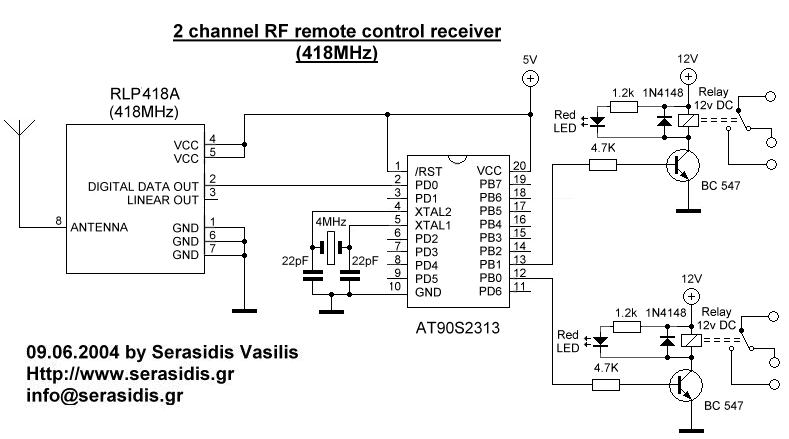
2 channel RF remote control
The basic small-range remote controls are Infrared and RF (Radio Frequency). One of the weaknesses of Infrared is that the signal cannot pass through walls. Therefore, to control a garage door, an RF remote control is necessary. The circuit (transmitter...
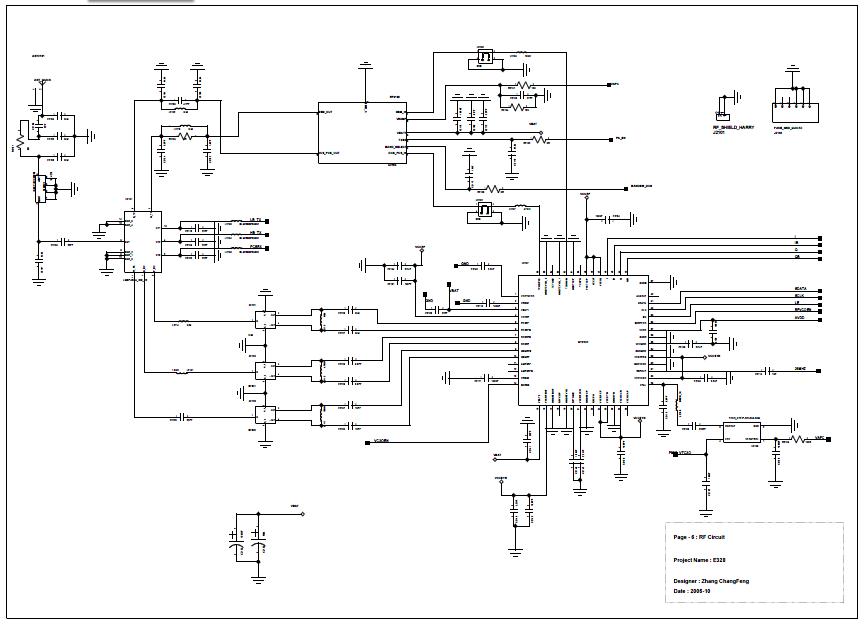
schematic of lenovo e317
Analog baseband digital circuit table of contents: EMI interface, BPI bus, JTAG, LCD interface, keypad, UART, MINT, GPIO, MCP keypad, audio, RF, I/O connector, power cones, serial time, battery charging and analog, LED driver, RF control, JTAG, IOTA, audio codecs,...

Wireless video camera link
This high-performance video camera link transmits signals from a video camera to a VCR or from a VCR to TVs throughout a home. The initial stage of the RF chain features a crystal-controlled oscillator, Q1, operating at a frequency range...

frx 2001
Software, applications, and programming resources. Amateur radio and travel. Stereogram art.
The provided content outlines various topics of interest, including software applications and programming resources, amateur radio, travel, and stereogram art. Each of these areas represents a distinct field with its...
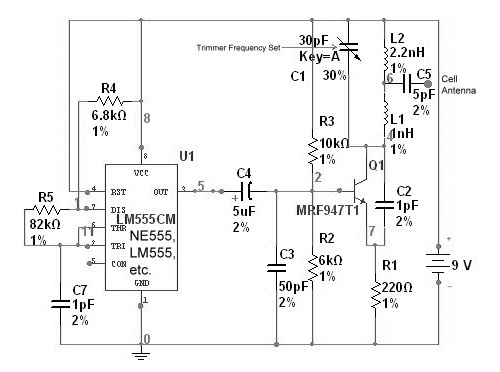
radio station blocker circuit
This device functions as a reversal of a radio station, sending a null signal to a selected frequency to eliminate the actual broadcast. The radio transmitter operates at a loss of 10,000W; therefore, this circuit is intended for use only...
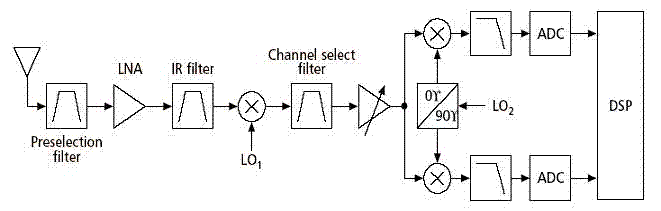
receiver architectures
Various architectures of receivers have been proposed in literature, but the most popular architectures among them, such as Heterodyne, Homodyne, Wideband-IF, and Low-IF, are presented here.
The Heterodyne receiver architecture utilizes two frequencies: the incoming radio frequency (RF) signal and a...

Crystal radio schematics
The fundamentals of crystals have not changed since this article appeared in a 1960 edition of Popular Electronics. The methods for growing, cutting, and packaging crystals have evolved significantly. Understanding their operation at the atomic level has also advanced considerably....

RF-powered sidetone oscillator
A sidetone oscillator is a specific type of audio astable multivibrator. Keying is achieved by turning the oscillator on and off through the application of a positive DC potential, which is generated from the RF signal to the reset terminal...

Tuned Rf Wavemeter
L1 and L2 form a tuned transformer with an optimum turns ratio of approximately 1:3. L2 and C1 are used to tune to the desired frequency. The frequency range can extend from 10 kHz to over 200 MHz, depending on...