


Reference Design for an 802.11b/g RF Front-End Module Using the MAX2830
#RF front-end
#MAX2830
#WLAN
#802.11b/g
#transceiver
#wireless communication
#RF module
#IEEE standard
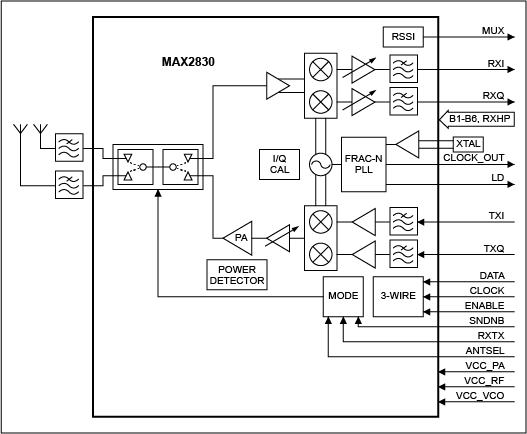
Description: This module utilizes the highly integrated MAX2830 RF transceiver, providing a complete RF front-end solution that complies with the WLAN IEEE 802.11b/g standard.
The MAX2830 RF transceiver is designed for wireless communication applications, specifically targeting WLAN systems. It integrates various functionalities required for RF signal processing, including a low-noise amplifier (LNA), a power amplifier (PA), and a frequency synthesizer, all within a compact package. This integration simplifies the design of RF front-end circuits, reducing the need for multiple discrete components and thus minimizing the overall footprint of the device.
The RF transceiver operates within the 2.4 GHz ISM band, which is commonly used for WLAN communications. It supports both 802.11b and 802.11g standards, enabling high data rates and reliable connectivity. The device features advanced power management capabilities, allowing for efficient operation and extended battery life in portable applications.
In terms of performance, the MAX2830 offers excellent sensitivity and linearity, ensuring robust communication even in challenging environments. The LNA provides high gain with low noise figure, while the PA is designed to deliver sufficient output power for effective transmission over the required range.
The transceiver is typically interfaced with a microcontroller or baseband processor that handles the digital signal processing. The design of the associated circuitry must include proper impedance matching and filtering to ensure optimal performance. Additionally, careful attention must be paid to the layout of the PCB to minimize signal degradation and interference, particularly in high-frequency applications.
Overall, the MAX2830 RF transceiver represents a versatile and efficient solution for developing WLAN-enabled devices, streamlining the design process and enhancing performance in wireless communication systems.This module uses the highly integrated MAX2830 RF transceiver. It is a complete RF front-end solution that meets the WLAN IEEESM 802.11b/g standard..
The MAX2830 RF transceiver is designed for wireless communication applications, specifically targeting WLAN systems. It integrates various functionalities required for RF signal processing, including a low-noise amplifier (LNA), a power amplifier (PA), and a frequency synthesizer, all within a compact package. This integration simplifies the design of RF front-end circuits, reducing the need for multiple discrete components and thus minimizing the overall footprint of the device.
The RF transceiver operates within the 2.4 GHz ISM band, which is commonly used for WLAN communications. It supports both 802.11b and 802.11g standards, enabling high data rates and reliable connectivity. The device features advanced power management capabilities, allowing for efficient operation and extended battery life in portable applications.
In terms of performance, the MAX2830 offers excellent sensitivity and linearity, ensuring robust communication even in challenging environments. The LNA provides high gain with low noise figure, while the PA is designed to deliver sufficient output power for effective transmission over the required range.
The transceiver is typically interfaced with a microcontroller or baseband processor that handles the digital signal processing. The design of the associated circuitry must include proper impedance matching and filtering to ensure optimal performance. Additionally, careful attention must be paid to the layout of the PCB to minimize signal degradation and interference, particularly in high-frequency applications.
Overall, the MAX2830 RF transceiver represents a versatile and efficient solution for developing WLAN-enabled devices, streamlining the design process and enhancing performance in wireless communication systems.This module uses the highly integrated MAX2830 RF transceiver. It is a complete RF front-end solution that meets the WLAN IEEESM 802.11b/g standard..

FOUR BAND CW TRANSCEIVER WITH DIRECT CONVERSION
The performance of the 80-meter CW transceiver using the phase method for sideband suppression is very good. Construction was easy with all standard electronic components available, without the need for an expensive or complex crystal filter. Almost no signals are...
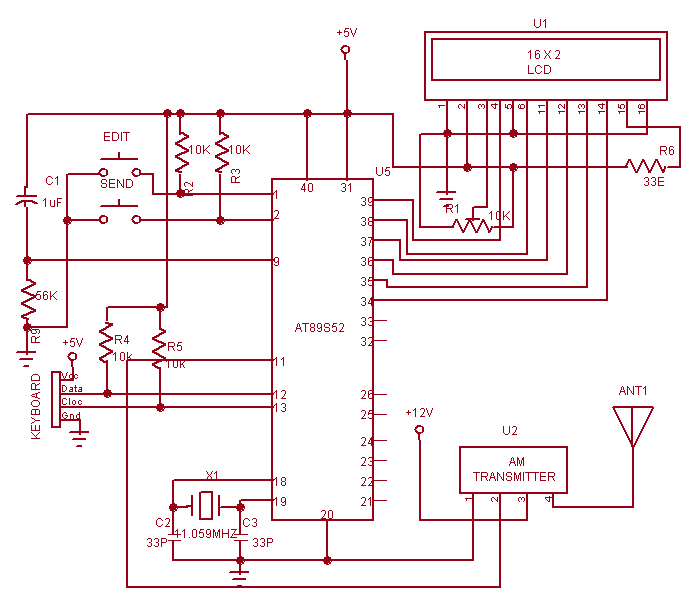
Wireless Data Communication system
This project is used to communicate or transmit a text message from one place to another place through wireless. The text message is encrypted by using the Microcontroller and the encrypted message was transmitted through wireless. At the receiver end...

5 W ATV TRANSCEIVER
The transmitter schematic, which is a component of the transceiver, can be found in the entry titled S-W ATV Transmitter for 440 MHz, Figure 5-1. The downconverter section is illustrated here. This transmitter includes both video and audio sections, producing...

7MHz CW transceiver made with Motrola MC3362P
The 7MHz CW transceiver is constructed using the MC3362P integrated circuit, originally intended for a 10MHz band transceiver. Due to concerns regarding unexpected neighboring spurious signals, the frequency was altered to 7MHz, leading to the completion of the transceiver. This...

wireless motor control through rf
DC motors can be operated remotely using controls transmitted via an RF module. This circuit employs an RF module to manage DC motors through a motor driver integrated circuit (IC) L293D. Transmission is initiated by setting pin 14 (TE, active...

rf module interfacing with spartan 3an fpga
The RF module operates at radio frequencies, with a frequency range between 30 kHz and 300 GHz. In this RF system, digital data is represented as variations in the amplitude of a carrier wave, a modulation technique known as Amplitude...

A 70cm Wide-band Transceiver Concept
This article provides a detailed overview of a 70 cm wideband transceiver designed for duplex operation. The modules operate within a 200 kHz wide duplex channel, selectable from 430-440 MHz with a 100 kHz channel spacing. Initial prototypes were introduced...

transceiver circuits
The unit is based on a PHILIPS FM880 link transceiver originally supplied to a Telecom Australia specification for telephone applications in remote areas of Australia. The FM880 is part of a family of equipment that includes the PHILIPS FM828/FM814 series...

QRP CW TRANSCEIVER
This is a 3-W, single-circuit board, VFO-controlled CW transceiver for 40 or 30 meters, featuring a direct-conversion receiver with audio filtering, Receiver Incremental Tuning (RIT), and speaker level audio volume. The transmit frequency is generated by Q1 and its associated...