


SDR Transforms Amateur Radio
#SDR
#software-defined radio
#ham radio
#SWL
#communication
#RF
#amateur radio
#wireless
#receiver
#transmitter

Description: Software-defined radios (SDRs) are utilized in various communication fields, including amateur radio and shortwave listening.
Software-defined radios (SDRs) represent a significant advancement in communication technology, allowing for flexibility and adaptability in radio frequency applications. Unlike traditional radios that rely on hardware components for signal processing, SDRs utilize software to perform modulation, demodulation, and other signal processing tasks. This software-centric approach enables users to customize their radios for specific applications, including amateur radio (ham radio) and shortwave listening (SWL).
In an SDR system, the core components typically include an analog-to-digital converter (ADC), a digital signal processor (DSP), and a software interface. The ADC converts incoming analog signals into digital form, which is then processed by the DSP. The DSP executes various algorithms for filtering, demodulation, and decoding, allowing the SDR to operate across a wide frequency range and support multiple communication protocols.
The software component of the SDR is crucial, as it allows for updates and modifications to be made without the need for hardware changes. This flexibility is particularly beneficial for amateur radio operators who may want to experiment with different modes of communication, such as single sideband (SSB), frequency modulation (FM), or digital modes like PSK31 and FT8.
Furthermore, SDRs can be integrated with additional technologies such as GPS for precise timing and location-based applications, enhancing their functionality in various communication scenarios. The ability to leverage open-source software platforms also encourages innovation and collaboration among users, resulting in a continually evolving landscape of communication capabilities.
Overall, the implementation of software-defined radios has transformed the landscape of communication technologies, offering versatile solutions for both hobbyists and professionals in the field.Software-defined radios (SDRs) are used in all areas of communications including ham radio and SWL
Software-defined radios (SDRs) represent a significant advancement in communication technology, allowing for flexibility and adaptability in radio frequency applications. Unlike traditional radios that rely on hardware components for signal processing, SDRs utilize software to perform modulation, demodulation, and other signal processing tasks. This software-centric approach enables users to customize their radios for specific applications, including amateur radio (ham radio) and shortwave listening (SWL).
In an SDR system, the core components typically include an analog-to-digital converter (ADC), a digital signal processor (DSP), and a software interface. The ADC converts incoming analog signals into digital form, which is then processed by the DSP. The DSP executes various algorithms for filtering, demodulation, and decoding, allowing the SDR to operate across a wide frequency range and support multiple communication protocols.
The software component of the SDR is crucial, as it allows for updates and modifications to be made without the need for hardware changes. This flexibility is particularly beneficial for amateur radio operators who may want to experiment with different modes of communication, such as single sideband (SSB), frequency modulation (FM), or digital modes like PSK31 and FT8.
Furthermore, SDRs can be integrated with additional technologies such as GPS for precise timing and location-based applications, enhancing their functionality in various communication scenarios. The ability to leverage open-source software platforms also encourages innovation and collaboration among users, resulting in a continually evolving landscape of communication capabilities.
Overall, the implementation of software-defined radios has transformed the landscape of communication technologies, offering versatile solutions for both hobbyists and professionals in the field.Software-defined radios (SDRs) are used in all areas of communications including ham radio and SWL

Simple-ham-band-receiver
This circuit is designed for operation in the 80m band. It utilizes a 365-pF variable capacitor, specifically intended for the broadcast band, which should be equipped with a vernier drive featuring a six-to-one tuning ratio. This configuration enhances the tuning...

Beacon-transmitter
This transmitter is suitable for transmitter hunts, remote key finding, or radio telemetry in model rockets. It can be tuned to the two-meter band or other VHF bands by adjusting capacitor C1 and inductor L1. L1 consists of four turns...

Sensitive RF Voltmeter Probe
Sensitive RF Voltmeter Probe Circuit. This circuit measures RF voltages beyond 200 MHz and up to about 5 V. PARTS LIST: R1 - 4.7 MΩ, R2 - 1 MΩ, R3 - 1 MΩ, R4 - 100 kΩ, R5 - 330...

Schematic of The Infrared Rays Wireless Headphone
The transmitter circuit for inductive headphones must be installed on a wall or ceiling, limiting their use outdoors. This is a significant drawback of inductive headphones. In contrast, infrared wireless headphones do not have this limitation; their flexible infrared transmitter...

One kind of wireless remote control circuit
The remote control transmitter consists of a DTMF generator and an FM transmitter circuit. A UM91214B phone-specific integrated circuit (IC) is utilized to generate the DTMF signal, with a 3V power supply provided by a 3V zener diode (D1). The...

RF Induction Meter
This instrument measures inductances from 0.1 microhenry to 3 millihenries, divided into four ranges set by a switch. It operates from 12 volts and is powered by eight AA type cells attached to the unit. Initially, Drew Diamond's unit in...
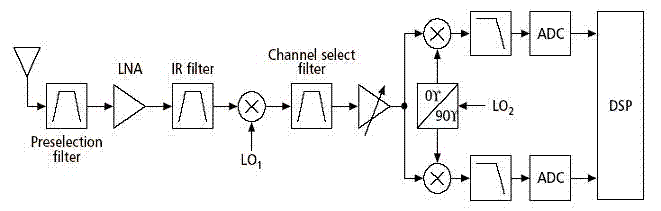
receiver architectures
Various architectures of receivers have been proposed in literature, but the most popular architectures among them, such as Heterodyne, Homodyne, Wideband-IF, and Low-IF, are presented here.
The Heterodyne receiver architecture utilizes two frequencies: the incoming radio frequency (RF) signal and a...

Building a Wireless Temperature Sensor
A wireless temperature sensor allows temperature measurements to be taken anywhere within the range of the transmitter and receiver. One straightforward approach to achieve this is by utilizing a voltage-to-frequency conversion chip in conjunction with an analog temperature sensor, such...

Intelligent home lighting control switch transmitter and receiver circuit
This design aims to create a long-distance wireless remote control switch lighting control system, which consists of a transmission system and a reception system. The system utilizes wireless transceiver modules for RF transmission and reception. The transmitting portion mainly comprises...