


Simple Noise Limiter For Receivers Circuit
#noise limiter
#diode clipper
#receiver
#signal processing
#RF
#noise reduction
#audio processing
#communication

Description: This circuit employs a diode series clipper to limit noise peaks on a received signal. It is most effective in scenarios where several volts peak-to-peak of audio signal are present.
The diode series clipper circuit is designed to protect subsequent stages of a signal processing system from excessive voltage spikes that can occur due to noise or other interference. The circuit typically consists of a pair of diodes arranged in series with the input signal, which allows the circuit to "clip" or limit the amplitude of the incoming signal to a predefined level.
In operation, when the input voltage exceeds the forward voltage drop of the diodes, the diodes conduct and shunt the excess voltage to ground, effectively preventing the output voltage from rising above a certain threshold. This action helps to maintain signal integrity by reducing distortion caused by noise peaks.
The circuit is particularly beneficial in audio applications, where unwanted transients can lead to audible artifacts or damage to sensitive components. The effectiveness of the diode series clipper increases with the amplitude of the input signal; thus, it is best utilized in environments where the audio signal is several volts peak-to-peak.
In practical implementations, it is important to choose diodes with appropriate voltage and current ratings to ensure reliable operation. Additionally, the clipping level can be adjusted by selecting diodes with different forward voltage drops or by configuring the circuit with additional components, such as resistors or capacitors, to tailor the response to specific requirements. This circuit uses a diode series clipper to limit noise peaks on a received signal. It is best used where several volts p-p of audio signal are available.
The diode series clipper circuit is designed to protect subsequent stages of a signal processing system from excessive voltage spikes that can occur due to noise or other interference. The circuit typically consists of a pair of diodes arranged in series with the input signal, which allows the circuit to "clip" or limit the amplitude of the incoming signal to a predefined level.
In operation, when the input voltage exceeds the forward voltage drop of the diodes, the diodes conduct and shunt the excess voltage to ground, effectively preventing the output voltage from rising above a certain threshold. This action helps to maintain signal integrity by reducing distortion caused by noise peaks.
The circuit is particularly beneficial in audio applications, where unwanted transients can lead to audible artifacts or damage to sensitive components. The effectiveness of the diode series clipper increases with the amplitude of the input signal; thus, it is best utilized in environments where the audio signal is several volts peak-to-peak.
In practical implementations, it is important to choose diodes with appropriate voltage and current ratings to ensure reliable operation. Additionally, the clipping level can be adjusted by selecting diodes with different forward voltage drops or by configuring the circuit with additional components, such as resistors or capacitors, to tailor the response to specific requirements. This circuit uses a diode series clipper to limit noise peaks on a received signal. It is best used where several volts p-p of audio signal are available.

RF Actuated Keying Monitor
Sending Morse on a rig without a sidetone is not impossible, but is not particularly pleasant either. This battery-powered monitor has been designed to provide an audible indication of keying for those whose rigs lack a CW sidetone. Its sensor...
Armstrong Oscillator
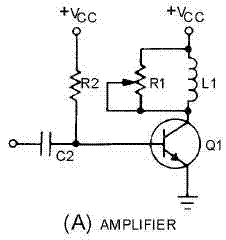
The Armstrong oscillator is utilized to generate a sine-wave output with a constant amplitude and fairly stable frequency within the RF range. It is commonly employed as a local oscillator in receivers, as a source in signal generators, and as...

3-Wire Receiver/Message Demuxer
This 3-wire receiver verifies the initial four data bits of 16 received bits against a predetermined address. If the two match, the remaining 12 bits are stored in two 6-bit flip-flop registers. The design can utilize either CMOS or TTL...

ZS100 Connection Signal
The following circuit illustrates a Noisy Regen Receiver Circuit Diagram. Features include its application in model remote-control systems and its operation as a 27-MHz superheterodyne receiver.
The Noisy Regen Receiver is a type of radio receiver that utilizes regenerative feedback to...
One Receiver
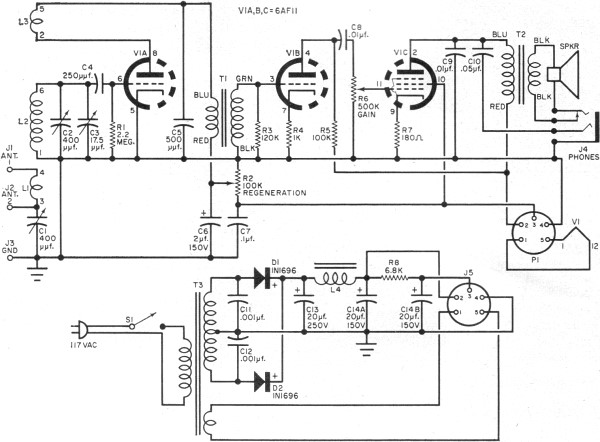
RF Cafe visitor David M. requested the scanning and posting of an article from the January 1963 edition of Popular Electronics, authored by Philip Hatfield from the Receiving Tube Department of General Electric. The article describes a straightforward design utilizing...

100 MHz RF oscillator with ATtiny12
A frequency reference for tuning up the RS-232 to 100 MHz RF desktop channel adapter elsewhere on this site, when I found this Saronix crystal oscillator in my junk box. A few minutes with AVRStudio produced an ATtiny12 to make...

6-17 MHz SW reciever
Its very simple as It uses only 3 transistors 2n2222. The Coils can be altered to change the range of reception by lowering or highering the frequency. More: This circuit is a SW band receiver of range 6 to 17...

RF Induction Meter
This instrument measures inductances from 0.1 microhenry to 3 millihenries, divided into four ranges set by a switch. It operates from 12 volts and is powered by eight AA type cells attached to the unit. Initially, Drew Diamond's unit in...

Radio harmonic detection circuit
The demodulation and detection circuit is a radio AM intermediate frequency (IF) signal amplifier that performs two-stage detection using diode Dr. It extracts the audio signal from the IF carrier detection and subsequently sends it to the power amplifier stage....