


Spy FM Transmitter
#FM transmitter
#crystal oscillator
#Digi-Key Electronics
#frequency customization
#150-165 MHz
#barrel crystal
#CA-301
#wireless transmission
#spy device
#RF circuit

Description: Construct this circuit utilizing a Digi-Key Electronics Barrel Crystal (CA-301) with a frequency of 15 MHz to achieve a standard output frequency of 150.00 MHz. For frequency customization, follow the provided instructions. Typically, this circuit is designed to operate within a frequency range of 150 to 165 MHz. The crystals employed are the Digi-Key Electronics Barrel Crystals CA-301 type, which are relatively inexpensive. This circuit incorporates an X5 multiplier followed by an X2 multiplier in the final stage. For instance, using a 15 MHz Barrel Crystal, the output frequency at Q4 is calculated as: Xtal x 5, resulting in 75 MHz at Q5. Q5 then multiplies 75 MHz by 2, yielding a final output frequency of 150.00 MHz at Q6. Any fundamental crystal within the range of 14 to 17 MHz can produce frequencies between 140 to 170 MHz, provided the crystal has a load capacitance of approximately 18 pF. To create a transmitter at a custom frequency, apply the X5 X2 formula and order a custom cut crystal with an 18 pF load capacitance. A recommended crystal would have a fundamental frequency of 15.825 MHz, a tolerance of 0.001%, and a load capacitance of 18 pF. When tuning the transmitter, the output transmit frequency would be 158.250 MHz. The original circuits mentioned were produced and sold in large quantities to law enforcement agencies, with research and development costs amounting to over a million dollars by current standards.
The circuit design integrates a frequency multiplier approach to achieve the desired output frequency. The initial stage utilizes a 15 MHz crystal oscillator, which serves as the frequency source. The X5 multiplier stage amplifies the fundamental frequency to 75 MHz. This stage typically employs a transistor configured as a common emitter amplifier, which provides the necessary gain while maintaining signal integrity. The output of the first multiplier is then fed into the second stage, the X2 multiplier, which further doubles the frequency to achieve the target output of 150 MHz.
The choice of the Digi-Key Electronics Barrel Crystal CA-301 is crucial due to its stability and low cost. The crystal's specifications, particularly the load capacitance of 18 pF, are essential for ensuring optimal performance of the oscillators and multipliers. The circuit should be designed considering the impedance matching between stages to minimize signal loss and distortion.
The final output stage, Q6, must be configured to handle the amplified frequency while providing the necessary output power for transmission. This may involve additional filtering to remove harmonics and unwanted signals, ensuring compliance with transmission standards. The design should also incorporate proper power supply decoupling and bypassing to maintain stable operation across varying load conditions.
Overall, this circuit exemplifies a practical application of frequency multiplication techniques in RF design, suitable for various communication systems, including those used by law enforcement. The modular approach allows for flexibility in frequency selection, enabling the adaptation of the circuit for different operational requirements.Build this circuit using a Digi-Key Electronics Barrel Crystal (CA-301), 15 Mhz for a standard output frequency of 150. 00 Mhz. If you want to customize the frequency, follow the directions below. I usually build this circuit to operate between 150 to 165 Mhz. The Crystals I use Are The Digi-Key Electronics Barrel Crystals CA-301 Type which cost a couple of bucks per crystal.
This circuit uses a X5 Multiplier and then a X2 Multiplier In the Final. Example: If I use a 15 Mhz Barrel Crystal, the frequency at Q4s output is: Xtal X 5 Or: 75 Mhz into Q5. Q5 Multiplies 75 Mhz X 2 for an end frequency out of the final Q6 ( Desired Output Frequency ) of 150.
00 Mhz. Virtually any Fundamental Crystal between 14 and 17 Mhz will output a frequency of between 140 to 170 Mhz, if the crystal has a load capacitance of around 18 pf. If you wish to build this transmitter on A custom frequency simply use the X5 X2 formula below and order a custom cut crystal specifying an 18 pf CL.
I would order the crystal at a Fundamental frequency of 15. 825 Mhz, tolerance of. 001% and a Crystal Load Capacitance of 18 pf. When I tune my transmitter, my output transmit frequency would be: 158. 250 Mhz. The Original Circuits Below Were Built and Sold - In The Thousands To Law Enforcement. Their Original Research and Development Cost, By Today`s Standards, Would Total - Well Over A Million Dollars.
The circuit design integrates a frequency multiplier approach to achieve the desired output frequency. The initial stage utilizes a 15 MHz crystal oscillator, which serves as the frequency source. The X5 multiplier stage amplifies the fundamental frequency to 75 MHz. This stage typically employs a transistor configured as a common emitter amplifier, which provides the necessary gain while maintaining signal integrity. The output of the first multiplier is then fed into the second stage, the X2 multiplier, which further doubles the frequency to achieve the target output of 150 MHz.
The choice of the Digi-Key Electronics Barrel Crystal CA-301 is crucial due to its stability and low cost. The crystal's specifications, particularly the load capacitance of 18 pF, are essential for ensuring optimal performance of the oscillators and multipliers. The circuit should be designed considering the impedance matching between stages to minimize signal loss and distortion.
The final output stage, Q6, must be configured to handle the amplified frequency while providing the necessary output power for transmission. This may involve additional filtering to remove harmonics and unwanted signals, ensuring compliance with transmission standards. The design should also incorporate proper power supply decoupling and bypassing to maintain stable operation across varying load conditions.
Overall, this circuit exemplifies a practical application of frequency multiplication techniques in RF design, suitable for various communication systems, including those used by law enforcement. The modular approach allows for flexibility in frequency selection, enabling the adaptation of the circuit for different operational requirements.Build this circuit using a Digi-Key Electronics Barrel Crystal (CA-301), 15 Mhz for a standard output frequency of 150. 00 Mhz. If you want to customize the frequency, follow the directions below. I usually build this circuit to operate between 150 to 165 Mhz. The Crystals I use Are The Digi-Key Electronics Barrel Crystals CA-301 Type which cost a couple of bucks per crystal.
This circuit uses a X5 Multiplier and then a X2 Multiplier In the Final. Example: If I use a 15 Mhz Barrel Crystal, the frequency at Q4s output is: Xtal X 5 Or: 75 Mhz into Q5. Q5 Multiplies 75 Mhz X 2 for an end frequency out of the final Q6 ( Desired Output Frequency ) of 150.
00 Mhz. Virtually any Fundamental Crystal between 14 and 17 Mhz will output a frequency of between 140 to 170 Mhz, if the crystal has a load capacitance of around 18 pf. If you wish to build this transmitter on A custom frequency simply use the X5 X2 formula below and order a custom cut crystal specifying an 18 pf CL.
I would order the crystal at a Fundamental frequency of 15. 825 Mhz, tolerance of. 001% and a Crystal Load Capacitance of 18 pf. When I tune my transmitter, my output transmit frequency would be: 158. 250 Mhz. The Original Circuits Below Were Built and Sold - In The Thousands To Law Enforcement. Their Original Research and Development Cost, By Today`s Standards, Would Total - Well Over A Million Dollars.

Stereo FM transmitter using BA1404
A high-quality stereo FM transmitter circuit is presented. This circuit utilizes the BA1404 integrated circuit from ROHM Semiconductors. The BA1404 is a monolithic FM stereo modulator that incorporates a stereo modulator, FM modulator, and RF amplifier circuitry. The FM modulator...

Coil-less FM Transmitter
The RF oscillator using the inverter N2 and 10.7MHz ceramic filter is driving the parallel combination of N4 to N6 through N3. Since these inverters are in parallel, the output impedance will be low so that it can directly drive...

FM transmitter microphone
An operational amplifier integrated circuit (741) amplifies the audio signal from microphone MIC1, with resistor R12 adjusting its gain. The amplified audio is directed to the oscillator circuit, which includes transistor Q1 and associated components. D2 is a varactor diode,...

Long Range FM Transmitter
The power output of many transmitter circuits is low due to the absence of power amplifier stages. The transmitter circuit presented here includes an additional RF power amplifier stage after the oscillator stage, which elevates the power output to 200-250...
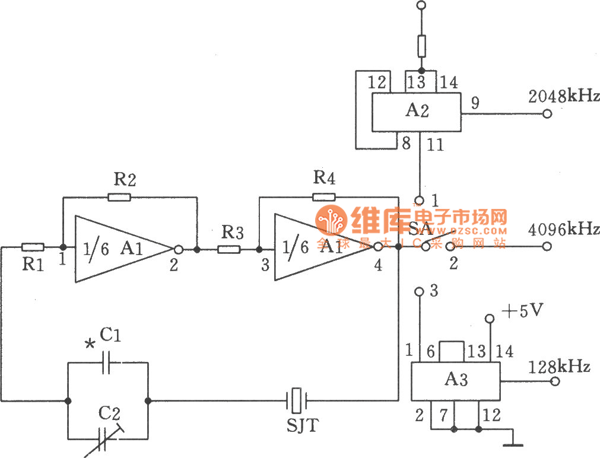
Mutiple Output Crystal Oscillator Sensor
The figure illustrates a multiple output crystal oscillator, which primarily consists of three gates of Al, four resistors, two capacitors, and a crystal. Resistors R1 to R4 offset two inverters within the linear range and are connected between pin 4...

Integrated-am-receiver
A crystal oscillator is used so that a narrow-band hybrid IF filter can be utilized. This circuit includes aerial and local oscillator circuits for a 27-MHz receiver, intended for the remote control of garage doors, projectors, curtains, and similar applications.
The...

Crystal-controlled signal source
This general-purpose signal source is highly effective for signal-tracing applications. The output level is adjustable, exceeding 1 Vrms into a 50 Ω load. It is compatible with nearly any crystal in the 1 to 15 MHz frequency range. Q1 operates...

Simple FM Transmitter Bug
This is a simple design of a small FM transmitter bug that is ideal for transmitting and eavesdropping purposes. Due to its high sensitivity, it can even pick up the ticking of a clock. The estimated range is approximately 50...

Crystal oscillator circuit diagram of a compatible IC
Temperature-stable resistors R1 and R2 are used in NAND gate configurations, ensuring that the switches operate in the linear region. Capacitor C1 functions as a DC component at the operating frequencies. Additionally, the impedance must remain below 0.1 ohm. The...