


device Cheapest way to build or buy a remote controlled sound maker
#sound maker
#remote control
#programmable
#timed activation
#cheap
#DIY
#audio
#scheduler
#low-cost
#automation

Description: A more affordable method to create or purchase a device that offers similar functionality. It does not necessarily need to be remote-controlled if it can be programmed to activate at specific times.
This description suggests the development of a cost-effective electronic device that can perform tasks typically associated with more expensive alternatives. The device's functionality may include automation features, allowing it to operate independently based on pre-set schedules rather than requiring remote control.
For example, consider a programmable timer circuit that can control various appliances or systems. The circuit could incorporate a microcontroller, such as an Arduino or a PIC, which would allow users to input specific time settings for activation. The microcontroller can drive a relay module to handle higher voltage appliances, making it suitable for a range of applications, from turning lights on and off to controlling small motors.
The schematic for such a device would include the following components:
1. **Microcontroller**: The central unit that executes programmed instructions. It should be selected based on the required input/output pins and processing power.
2. **Real-Time Clock (RTC)**: This component keeps track of the current time, allowing the microcontroller to trigger actions at the specified times. Modules like the DS3231 can provide high accuracy.
3. **Relay Module**: Used to switch high voltage loads. The relay can be controlled by the microcontroller, allowing it to turn devices on or off based on the programmed schedule.
4. **Power Supply**: Ensures that the microcontroller and other components receive the necessary voltage and current. A regulated power supply would be essential for consistent operation.
5. **User Interface**: This could be a simple keypad and LCD display that allows users to set the time and configure other settings easily.
6. **Protection Components**: Diodes for flyback protection across the relay coils, fuses for overcurrent protection, and capacitors for voltage smoothing.
The overall design should prioritize safety, especially when dealing with high voltage circuits, and ensure that the user interface is intuitive for ease of programming. This approach not only reduces costs but also provides flexibility in functionality, catering to various user needs without the complexities associated with remote-controlled devices.A cheaper way to build or buy something with similar functionality It doesn`t necessarily even need to be remote controlled if it could be programmed to go off at certain times.
This description suggests the development of a cost-effective electronic device that can perform tasks typically associated with more expensive alternatives. The device's functionality may include automation features, allowing it to operate independently based on pre-set schedules rather than requiring remote control.
For example, consider a programmable timer circuit that can control various appliances or systems. The circuit could incorporate a microcontroller, such as an Arduino or a PIC, which would allow users to input specific time settings for activation. The microcontroller can drive a relay module to handle higher voltage appliances, making it suitable for a range of applications, from turning lights on and off to controlling small motors.
The schematic for such a device would include the following components:
1. **Microcontroller**: The central unit that executes programmed instructions. It should be selected based on the required input/output pins and processing power.
2. **Real-Time Clock (RTC)**: This component keeps track of the current time, allowing the microcontroller to trigger actions at the specified times. Modules like the DS3231 can provide high accuracy.
3. **Relay Module**: Used to switch high voltage loads. The relay can be controlled by the microcontroller, allowing it to turn devices on or off based on the programmed schedule.
4. **Power Supply**: Ensures that the microcontroller and other components receive the necessary voltage and current. A regulated power supply would be essential for consistent operation.
5. **User Interface**: This could be a simple keypad and LCD display that allows users to set the time and configure other settings easily.
6. **Protection Components**: Diodes for flyback protection across the relay coils, fuses for overcurrent protection, and capacitors for voltage smoothing.
The overall design should prioritize safety, especially when dealing with high voltage circuits, and ensure that the user interface is intuitive for ease of programming. This approach not only reduces costs but also provides flexibility in functionality, catering to various user needs without the complexities associated with remote-controlled devices.A cheaper way to build or buy something with similar functionality It doesn`t necessarily even need to be remote controlled if it could be programmed to go off at certain times.
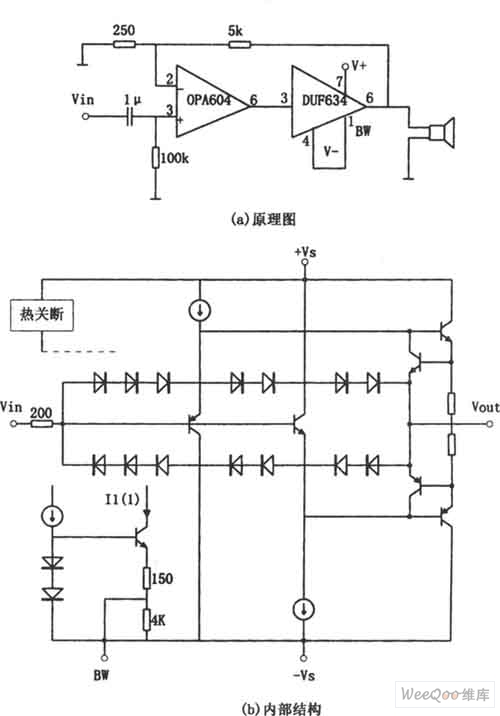
OPA604 High Performance and Small Power Audio Amplifier
The provided image depicts a high-performance and low-power audio power amplifier circuit. The initial stage utilizes the MOSFET hi-fi operational amplifier OPA604, while the subsequent stage employs the high-speed buffer BUF634. Voltage series negative feedback is implemented between the two...

Packard Bell Remote Control
When a key is pressed, the remote control transmits a preamble followed by 32 bits of information encoded using specific pulse timings. The pulse examples can be observed in logic analyzer screen captures, although some glitches are present due to...

Audio/Video Switcher
This circuit is a two-channel baseband video switcher. Buffer amplifiers U1/Q1, U4/Q4, and associated components produce a buffered 75-ohm video signal, which is routed to the switching network K1/K2/K3. Relay K1 selects either of the two video amplifiers and feeds...
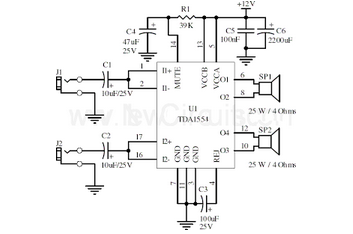
22W Stereo Amplifier Using TDA1554
This document presents a 22-watt stereo audio power amplifier circuit diagram based on the TDA1554 integrated circuit from NXP Semiconductors (formerly Philips Semiconductors).
The 22-watt stereo audio power amplifier circuit utilizing the TDA1554 IC is designed to deliver high-quality audio amplification...

Variable_audio_oscillator_with_a_range_of_20_hertz_to_20_kilohertz
A variable audio oscillator operates within a frequency range of 20 hertz to 20 kilohertz. The circuit utilizes an Intersil 8038 waveform generator, which is designed in a 14-pin dual in-line package (DIP).
The variable audio oscillator circuit is designed to...

Fast Audio Peak Limiter
The circuit devised by Phil Allison still has some input voltage limitations, since it is based on a FET. Junction FET VCAs also create considerable distortion, with the worst of it appearing when the signal is attenuated by 6dB. The...

stk415 090e 2x50 watt stereo
This electronic project stereo amplifier is based on the STK415-090-E class H audio power amplifier hybrid integrated circuit (IC), which includes a built-in power supply switching circuit. The STK415-090-E class H audio power amplifier achieves high efficiency in audio power...

HA13118 IC For 18W Car Stereo Amplifier
This is a Class AB audio power amplifier utilizing the Hitachi HA13118 module, suitable for car applications. It can also be used in various other settings.
The Class AB audio power amplifier is designed to deliver high-quality sound reproduction while maintaining...

Accident Prevention and Security System for Automobiles
This is a remote-controlled land rover that can be operated using a cell phone. This allows the user to move the land rover by sending various commands from their device. The rover can be controlled from virtually anywhere in the...