


Remote control for lamp or appliance
#triac
#transformer
#switch
#resistor
#load control
#6V
#filament transformer
#magnetizing current
#shunting resistor

Description: The circuit utilizes the primary current of a small 6-volt filament transformer to control a triac and activate the load. When switch S1 in the 6-volt secondary of the transformer is open, a small "magnetizing" current flows through the primary winding. This magnetizing current may be sufficient to trigger the triac. Consequently, a shunting resistor, R1, is necessary to prevent such triggering. R1 is adjusted to the highest resistance that will not cause the triac to trigger with S1 open. When the single-pole remote switch S1 closes, the secondary of the transformer is shorted, allowing a high current to flow through the 120-volt primary. This action triggers the triac and energizes the load. Once the triac conducts, the current through the primary ceases, preventing damage to the transformer.
The circuit design employs a small 6-volt filament transformer, which serves as the primary power source for the triac control mechanism. The transformer’s primary winding is connected to a 120-volt AC supply, while the secondary winding is connected to a switch (S1) that controls the load. The triac is a semiconductor device that can control high voltages and currents, allowing for efficient management of the load.
In the quiescent state, with switch S1 open, the circuit experiences a magnetizing current that flows through the primary winding of the transformer. This current, although small, has the potential to unintentionally trigger the triac. To mitigate this risk, a shunting resistor (R1) is incorporated into the circuit. The value of R1 is critical; it must be set to the maximum resistance that prevents the triac from triggering while S1 is in the open position. This ensures that the triac remains off until the switch is intentionally closed.
Upon closing switch S1, the secondary winding of the transformer is effectively shorted, resulting in a significant increase in current flowing through the primary winding. This surge in current is sufficient to trigger the triac, switching it into a conducting state. As the triac turns on, it allows current to flow to the load, thereby energizing it. The triac remains in this conducting state as long as there is sufficient current flowing through it.
A critical feature of this design is that once the triac is triggered and begins conducting, it effectively interrupts the magnetizing current from the transformer’s primary winding. This self-regulating mechanism prevents the transformer from overheating or sustaining damage due to continuous current flow. The circuit thus provides a reliable means of controlling a load using a low-voltage control signal while protecting the transformer from potential failure modes.
Overall, this circuit exemplifies effective use of a triac for load control, employing a transformer and a strategically placed resistor to manage triggering conditions, ensuring safe and reliable operation.The circuit uses the primary current of a small 6 volt filament transformer to actuate a triac and energize the load. When switch Si, in the six-volt secondary, of the transformer is open, a small "magnetizing" current flows through the primary winding.
This magnetizing current may be large enough to trigger the triac. Therefore, a shunting resistor, Rl, is required to prevent such triggering. Rl, is adjusted for the highest resistance that will not cause theitriac to trigger with SI open When single-pole remote switch, SI, closes, the secondary of the transformer is shorted and a high current flows through the 120-volt primary. This triggers the triac and energizes the load. When the triac conducts, current through the primary stops and thus prevents burning out the transformer.
The circuit design employs a small 6-volt filament transformer, which serves as the primary power source for the triac control mechanism. The transformer’s primary winding is connected to a 120-volt AC supply, while the secondary winding is connected to a switch (S1) that controls the load. The triac is a semiconductor device that can control high voltages and currents, allowing for efficient management of the load.
In the quiescent state, with switch S1 open, the circuit experiences a magnetizing current that flows through the primary winding of the transformer. This current, although small, has the potential to unintentionally trigger the triac. To mitigate this risk, a shunting resistor (R1) is incorporated into the circuit. The value of R1 is critical; it must be set to the maximum resistance that prevents the triac from triggering while S1 is in the open position. This ensures that the triac remains off until the switch is intentionally closed.
Upon closing switch S1, the secondary winding of the transformer is effectively shorted, resulting in a significant increase in current flowing through the primary winding. This surge in current is sufficient to trigger the triac, switching it into a conducting state. As the triac turns on, it allows current to flow to the load, thereby energizing it. The triac remains in this conducting state as long as there is sufficient current flowing through it.
A critical feature of this design is that once the triac is triggered and begins conducting, it effectively interrupts the magnetizing current from the transformer’s primary winding. This self-regulating mechanism prevents the transformer from overheating or sustaining damage due to continuous current flow. The circuit thus provides a reliable means of controlling a load using a low-voltage control signal while protecting the transformer from potential failure modes.
Overall, this circuit exemplifies effective use of a triac for load control, employing a transformer and a strategically placed resistor to manage triggering conditions, ensuring safe and reliable operation.The circuit uses the primary current of a small 6 volt filament transformer to actuate a triac and energize the load. When switch Si, in the six-volt secondary, of the transformer is open, a small "magnetizing" current flows through the primary winding.
This magnetizing current may be large enough to trigger the triac. Therefore, a shunting resistor, Rl, is required to prevent such triggering. Rl, is adjusted for the highest resistance that will not cause theitriac to trigger with SI open When single-pole remote switch, SI, closes, the secondary of the transformer is shorted and a high current flows through the 120-volt primary. This triggers the triac and energizes the load. When the triac conducts, current through the primary stops and thus prevents burning out the transformer.

kermit
The neighbor's drill charger ceased functioning, and it was discovered that the primary wires in the transformer were defective. The charger featured a straightforward design, comprising a transformer, a diode bridge, and a larger resistor. It was rated to deliver...

Triac low output problem
The circuit consists of two separate 3023 optoisolators controlling two distinct triacs, each responsible for powering a large 3-phase contactor. One contactor operates correctly, while the other experiences issues, not receiving sufficient power to engage fully. The upper image illustrates...

Time Delay Switch with Triac
This time delay switch circuit is designed to activate an AC load, such as lamps, after a delay of three minutes. It helps protect the load from inrush currents and transients during power-on, which can potentially harm the device. The...

Simple Power Supply Circuit easy to make Schematic Diagram
Initially, voltage from AC 220V or 110V enters the transformer, which reduces it to 12V AC. This AC voltage is then rectified using either four diodes or a bridge rectifier to convert it to DC voltage. The resulting DC voltage...
START UP CONTROL
A bidirectional three-layer trigger for a triac allows triggering on both half-cycles, with the activation point determined by a 1-megohm potentiometer setting. The triac's rating dictates the load size it can manage. This circuit combines two functions: it serves as...

ac TRIAC dimmer circuit design help (resistive load)
A light-dimming control system is being developed for a 240V heat lamp with a power dissipation of approximately 250W. The objective is to adjust the heat output of the lamp using control from a microprocessor. The development is based on...

The Simplest Car Battery Charger
This very simple circuit uses a transformer, two diodes, a capacitor, and an ammeter. To charge a battery, just connect the + and - terminals of the circuit to the corresponding terminals of the battery. When the battery is not...

Triac Applications
Next to SCR, the triac is the second most commonly used component in the thyristor family. It has largely replaced SCR in many control applications due to its bidirectional conductivity. Key applications include motor speed regulation, temperature control, illumination control,...
Triple Power Supply
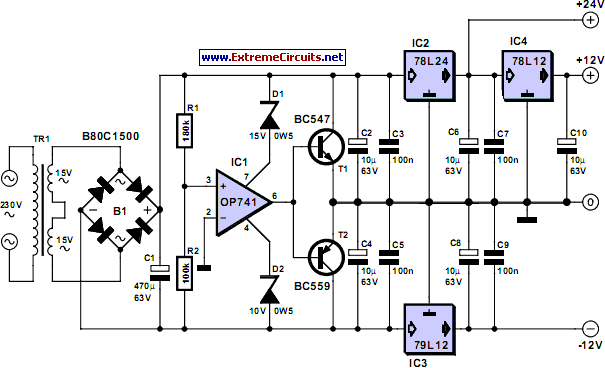
Inexpensive miniature transformers typically provide one or two secondary voltages, which are sufficient for generating a set of positive and negative supply voltages, as required for operational amplifier circuits. However, if an additional voltage higher than either of the supply...