


Remote-Control Tester Circuit
#IR tester
#remote control
#infrared
#testing circuit
#signal detector
#electronics testing
#DIY electronics
#IR receiver
#button tester

Description: The IR Tester circuit indicates whether the button pressed on a remote control is functioning. Q1 is a phototransistor that is activated by infrared (IR) energy.
The IR Tester circuit operates by detecting infrared signals emitted by remote control devices when a button is pressed. The core component, Q1, is a phototransistor that responds to these IR signals by changing its conductivity. When IR light from the remote control reaches Q1, it generates a current flow through the phototransistor, which can be used to trigger an output indication, such as an LED or a buzzer.
In a typical configuration, the circuit may include a power supply, a resistor for current limiting, and an output device. The power supply can be a battery or any suitable DC source, providing the necessary voltage for the circuit operation. The resistor is connected in series with Q1 to ensure that the current flowing through the phototransistor remains within safe limits, preventing damage and ensuring reliable operation.
The output device, often an LED, is connected to indicate the presence of IR signals. When the remote control button is pressed, and the phototransistor is activated by the IR light, the LED will illuminate, providing a visual confirmation that the remote control is functioning correctly. In some designs, a buzzer may be used instead of an LED for audible feedback.
The circuit can be further enhanced by adding a variable resistor (potentiometer) to adjust the sensitivity of the phototransistor, allowing it to detect IR signals from various remote controls with different output power levels. Additionally, the circuit may include a small capacitor to filter any noise from the detected signal, ensuring that only valid IR signals trigger the output indication.
This simple yet effective design is useful for troubleshooting remote control devices and ensuring that they are operational, making it an essential tool for electronics enthusiasts and technicians. The IR Tester circuit lets you know if the button you press on a remote control is working. Ql is a photo transistor that is activated by IR energy.
The IR Tester circuit operates by detecting infrared signals emitted by remote control devices when a button is pressed. The core component, Q1, is a phototransistor that responds to these IR signals by changing its conductivity. When IR light from the remote control reaches Q1, it generates a current flow through the phototransistor, which can be used to trigger an output indication, such as an LED or a buzzer.
In a typical configuration, the circuit may include a power supply, a resistor for current limiting, and an output device. The power supply can be a battery or any suitable DC source, providing the necessary voltage for the circuit operation. The resistor is connected in series with Q1 to ensure that the current flowing through the phototransistor remains within safe limits, preventing damage and ensuring reliable operation.
The output device, often an LED, is connected to indicate the presence of IR signals. When the remote control button is pressed, and the phototransistor is activated by the IR light, the LED will illuminate, providing a visual confirmation that the remote control is functioning correctly. In some designs, a buzzer may be used instead of an LED for audible feedback.
The circuit can be further enhanced by adding a variable resistor (potentiometer) to adjust the sensitivity of the phototransistor, allowing it to detect IR signals from various remote controls with different output power levels. Additionally, the circuit may include a small capacitor to filter any noise from the detected signal, ensuring that only valid IR signals trigger the output indication.
This simple yet effective design is useful for troubleshooting remote control devices and ensuring that they are operational, making it an essential tool for electronics enthusiasts and technicians. The IR Tester circuit lets you know if the button you press on a remote control is working. Ql is a photo transistor that is activated by IR energy.

Remote Control Tester
Remote control tester circuit diagram. The tester is designed around the infrared receiver module TSOP1738. The operation of the remote control is indicated by a tone from the buzzer. The circuit is sensitive and has a range of about 5...

remote control receiver circuit
The circuit consists of an infrared transmitter-receiver pair that uses infrared beam transmission to switch the toy car on or off. It can be modified to allow the toy car to turn left or right. To operate the toy car,...
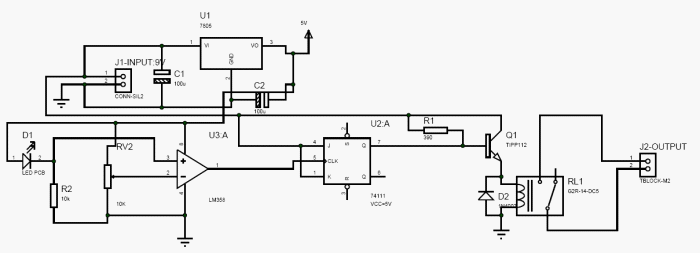
Infrared Light Controled Switch
This circuit is a simple remote-controlled relay capable of switching lamps or other devices. D1 can be a phototransistor, LDR, or an infrared transistor. The circuit is controlled using an IR remote, similar to a TV remote control, when the...

PC Infrared Receiver
This is the latest version of the Improved Infrared Receiver with Status LED which can control any desktop PC with an ordinary remote control. The project comes along with a small PCB in order to save space. It connects to...

Sending Data Over IR Wireless Infrared Communication Link System
The fundamental theory behind infrared technology necessary for this tutorial was previously covered in the Infrared Receiver tutorial, so a concise overview will be provided here. The explanation will begin with a general description of infrared and its relevance in...

Sp6691 Remote Control 100khz Infrared Led Driver
Loop stability analysis typically begins with an open-loop Bode plot of the system being examined, such as the power stage of a buck or flyback converter. This plot allows the designer to extract phase and gain information within the desired...
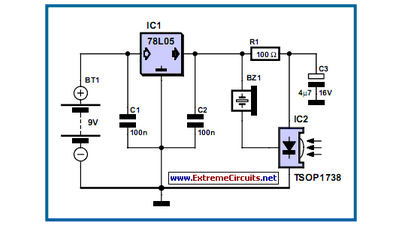
IR Remote Control Tester
This compact circuit is designed to verify the basic functionality of an infrared remote control unit. It operates on the straightforward principle of connecting a piezo buzzer directly to an infrared (IR) receiver integrated circuit (IC). This approach is nearly...

infrared remote for toy car motor
This add-on circuit enables remote switching on and off of battery-operated toy cars using a TV or video remote control handset that operates at 30 to 40 kHz. When powered by a 6V battery, the decade counter CD4017 (IC2), configured...

How to make a Simple Infra Red Remote Control Circuit
Controlling household electrical gadgets or any electrical equipment remotely can be enjoyable. While using a remote to control devices like a TV or DVD player is a common experience, managing other domestic appliances such as water pumps and lights typically...