


1-Wire Barometer
#1-Wire
#barometer
#Dallas Semiconductor
#pressure sensor
#calibration
#measurement
#weather station
#sensor network

Description: Construction of a 1-Wire Barometer. This page shows the circuit and provides construction and calibration details. This barometer connects to a Dallas Semiconductor 1-Wire network.
The 1-Wire Barometer is designed to measure atmospheric pressure and transmit this data over a 1-Wire network, which is commonly used for sensor applications due to its simplicity and low wiring requirements. The circuit typically includes a pressure sensor, a microcontroller, and the necessary interfacing components to ensure compatibility with the 1-Wire protocol.
The pressure sensor, often a piezoresistive or capacitive type, converts the atmospheric pressure into a proportional electrical signal. This signal is then processed by a microcontroller, which performs analog-to-digital conversion to obtain a digital representation of the pressure reading. The microcontroller also manages the communication over the 1-Wire network, sending the pressure data to a central controller or display unit.
Construction details include the selection of appropriate components, such as the microcontroller (often from the Microchip or Atmel families), and the pressure sensor, which should be chosen based on the desired pressure range and accuracy. The circuit design must ensure proper power supply decoupling and include pull-up resistors on the 1-Wire bus to maintain signal integrity.
Calibration of the barometer is essential for accurate readings. This process involves comparing the sensor output against known pressure standards and adjusting the software algorithms in the microcontroller to compensate for any deviations. Calibration may also involve temperature compensation, as temperature variations can affect sensor readings.
This 1-Wire Barometer can be integrated into larger environmental monitoring systems, allowing for remote data collection and analysis, making it suitable for applications in meteorology, agriculture, and HVAC systems.Construction of a 1-Wire Barometer. This page shows the circuit, and gives construction and calibration details. This barometer connects to a Dallas Semiconductor 1-Wire network.
The 1-Wire Barometer is designed to measure atmospheric pressure and transmit this data over a 1-Wire network, which is commonly used for sensor applications due to its simplicity and low wiring requirements. The circuit typically includes a pressure sensor, a microcontroller, and the necessary interfacing components to ensure compatibility with the 1-Wire protocol.
The pressure sensor, often a piezoresistive or capacitive type, converts the atmospheric pressure into a proportional electrical signal. This signal is then processed by a microcontroller, which performs analog-to-digital conversion to obtain a digital representation of the pressure reading. The microcontroller also manages the communication over the 1-Wire network, sending the pressure data to a central controller or display unit.
Construction details include the selection of appropriate components, such as the microcontroller (often from the Microchip or Atmel families), and the pressure sensor, which should be chosen based on the desired pressure range and accuracy. The circuit design must ensure proper power supply decoupling and include pull-up resistors on the 1-Wire bus to maintain signal integrity.
Calibration of the barometer is essential for accurate readings. This process involves comparing the sensor output against known pressure standards and adjusting the software algorithms in the microcontroller to compensate for any deviations. Calibration may also involve temperature compensation, as temperature variations can affect sensor readings.
This 1-Wire Barometer can be integrated into larger environmental monitoring systems, allowing for remote data collection and analysis, making it suitable for applications in meteorology, agriculture, and HVAC systems.Construction of a 1-Wire Barometer. This page shows the circuit, and gives construction and calibration details. This barometer connects to a Dallas Semiconductor 1-Wire network.

Bridge the digital pressure signal conditioner MAX1458 excitation circuit diagram
The excitation circuit for the digital pressure signal conditioner MAX1458 is illustrated. The output DAC3 is utilized to adjust the sensor excitation current (IBR), enabling full-scale fine calibration. The reference current (IISRC) is determined by the resistor RISRC and the...

pressure sensor circuit
A dance pad consists of four pressure sensors (up, down, left, right). A USB controller has already been created for the dance pad, and the next step involves connecting the actual sensors. The intention is to pull the input down...

Pressure Sensor Alarm Circuit Schematic
The simple pressure sensor alarm is constructed using a few inexpensive and readily available components. The operation of this circuit is straightforward and self-explanatory. When powered by a 9V compact battery, the active piezo sounder at the output of IC1...

electronic torricelli barometer
While it may lack the aesthetic appeal of traditional mercury barometers featuring elongated glass tubes mounted on intricately carved wooden bases, the Torricelli barometer described here serves as a functional equivalent and electronic replica of the original Torricelli barometer. Instead...

Weather station
This 1-Wire MicroLAN uses a capacitor and diode half-wave rectifier to provide parasitic power from the data line for the station's various sensors and to transfer data. Each sensor has a unique serial number that identifies it to the bus....

Pressure Sensor Signal Conditioning Circuit with Single Op-Amp
This is a pressure sensor signal conditioning circuit. It is a simple and inexpensive circuit due to its small geometry and the use of a straightforward pressure sensor.
The pressure sensor signal conditioning circuit is designed to convert the raw output...

Digital-ProfiLab 4.0
Digital-ProfiLab was designed for measurement and control applications, combining features like circuit and logic simulation, front panel design, and hardware control to one powerful tool. Incoming signals from external devices may be processed and displayed. A circuit editor is used...

Digital Altimeter Circuit
A pressure sensor (IC4) is utilized in conjunction with a DC amplifier to convert the bridge output from IC4 into a single-ended voltage. IC1 provides a reference voltage for setting the barometric pressure. IC3 is an A/D converter produced by...
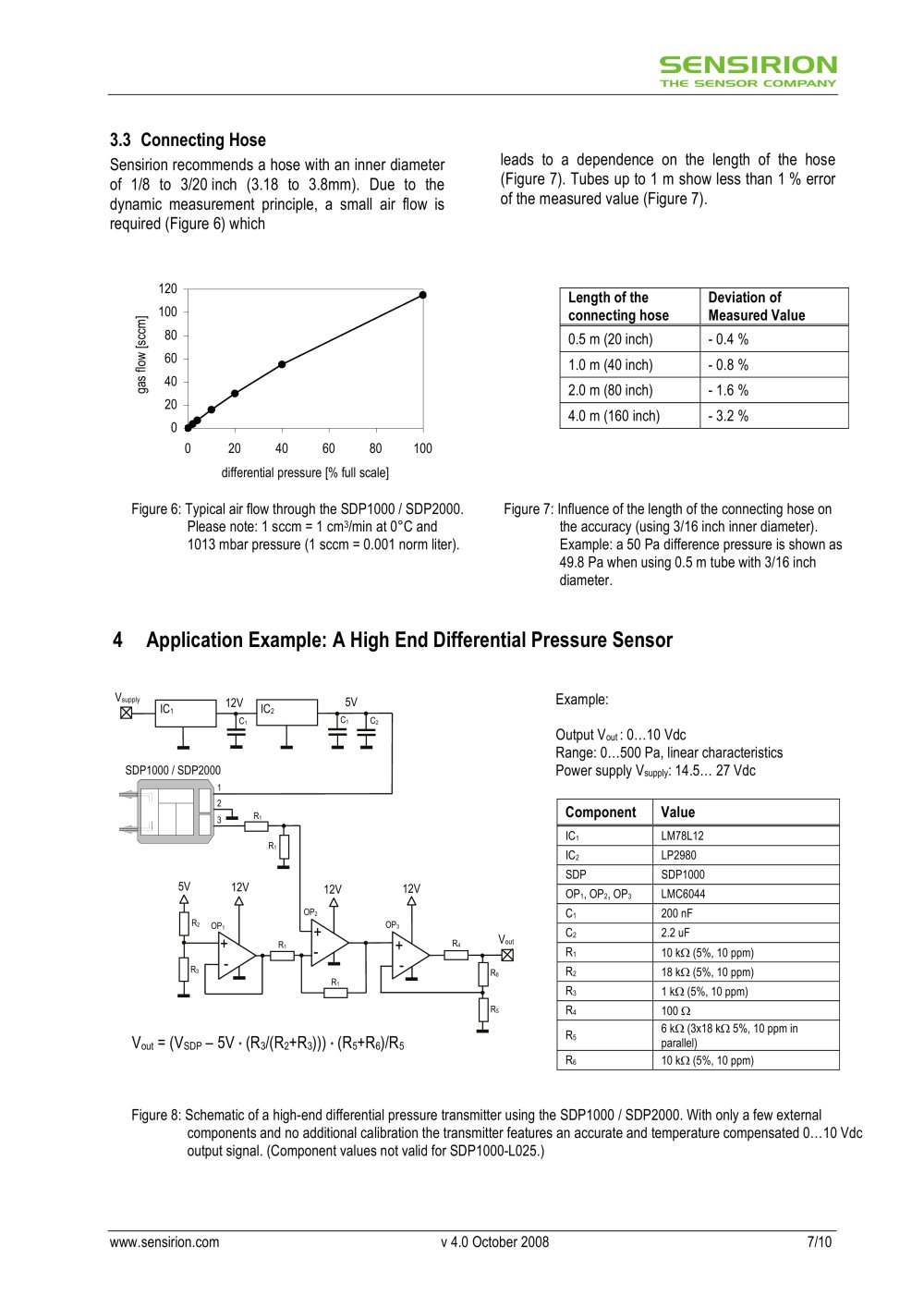
differential pressure sensor sdp1000
Consult Sensirion's entire datasheet for the Differential Pressure Sensor SDP1000/2000 catalogue on DirectIndustry. Page: 7/10.
The Sensirion SDP1000/2000 series of differential pressure sensors are designed for precise measurement of pressure differences in various applications. These sensors utilize a MEMS (Micro-Electro-Mechanical Systems)...