


3V Water-Level Detector

Description: This circuit was originally designed to detect low water levels in a Christmas tree stand, but it can also be utilized as a water-level detector for pump controls and water sensors in garden and lawn applications. It employs a comparator and probe configuration using a Linear Technology LTC1040CN comparator to drive a 2N3906 transistor, which activates a tone generator. The circuit samples every 20 seconds to minimize current consumption, allowing a pair of dry cells to power the system for several months.
The circuit is fundamentally based on a water-level sensing mechanism that employs a comparator to evaluate the voltage levels from the probes immersed in water. The LTC1040CN comparator is chosen for its low power consumption and high precision, making it suitable for battery-operated applications. The probes, typically made of conductive materials, are positioned at predetermined levels within the water container. When the water level drops below a certain threshold, the resistance changes, leading to a voltage drop at the comparator's input.
The output from the LTC1040CN comparator is connected to the base of a 2N3906 transistor. The transistor acts as a switch, controlling the tone generator circuit. When the comparator detects a low water condition, it sends a signal to turn on the transistor, which in turn activates the tone generator. This generates an audible alert, notifying users of the low water condition.
To enhance the circuit's efficiency, the sampling rate is set to every 20 seconds. This interval is specifically chosen to strike a balance between timely detection of low water levels and conserving battery life. The use of dry cells as the power source ensures that the circuit can operate for an extended period, potentially lasting several months before requiring a battery replacement.
In summary, this versatile circuit design not only serves its original purpose of monitoring water levels in a Christmas tree stand but also finds applications in various domains where water-level detection is crucial. Its low power consumption, combined with reliable performance, makes it an excellent choice for both hobbyist projects and practical implementations in irrigation systems and pump control applications. Originally, this circuit was used to sense a low-water level in a Christmas tree stand, but the circuit can be use d as a water-level detector for pump controls, water sensors (for garden and lawn applications), etc. A comparator and probe setup with a Linear Technology LTC1040CN comparator drives a 2N3906, which switches a tone generator.
Sampling occurs every 20 seconds, which minimizes current drain. A pair of dry cells will power the circuit for several months.
The circuit is fundamentally based on a water-level sensing mechanism that employs a comparator to evaluate the voltage levels from the probes immersed in water. The LTC1040CN comparator is chosen for its low power consumption and high precision, making it suitable for battery-operated applications. The probes, typically made of conductive materials, are positioned at predetermined levels within the water container. When the water level drops below a certain threshold, the resistance changes, leading to a voltage drop at the comparator's input.
The output from the LTC1040CN comparator is connected to the base of a 2N3906 transistor. The transistor acts as a switch, controlling the tone generator circuit. When the comparator detects a low water condition, it sends a signal to turn on the transistor, which in turn activates the tone generator. This generates an audible alert, notifying users of the low water condition.
To enhance the circuit's efficiency, the sampling rate is set to every 20 seconds. This interval is specifically chosen to strike a balance between timely detection of low water levels and conserving battery life. The use of dry cells as the power source ensures that the circuit can operate for an extended period, potentially lasting several months before requiring a battery replacement.
In summary, this versatile circuit design not only serves its original purpose of monitoring water levels in a Christmas tree stand but also finds applications in various domains where water-level detection is crucial. Its low power consumption, combined with reliable performance, makes it an excellent choice for both hobbyist projects and practical implementations in irrigation systems and pump control applications. Originally, this circuit was used to sense a low-water level in a Christmas tree stand, but the circuit can be use d as a water-level detector for pump controls, water sensors (for garden and lawn applications), etc. A comparator and probe setup with a Linear Technology LTC1040CN comparator drives a 2N3906, which switches a tone generator.
Sampling occurs every 20 seconds, which minimizes current drain. A pair of dry cells will power the circuit for several months.

Wire Break Sensor Alarm Circuit Schematic
The circuit of a loop sensor-based simple security alarm is described here. The sensor loop consists of a short length of thin enamelled copper wire.
The loop sensor security alarm operates on the principle of detecting interruptions in the circuit formed...

Water-Level Control
This circuit powers a water pump when the water reaches a predetermined level and turns off when the water recedes to another predetermined point. Gates U1A through U1C have their two inputs tied together and serve as probes placed at...

Automatic Room light Control With Bi Directional Visitor Counter
The objective of this project is to create a controller-based model that counts the number of individuals entering a specific room and activates the lighting accordingly. This is achieved through the use of sensors that detect the current number of...

Detector And Controller
Many applications require analog signals to be sensed and digital signals to be controlled. A way to detect these points is by using a 555 timer in an unconventional configuration. This method will also add hysteresis to the circuit and...

Water-level sensing control circuit
The circuit supplies power to the load until water conducts through the probe, allowing gate current to bypass from the low current SCR. This configuration provides an isolated low voltage probe to meet safety requirements.
The described circuit operates as a...

3V Power Supply For Portable Radios
Most small portable radios require a 3-V supply, which is typically provided by two AA or AAA batteries. Many of these radios are equipped with a charger socket since rechargeable batteries are an option. When used in a stationary setting,...

Cat / Dog Detector
This can be used to control entry on a Cat or Dog Door. NOTE: There may be some changes and improvements coming. However, this circuit does work and you can build it as shown. The PCB shown below is available...
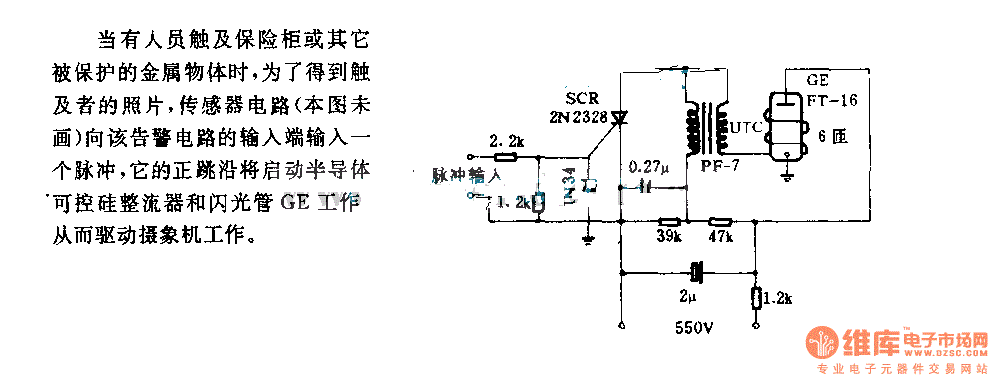
The alarm circuit diagram for safety box and other metal objects
When an individual touches the safety box or other protected metal objects, the sensor circuit generates a pulse to the alarm circuit. The positive edge of this pulse activates the semiconductor and thyristor flash GE, subsequently triggering the camera to...

Sensor-Activated Relay Pulser Circuit
A sensor activates transistor Q1 to turn on the low-frequency 555 oscillator, which generates pulses to control LAMP II. The sensor may respond to variations in light or temperature. Either resistor RA or RB can function as the sensor, depending...