


4-20 mA current loop circuit
#4-20 mA
#current loop
#temperature sensor
#analog transmitter
#NTC sensor
#loop powered
#industrial sensor
#measurement
#instrumentation
#signal transmission

Description: Continued from the previous post. The same principle is true for the following: temperature to current transmitter. In this case, the input voltage is proportional to the measured temperature, not the rotation. The temperature input is a full analog, 2-wire, 4-20 mA loop-powered transmitter U3, which is a low-cost, NTC-based, integrated temperature sensor.
The temperature to current transmitter operates on a 2-wire configuration, which simplifies installation and reduces the amount of wiring required. The 4-20 mA current loop is a standard in industrial applications for transmitting analog signals over long distances while minimizing the effects of noise and voltage drops. In this configuration, the transmitter outputs a current signal that is directly proportional to the temperature detected by the NTC (Negative Temperature Coefficient) sensor.
The NTC sensor exhibits a decrease in resistance as temperature increases, allowing for precise temperature measurements. The transmitter converts the resistance change into a corresponding current output. For example, at a temperature of 0°C, the output might be 4 mA, while at 100°C, it could reach 20 mA. This linear relationship enables easy interpretation of the current signal into a temperature reading.
The loop-powered design means that the transmitter receives its operating power from the current loop itself, eliminating the need for an external power source. This is particularly advantageous in remote or hard-to-access locations where power supply installation may be impractical.
Overall, the U3 temperature to current transmitter provides an efficient and reliable means of measuring temperature and transmitting that information to monitoring systems, making it suitable for various industrial applications, including HVAC systems, process control, and environmental monitoring.Continued from the previous post. The same priciple is true for the followings, temperature to current transmitter. In this case the input voltage is propotional to the measured temperature, not the rotation. Temperature input, full analog, 2 wire, 4-20 mA loop powered transmitter U3 is a low cost, NTC based, integrated temperature sensor. The next..
The temperature to current transmitter operates on a 2-wire configuration, which simplifies installation and reduces the amount of wiring required. The 4-20 mA current loop is a standard in industrial applications for transmitting analog signals over long distances while minimizing the effects of noise and voltage drops. In this configuration, the transmitter outputs a current signal that is directly proportional to the temperature detected by the NTC (Negative Temperature Coefficient) sensor.
The NTC sensor exhibits a decrease in resistance as temperature increases, allowing for precise temperature measurements. The transmitter converts the resistance change into a corresponding current output. For example, at a temperature of 0°C, the output might be 4 mA, while at 100°C, it could reach 20 mA. This linear relationship enables easy interpretation of the current signal into a temperature reading.
The loop-powered design means that the transmitter receives its operating power from the current loop itself, eliminating the need for an external power source. This is particularly advantageous in remote or hard-to-access locations where power supply installation may be impractical.
Overall, the U3 temperature to current transmitter provides an efficient and reliable means of measuring temperature and transmitting that information to monitoring systems, making it suitable for various industrial applications, including HVAC systems, process control, and environmental monitoring.Continued from the previous post. The same priciple is true for the followings, temperature to current transmitter. In this case the input voltage is propotional to the measured temperature, not the rotation. Temperature input, full analog, 2 wire, 4-20 mA loop powered transmitter U3 is a low cost, NTC based, integrated temperature sensor. The next..
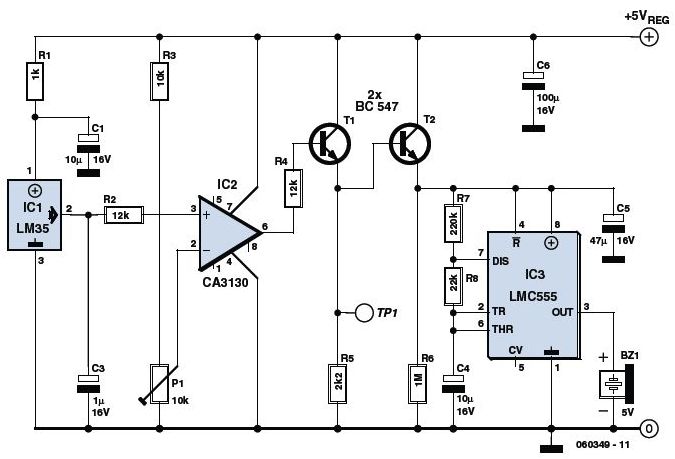
Detector circuit
This is an Overheat Detector Alarm Switch using the Temperature Sensor IC LM35. The core of this overheat detector (fire alarm) circuit is a precision integrated temperature sensor, the LM35 (IC1), which provides an accurately linear and directly proportional output...

TMP01 4 to 20mA Current Loop
This is a 4 mA to 20 mA current loop circuit. This circuit is used to transmit a signal over long distances. The accuracy of this circuit is not compromised.
The 4 mA to 20 mA current loop circuit is a...

DIGITAL THERMOMETER CIRCUIT
This circuit consists of a temperature sensor, amplifier, voltage-to-frequency (V/F) converter, a three-digit binary coded decimal (BCD) counter, a time base, and seven-segment LED displays. In addition to the 9400 V/F converter, other integrated circuits (ICs) required for this project...

cto frequency converter
In certain temperature measurement applications, converting the measured value into a frequency rather than a voltage offers distinct advantages. A temperature-to-frequency converter can be directly interfaced with a frequency counter or connected to a computer without necessitating an A/D interface...

Computer-Controlled 4-20mA Current Loop
In certain industries, a computer-controlled 4-20 mA current loop is utilized to manage various equipment. This current loop is employed to transmit a signal over a distance.
The 4-20 mA current loop is a standard method for transmitting analog signals in...
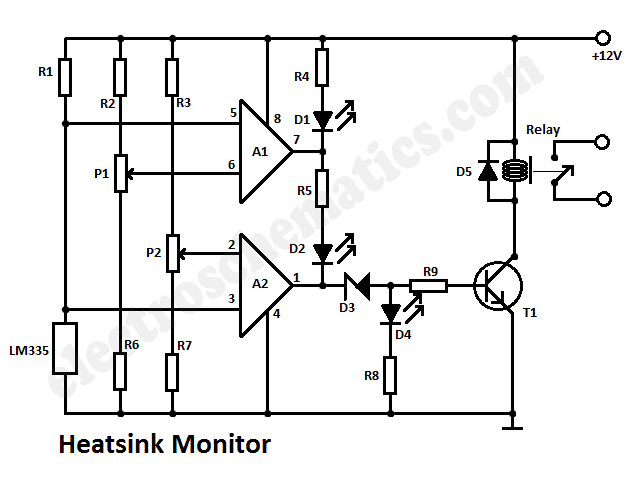
Heatsink Temperature Monitor Circuit
This heatsink temperature monitor circuit uses three LEDs to signal when the temperature exceeds two boundary levels. When the heatsink temperature is below 50 degrees...
This heatsink temperature monitor circuit is designed to provide visual indications of temperature levels using three...
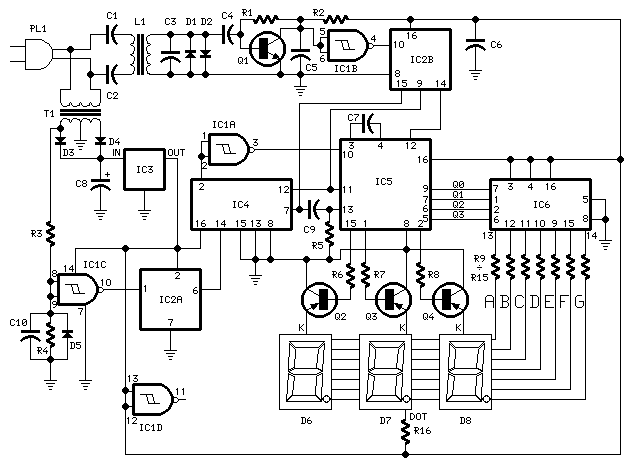
Digital Remote Thermometer
This circuit is designed for precise centigrade temperature measurement. It includes a transmitter section that converts the sensor's output voltage, which is proportional to the measured temperature, into frequency. The output frequency bursts are transmitted through the mains supply cables....

TC620 temperature sensor circuit diagram of automatic heating temperature control
The circuit includes the TC620 temperature control circuit, the temperature indicator circuit, a thyristor-controlled heating circuit, a vocal music buck rectifier circuit, and the AC circuit.
The TC620 temperature control circuit is designed to regulate temperature by monitoring the temperature sensor...

TC621 temperature sensor using poultry hatchery electronic thermostat control circuit diagram
Eggs hatch chicks at temperature requirements within the range of 36 to 39 degrees Celsius. The temperature sensor integrated circuits utilize the TC621 temperature control circuit, which has fewer external components, is low cost, and offers high reliability. Users can...