


Acid rain monitor
#acid rain
#MOSFET
#Wheatstone bridge
#sensor
#bridge rectifier
#voltage regulator
#lead-acid cell
#electrodes
#measurement

Description: A bridge rectifier and a 12-volt regulator power the MOSFET sensing circuit. The unregulated output of the bridge rectifier operates the drain solenoid via switch SI. The sensor is constructed from two electrodes, one made of copper and the other of lead. Together with the liquid contained by the sensor, they create a miniature lead-acid cell, which produces an output that is amplified by MOSFET Q1. The maximum output generated by the prototype cell was approximately 50 µA. MOSFET Q1 functions as the fourth leg of a Wheatstone bridge.
When acidity causes the sensor to generate a voltage, Q1 activates slightly, resulting in a decrease in its drain-to-source resistance. This variation in resistance creates an imbalance in the bridge, which is indicated by meter M1.
The circuit described integrates a bridge rectifier and a voltage regulator to ensure stable power supply to the MOSFET-based sensing circuit. The bridge rectifier converts alternating current (AC) to direct current (DC), providing an unregulated output that is subsequently processed by a 12-volt regulator. This regulated output is essential for the reliable operation of the drain solenoid, which is activated through switch SI.
The sensing mechanism employs a dual-electrode configuration, with one electrode made of copper and the other of lead. This arrangement, in conjunction with the liquid medium, simulates a miniature lead-acid cell. The electrochemical reaction occurring within this cell generates a small voltage, which is subsequently amplified by MOSFET Q1. The performance of the prototype cell yielded a maximum output of approximately 50 µA, indicating the sensitivity and effectiveness of the sensor.
MOSFET Q1 not only amplifies the signal but also plays a crucial role within a Wheatstone bridge configuration. In this setup, Q1 acts as the fourth leg, allowing for precise measurements of resistance changes. When the acidity of the liquid increases, it induces a voltage in the sensor, causing Q1 to turn on slightly. This activation leads to a reduction in the drain-to-source resistance of Q1, resulting in an imbalance within the Wheatstone bridge. The resulting voltage difference is detected and displayed by meter M1, providing a visual indication of the sensor's response to changes in acidity.
In summary, this circuit effectively combines rectification, regulation, and sensor amplification to create a reliable system for monitoring acidity. The integration of a Wheatstone bridge allows for accurate measurement of resistance changes, enabling precise detection of variations in the sensor's output due to changes in the liquid's acidity.A bridge rectifier and 12-volt regulator powers the MOSFET sensing circuit. The unregulated output of the bridge rectifier operates the drain solenoid via switch SI. The sensor itself is built from two electrodes, one made of copper, the other of lead. In combination with the liquid trapped by the sensor, they form a miniature lead-acid cell whose output is amplified by MOSFET Ql. The maximum output produced by our prototype cell was about 50 µ. MOSFET Ql serves as the fourth leg of a Wheatstone bridge. When acidity causes the sensor to generate a voltage, Ql turns on slightly, so its drain-to-source resistance decreases. That resistance variation causes an imbalance in the bridge, and that imbalance is indicated by meter Ml.
When acidity causes the sensor to generate a voltage, Q1 activates slightly, resulting in a decrease in its drain-to-source resistance. This variation in resistance creates an imbalance in the bridge, which is indicated by meter M1.
The circuit described integrates a bridge rectifier and a voltage regulator to ensure stable power supply to the MOSFET-based sensing circuit. The bridge rectifier converts alternating current (AC) to direct current (DC), providing an unregulated output that is subsequently processed by a 12-volt regulator. This regulated output is essential for the reliable operation of the drain solenoid, which is activated through switch SI.
The sensing mechanism employs a dual-electrode configuration, with one electrode made of copper and the other of lead. This arrangement, in conjunction with the liquid medium, simulates a miniature lead-acid cell. The electrochemical reaction occurring within this cell generates a small voltage, which is subsequently amplified by MOSFET Q1. The performance of the prototype cell yielded a maximum output of approximately 50 µA, indicating the sensitivity and effectiveness of the sensor.
MOSFET Q1 not only amplifies the signal but also plays a crucial role within a Wheatstone bridge configuration. In this setup, Q1 acts as the fourth leg, allowing for precise measurements of resistance changes. When the acidity of the liquid increases, it induces a voltage in the sensor, causing Q1 to turn on slightly. This activation leads to a reduction in the drain-to-source resistance of Q1, resulting in an imbalance within the Wheatstone bridge. The resulting voltage difference is detected and displayed by meter M1, providing a visual indication of the sensor's response to changes in acidity.
In summary, this circuit effectively combines rectification, regulation, and sensor amplification to create a reliable system for monitoring acidity. The integration of a Wheatstone bridge allows for accurate measurement of resistance changes, enabling precise detection of variations in the sensor's output due to changes in the liquid's acidity.A bridge rectifier and 12-volt regulator powers the MOSFET sensing circuit. The unregulated output of the bridge rectifier operates the drain solenoid via switch SI. The sensor itself is built from two electrodes, one made of copper, the other of lead. In combination with the liquid trapped by the sensor, they form a miniature lead-acid cell whose output is amplified by MOSFET Ql. The maximum output produced by our prototype cell was about 50 µ. MOSFET Ql serves as the fourth leg of a Wheatstone bridge. When acidity causes the sensor to generate a voltage, Ql turns on slightly, so its drain-to-source resistance decreases. That resistance variation causes an imbalance in the bridge, and that imbalance is indicated by meter Ml.

Mosfet stabilized power supply
One very important part of a tube amplifier is the power supply. It is crucial for the quality of the whole system. Especially beginners encounter problems like hum or drift that can become quite annoying. But rescue is ahead: the...
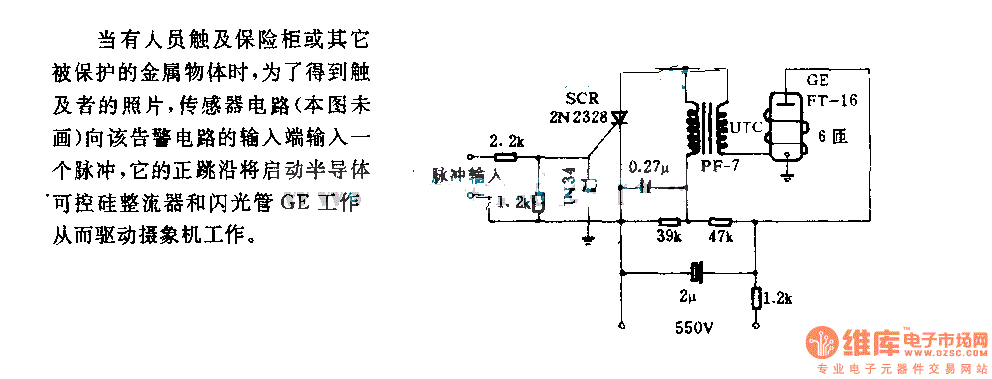
The alarm circuit diagram for safety box and other metal objects
When an individual touches the safety box or other protected metal objects, the sensor circuit generates a pulse to the alarm circuit. The positive edge of this pulse activates the semiconductor and thyristor flash GE, subsequently triggering the camera to...

irf44 mosfet based on 100 watt
This inverter circuit can provide a stable 230V output voltage. The operating frequency is determined by a variable resistor (VR1) and is typically set to 60 Hz. Various off-the-shelf transformers can be utilized, or custom-wound transformers can be created for...

MOSFET current sensing
The circuit shows the method of mirror current sensing a MOSFET. A fully conducting MOSFET is resistive and behaves exactly as a resistor. It therefore you limit the voltage across the MOSFET when it is conducting you automatically limit the...

Three-terminal voltage regulator integrated fixed a typical wiring circuit
A fixed three-terminal integrated voltage regulator can be directly employed in various electronic devices as a voltage regulator. It features internal protections such as overcurrent protection, thermal protection, and safe operating area protection, making the circuit easy to use, safe,...

building regulated 5v dc power supply
A regulated 5-volt DC supply is essential for powering microcontroller and TTL-based circuits. The output of most wall adapters is often too rippled and impure for use in digital circuits. An inexpensive power supply can be constructed using discrete components...

Complementary symmetry FET operating principle
An N-channel MOSFET and P-channel MOSFET form a complementary symmetry circuit, which includes a CMOS complementary output short circuit, as illustrated in the schematic. When the input terminal is high (logical 1), the N-channel field-effect transistor is activated, resulting in...

60w amplifier mosfet irfp240
The supply voltage rails were conservatively maintained at +40V and -40V. For those interested in experimentation, the supply voltage can be increased to a maximum of +50V and -50V, enabling the amplifier to reach its target output of 100W into...
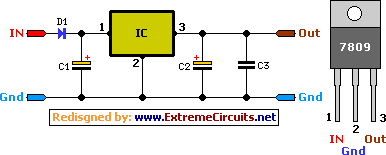
9 Volt 2 Ampere DC Power SupplyCircuit
A simple 9 Volt, 2 amp power supply utilizing a single integrated circuit (IC) regulator. This circuit is straightforward, as the regulator handles the majority of the work. The component used is the 7809 voltage regulator.
The circuit consists primarily of...