


An Ionisation Chamber Shield for OpenRelief
#ionisation chamber
#bias power supply
#inverter
#OpenRelief
#detector
#prototyping
#battery bank
#voltage conversion
#sensor shield
#radiation detection

Description: The OpenRelief project involves the prototyping of a simple ionization chamber. Initial tests utilized a bank of batteries for the bias power supply, and this document outlines the construction of an inverter to replace this setup. The bias voltage is applied across the electrodes of the ionization chamber, allowing for tiny currents to flow when ionizing radiation enters. Four PP3 batteries in series provided a bias of 36V, which may not be optimal and is also inconvenient. Credit is given to Charles Wenzel for designing the circuit described here, which the detector is based upon. The power supply schematic is provided below, and further details and alternative designs can be found on Charles Wenzel's website. The detector is built around an Arduino-compatible Nanode, and the power supply was constructed on a prototyping shield. The shield's top side is visible in the accompanying image, with the underside shown below. After completing the shield, the current consumption was measured at approximately 360 µA with a 5V input, yielding an output of around 90V. The current across the chamber electrodes is extremely small, in the nano/picoamp range, and the circuit efficiency ensures that the power drawn by the shield is minimal. After confirming the absence of shorts, the power supply functioned as intended without excessive current draw, allowing for the assembly of the detector for testing. The Nanode sketch logs data to both the serial port and the Cosm Internet of Things platform, necessitating a USB adapter for Internet connectivity. Upon powering up, the background reading fluctuated around 36, increasing to approximately 150 when a weak alpha particle source was brought near the chamber's mouth. These values are arbitrary indicators of the current flowing across the electrodes, with no calibration performed. Further development is needed for the detector design, focusing on enhancing stability for use as an alarm system to indicate potential concerns. Future improvements could allow for calibration to provide meaningful readings comparable to commercial designs, necessitating work on the chamber's mechanical design, Nanode firmware, and calibration processes.
The ionization chamber serves as a detector for ionizing radiation, where the design must ensure that the bias voltage is consistently applied across the electrodes to facilitate the detection of radiation events. The inverter circuit is crucial as it converts the lower voltage from the battery bank to the required higher voltage for the chamber operation. The design of the inverter should include components such as a transformer, diodes, and capacitors to ensure efficient voltage conversion and regulation.
The incorporation of an Arduino-compatible Nanode allows for flexibility in programming and data logging capabilities. The power supply shield should be designed to accommodate the Nanode while providing sufficient voltage and current for the ionization chamber. The efficiency of the circuit is paramount, as the minimal current drawn by the shield should not interfere with the sensitive measurements of the ionization chamber.
To enhance the stability of the detector, improvements may include refining the mechanical design of the chamber to reduce noise and environmental interference. Additionally, implementing robust firmware on the Nanode will assist in data processing and logging, ensuring accurate readings. Calibration processes must be developed to allow the detector to provide reliable measurements, potentially incorporating reference sources or standardized radiation levels for comparison.
Overall, the project aims to evolve from a prototype to a more sophisticated device capable of delivering reliable data, contributing to safety and monitoring applications in environments where ionizing radiation may pose risks.I was prototyping for the OpenRelief project. Based on a simple ionisation chamber, initial testing used a bank of batteries for the bias power supply and this post details the construction of an inverter to replace these. For details of the detector itself see the original post as none of th e fundamental details have changed, and for more on OpenRelief see the interview with project leader, Shane Coughlan. Just to recap, the bias voltage is applied across the ionisation chamber electrodes, between which tiny currents flow when ionising radiation enters the chamber.
Using four PP3 batteries in series provided a bias of 36v, which is possibly suboptimal in addition to not being terribly convenient. Once again I must give due credit to Charles Wenzel, who designed the circuit which is described here and that which the detector is based upon.
The power supply schematic is below and for further details and alternative designs see Charles` excellent website. Since the detector is based around an Arduino compatible Nanode, the power supply was constructed on a prototyping shield.
The top side of the shield can be seen in the picture at the top of this post, and the underside below. With the shield completed I wanted to check the current consumption, which as can be seen below is around 360uA at 5v input, giving an output of around 90v.
Since the current flow across the chamber electrodes will always be incredibly small ” in the order of nano/picoamps ” and the circuit is efficient, the power drawn by the shield should be barely noticeable. Having confirmed that there were no shorts, the power supply operated as expected and did not draw too much current, it was time to assemble the detector ready for testing.
The Nanode sketch logs data to both the serial port and the Cosm Internet of Things platform, and so a USB adapter was plugged in and it was connected to the Internet. On power up the background reading fluctuated around 36, rising to around 150 when a very weak alpha particle source was brought near to the mouth of the chamber.
It should be noted that these values are entirely arbitrary and nothing more than a indication of the amount of current flowing across the electrodes ” with no calibration of any sort. There still remains a reasonable amount of work to be done on the design of the detector itself. With the priority being to make it more stable in use as a simple alarm which can indicate when there is possible cause for concern.
Beyond which it would be great to evolve it to the point where it can be calibrated to provide meaningful readings on par with a commercial design. This will require work on the chamber mechanical design, Nanode firmware, and perhaps processes for calibration.
The ionization chamber serves as a detector for ionizing radiation, where the design must ensure that the bias voltage is consistently applied across the electrodes to facilitate the detection of radiation events. The inverter circuit is crucial as it converts the lower voltage from the battery bank to the required higher voltage for the chamber operation. The design of the inverter should include components such as a transformer, diodes, and capacitors to ensure efficient voltage conversion and regulation.
The incorporation of an Arduino-compatible Nanode allows for flexibility in programming and data logging capabilities. The power supply shield should be designed to accommodate the Nanode while providing sufficient voltage and current for the ionization chamber. The efficiency of the circuit is paramount, as the minimal current drawn by the shield should not interfere with the sensitive measurements of the ionization chamber.
To enhance the stability of the detector, improvements may include refining the mechanical design of the chamber to reduce noise and environmental interference. Additionally, implementing robust firmware on the Nanode will assist in data processing and logging, ensuring accurate readings. Calibration processes must be developed to allow the detector to provide reliable measurements, potentially incorporating reference sources or standardized radiation levels for comparison.
Overall, the project aims to evolve from a prototype to a more sophisticated device capable of delivering reliable data, contributing to safety and monitoring applications in environments where ionizing radiation may pose risks.I was prototyping for the OpenRelief project. Based on a simple ionisation chamber, initial testing used a bank of batteries for the bias power supply and this post details the construction of an inverter to replace these. For details of the detector itself see the original post as none of th e fundamental details have changed, and for more on OpenRelief see the interview with project leader, Shane Coughlan. Just to recap, the bias voltage is applied across the ionisation chamber electrodes, between which tiny currents flow when ionising radiation enters the chamber.
Using four PP3 batteries in series provided a bias of 36v, which is possibly suboptimal in addition to not being terribly convenient. Once again I must give due credit to Charles Wenzel, who designed the circuit which is described here and that which the detector is based upon.
The power supply schematic is below and for further details and alternative designs see Charles` excellent website. Since the detector is based around an Arduino compatible Nanode, the power supply was constructed on a prototyping shield.
The top side of the shield can be seen in the picture at the top of this post, and the underside below. With the shield completed I wanted to check the current consumption, which as can be seen below is around 360uA at 5v input, giving an output of around 90v.
Since the current flow across the chamber electrodes will always be incredibly small ” in the order of nano/picoamps ” and the circuit is efficient, the power drawn by the shield should be barely noticeable. Having confirmed that there were no shorts, the power supply operated as expected and did not draw too much current, it was time to assemble the detector ready for testing.
The Nanode sketch logs data to both the serial port and the Cosm Internet of Things platform, and so a USB adapter was plugged in and it was connected to the Internet. On power up the background reading fluctuated around 36, rising to around 150 when a very weak alpha particle source was brought near to the mouth of the chamber.
It should be noted that these values are entirely arbitrary and nothing more than a indication of the amount of current flowing across the electrodes ” with no calibration of any sort. There still remains a reasonable amount of work to be done on the design of the detector itself. With the priority being to make it more stable in use as a simple alarm which can indicate when there is possible cause for concern.
Beyond which it would be great to evolve it to the point where it can be calibrated to provide meaningful readings on par with a commercial design. This will require work on the chamber mechanical design, Nanode firmware, and perhaps processes for calibration.
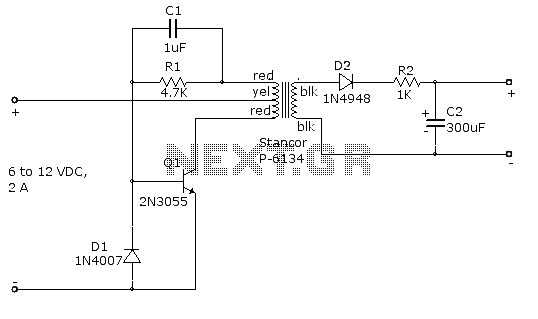
Super Simple Inverter
This is an example of a simple inverter that can be used to power a fluorescent lamp and a small strobe. This circuit will produce over 400 VDC from a 12 VDC, 2.5 A.
The described inverter circuit is designed to...

inverter
This inverter is designed to power appliances such as televisions and stereos while traveling or camping. It converts 12 VDC (volts direct current) to 120 VAC (volts alternating current).
This inverter functions by utilizing a series of electronic components to transform...
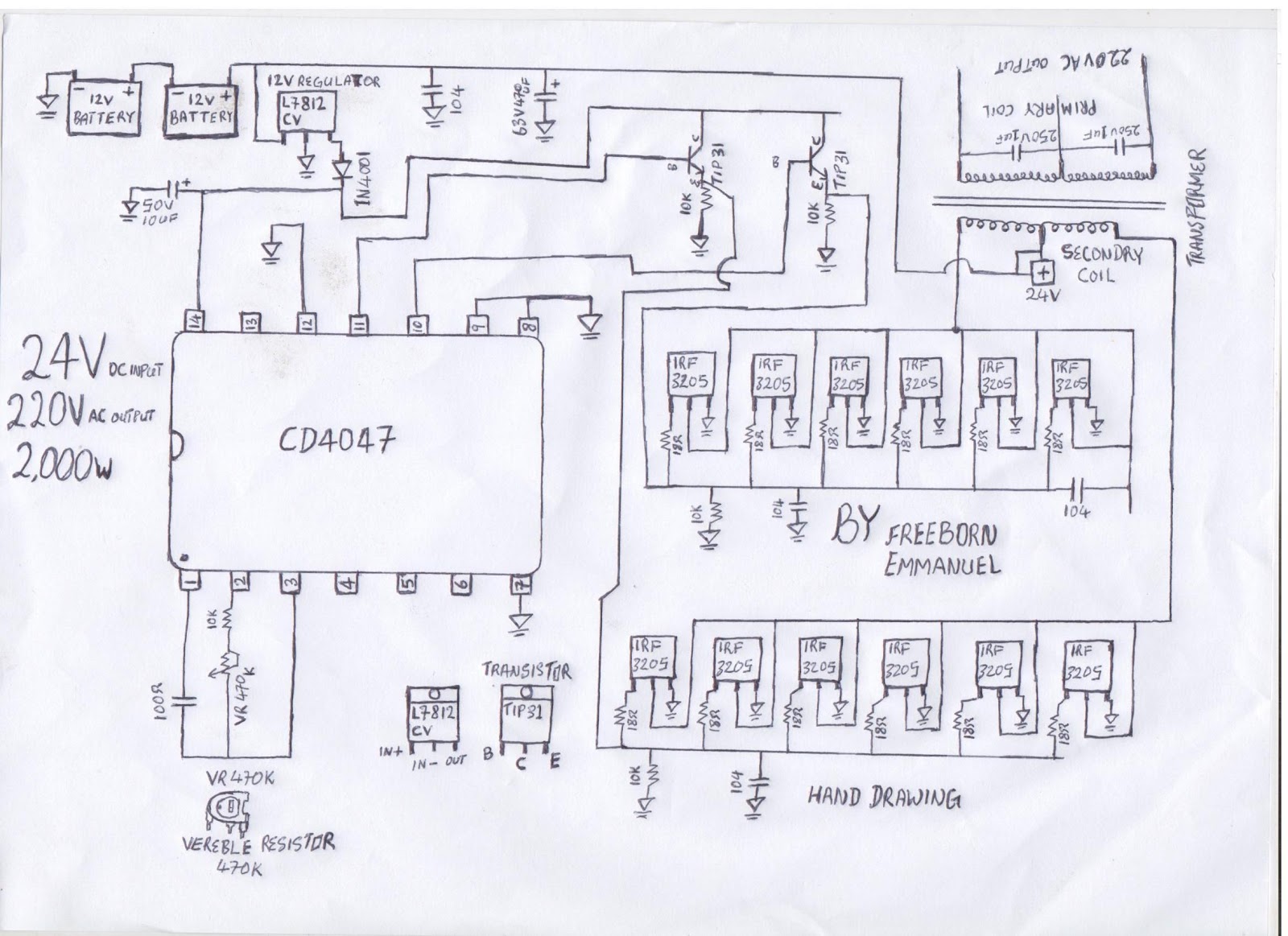
how to build a 2KVA inverter circuit diagram
The diagram illustrates a modified square wave inverter circuit. By adjusting the frequency resistor (VR 470k), the inverter's output frequency can be optimized to effectively power a freezer compressor and various other electronic appliances in a living room. The circuit...

Versatile Multifunction Circuit Uses Only Three Inverters
The versatile circuit can be employed to achieve various functions, including an astable multivibrator, a monostable multivibrator, a switch debouncer, or a frequency discriminator. Inverters U1a and U1b are configured as a latch. When the input voltage (VIN) is high,...

100W Inverter Circuit 12VDC to 220VAC
The schematic diagram of a 100W inverter circuit converts a 12V DC input into a 220V AC output. The circuit is built using the IC CD4047 to generate a 50Hz sine wave signal. The power transistor 2N3055 amplifies the signal...

Detector And Controller
Many applications require analog signals to be sensed and digital signals to be controlled. A way to detect these points is by using a 555 timer in an unconventional configuration. This method will also add hysteresis to the circuit and...

Geiger Counter
April 2006 marked the twentieth anniversary of the Chernobyl reactor accident. In the aftermath of the incident, winds dispersed much of the reactor's contents across central Europe, Scandinavia, and the UK. A large area surrounding the reactor remains restricted, raising...

Two inverter controlled synchronous motor of the second circuit
Adjust the potentiometers RPi and RPz to modify the speed of two motors.
The circuit utilizes two potentiometers, designated as RPi and RPz, to control the speed of two separate motors. Each potentiometer is connected in a voltage divider configuration, enabling...

Single-Phase Inverters
The simplest inverter to understand is the single-phase inverter, which converts a DC input voltage into single-phase AC voltage. The main components of the inverter can be either four silicon-controlled rectifiers (SCRs) or four transistors. A typical inverter circuit that...