


Barometer
#barometer
#pressure sensor
#calibration
#potentiometer
#voltage offset
#gain adjustment
#temperature sensitive
#hostile environment
#measurement

Description: The Bray Barometer requires manual calibration for voltage offset and gain. Although practical on the workbench, these devices are most likely mounted in inconvenient locations making secondary adjustment difficult. The Bray Barometer uses potentiometers for offset and gain adjustments. Potentiometers are notoriously temperature sensitive, and sensitive to hostile environments. More: * By only using a single 5V power supply, the Bray barometer cannot utilize the full 1.5-10V range of the DS2438's Analog to Digital Converter (ADC); by using a higher voltage input we can improve instrument range or sensitivity. * The Printed
The Bray Barometer operates by measuring atmospheric pressure and translating this measurement into an electrical signal. The device requires manual calibration to ensure accurate readings, which involves adjusting the voltage offset and gain settings. This calibration process is typically conducted on a workbench, where access to the device is straightforward. However, once installed in a location that is not easily accessible, performing these adjustments becomes challenging.
The barometer employs potentiometers for both offset and gain adjustments. While these components are effective for fine-tuning measurements, they are inherently sensitive to temperature variations and can be adversely affected by harsh environmental conditions. This sensitivity can lead to fluctuating readings, necessitating frequent recalibration under varying environmental circumstances.
Moreover, the Bray Barometer is designed to operate with a single 5V power supply. This limitation restricts the utilization of the full voltage range available from the DS2438's Analog to Digital Converter (ADC), which operates effectively within a range of 1.5V to 10V. By integrating a higher voltage power supply, the performance of the barometer could be significantly enhanced, allowing for improved measurement range and sensitivity. This adjustment would enable the device to yield more precise readings, particularly in applications requiring high accuracy.
In terms of circuit design, it is crucial to consider the placement of the potentiometers and the overall layout of the circuit to minimize the impact of temperature variations. Additionally, incorporating protective measures against environmental factors can further enhance the reliability and longevity of the Bray Barometer in various applications.The Bray Barometer requires manual calibration for voltage offset and gain. Although practical on the workbench, these devices are most likely mounted in inconvenient locations making secondary adjustment difficult. The Bray Barometer uses potentiometers for offset and gain adjustments. Potentiometers are notoriously temperature sensitive, and sensitive to hostile environments. * By only using a single 5V power supply, the Bray barometer cannot utilize the full 1.5-10V range of the DS2438`s Analog to Digital Converter. (ADC), by using a higher voltage input we can improve instrument range or sensitivity. * The Printed
The Bray Barometer operates by measuring atmospheric pressure and translating this measurement into an electrical signal. The device requires manual calibration to ensure accurate readings, which involves adjusting the voltage offset and gain settings. This calibration process is typically conducted on a workbench, where access to the device is straightforward. However, once installed in a location that is not easily accessible, performing these adjustments becomes challenging.
The barometer employs potentiometers for both offset and gain adjustments. While these components are effective for fine-tuning measurements, they are inherently sensitive to temperature variations and can be adversely affected by harsh environmental conditions. This sensitivity can lead to fluctuating readings, necessitating frequent recalibration under varying environmental circumstances.
Moreover, the Bray Barometer is designed to operate with a single 5V power supply. This limitation restricts the utilization of the full voltage range available from the DS2438's Analog to Digital Converter (ADC), which operates effectively within a range of 1.5V to 10V. By integrating a higher voltage power supply, the performance of the barometer could be significantly enhanced, allowing for improved measurement range and sensitivity. This adjustment would enable the device to yield more precise readings, particularly in applications requiring high accuracy.
In terms of circuit design, it is crucial to consider the placement of the potentiometers and the overall layout of the circuit to minimize the impact of temperature variations. Additionally, incorporating protective measures against environmental factors can further enhance the reliability and longevity of the Bray Barometer in various applications.The Bray Barometer requires manual calibration for voltage offset and gain. Although practical on the workbench, these devices are most likely mounted in inconvenient locations making secondary adjustment difficult. The Bray Barometer uses potentiometers for offset and gain adjustments. Potentiometers are notoriously temperature sensitive, and sensitive to hostile environments. * By only using a single 5V power supply, the Bray barometer cannot utilize the full 1.5-10V range of the DS2438`s Analog to Digital Converter. (ADC), by using a higher voltage input we can improve instrument range or sensitivity. * The Printed
RealView 2.0
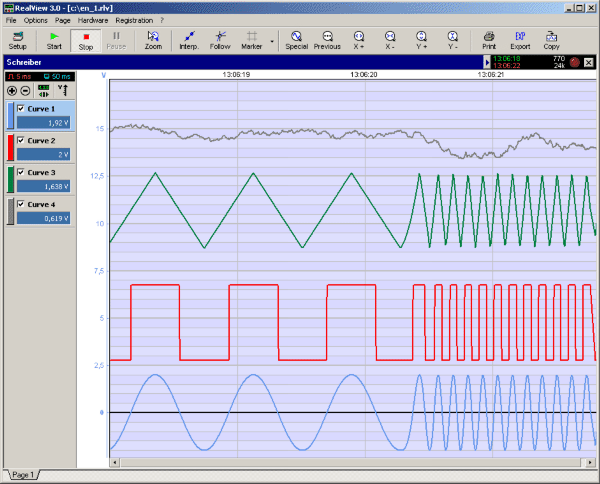
RealView is a measurement application, which records and plots measured values from analogue hardware devices in real-time. Several curves can be plotted into a single diagram. Several diagrams can be arranged on one or more pages if necessary. Plot options...

ProfiLab-Expert 4.0
The ProfiLab-Expert software allows you to develop your own digital or analogue measuring technology projects. It doesn't matter if you want to create analogue measurements or digital controls - you can realize it all. And for all this you don't...

Electronic Torricelli Barometer
While it may lack the aesthetic appeal of traditional mercury barometers featuring elongated glass tubes mounted on intricately carved wood, the Torricelli barometer presented here serves as a functional equivalent and an electronic representation of the original Torricelli barometer. Instead...

Pressure Sensor Alarm
The general-purpose circuit of the simple pressure sensor alarm is constructed using a few easily accessible and inexpensive components. The operation of this circuit is straightforward.
The simple pressure sensor alarm circuit typically includes a pressure sensor, an operational amplifier (op-amp),...

music circuit
This circuit allows for the adjustment of resistance using a potentiometer and the adjustment of capacitance by opening or closing switches. By manipulating the configuration of these switches, various combinations can be achieved to obtain different effective capacitance values. It...

Pressure sensor circuit
A pressure sensor circuit features a pressure sensor with a nominal resistance of 120 ohms. The amplifier circuit utilizes an AD521 operational amplifier with a gain of 100. It includes resistor components Rs and Rc, along with a decision-making element...

Digital-ProfiLab 4.0
Digital-ProfiLab was designed for measurement and control applications, combining features like circuit and logic simulation, front panel design, and hardware control to one powerful tool. Incoming signals from external devices may be processed and displayed. A circuit editor is used...

Error Compensation Circuit for Pressure Sensor
To obtain an accurate pressure value, it is essential to eliminate offset errors. Numerous basic circuit designs are employed to remove these offset errors.
Offset errors in pressure measurement systems can lead to inaccuracies in the readings, which may affect the...

electronic torricelli barometer
While it may lack the aesthetic appeal of traditional mercury barometers featuring elongated glass tubes mounted on intricately carved wooden bases, the Torricelli barometer described here serves as a functional equivalent and electronic replica of the original Torricelli barometer. Instead...