


basic lm35 temperature sensor circuit
#LM35
#temperature sensor
#op-amp
#amplifier
#relay driver
#fan control
#signal conditioning
#analog sensor
#temperature monitoring

Description: This is a basic overview of the LM35 temperature sensor, which is interfaced with an operational amplifier (op-amp) to boost its output. The LM35 provides a high output voltage when it detects high temperatures. The output can be utilized to drive a relay, fan, or other devices. For modifications to the LM35 temperature sensor, further details can be explored.
The LM35 temperature sensor is a precision integrated-circuit temperature sensor that provides an output voltage that is linearly proportional to the Celsius temperature. The sensor operates over a range of -55°C to +150°C and outputs 10 mV per degree Celsius. To enhance the output signal for further processing or control applications, an operational amplifier is often used.
In a typical circuit configuration, the LM35 is connected to the non-inverting input of an op-amp. The op-amp is configured in a non-inverting amplifier configuration to increase the output voltage from the sensor. The gain of the amplifier can be set by selecting appropriate resistor values for the feedback loop, allowing for customization based on the application requirements. For example, a gain of 2 would result in an output of 20 mV per degree Celsius, effectively doubling the sensitivity of the temperature measurement.
The output from the op-amp can be connected to various load devices such as relays or fans. A relay can be used for switching applications, allowing for control of larger loads based on the temperature readings. When the temperature exceeds a predetermined threshold, the output from the op-amp can energize the relay coil, activating the connected device. Similarly, a fan can be controlled to turn on or off based on the temperature, providing an effective cooling solution.
For modifications to the LM35 temperature sensor, additional circuitry may include filtering capacitors to stabilize the output signal, or temperature thresholds can be implemented using comparators for more complex control systems. These modifications can enhance the performance and versatility of the LM35 in various temperature monitoring and control applications.This is basic of workmaship LM35 temperatur sensor, whish is taken from the LM35 spending and boosted again by the amplifier op-amp. High output if the sensor is received by ic LM35 high temperature. You can use the output as driver relay, fan, or other. And if yo want to see modifications LM35 temperature sensor see.
The LM35 temperature sensor is a precision integrated-circuit temperature sensor that provides an output voltage that is linearly proportional to the Celsius temperature. The sensor operates over a range of -55°C to +150°C and outputs 10 mV per degree Celsius. To enhance the output signal for further processing or control applications, an operational amplifier is often used.
In a typical circuit configuration, the LM35 is connected to the non-inverting input of an op-amp. The op-amp is configured in a non-inverting amplifier configuration to increase the output voltage from the sensor. The gain of the amplifier can be set by selecting appropriate resistor values for the feedback loop, allowing for customization based on the application requirements. For example, a gain of 2 would result in an output of 20 mV per degree Celsius, effectively doubling the sensitivity of the temperature measurement.
The output from the op-amp can be connected to various load devices such as relays or fans. A relay can be used for switching applications, allowing for control of larger loads based on the temperature readings. When the temperature exceeds a predetermined threshold, the output from the op-amp can energize the relay coil, activating the connected device. Similarly, a fan can be controlled to turn on or off based on the temperature, providing an effective cooling solution.
For modifications to the LM35 temperature sensor, additional circuitry may include filtering capacitors to stabilize the output signal, or temperature thresholds can be implemented using comparators for more complex control systems. These modifications can enhance the performance and versatility of the LM35 in various temperature monitoring and control applications.This is basic of workmaship LM35 temperatur sensor, whish is taken from the LM35 spending and boosted again by the amplifier op-amp. High output if the sensor is received by ic LM35 high temperature. You can use the output as driver relay, fan, or other. And if yo want to see modifications LM35 temperature sensor see.
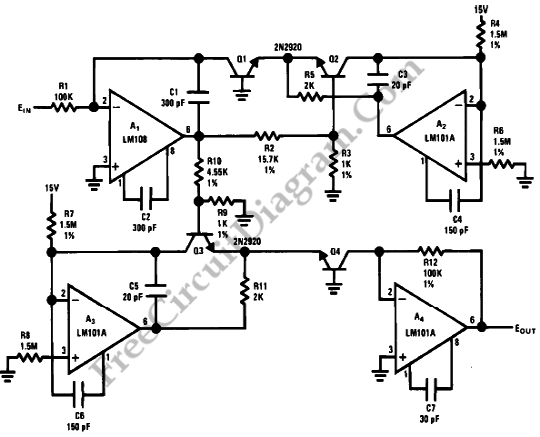
Power Function Circuit
It is possible to easily generate various non-linear functions such as X^(1/2), X^2, X^3, 1/X, XY, and X/Y using logarithms. In this context, division is transformed into subtraction, while multiplication is converted into addition.
The application of logarithmic properties in electronic...

Temperature-reporting-digital-thermometer
The ROMs or PROMs must contain the correct code to convert data from the NE5037, which serves as the address for the ROMs or PROMs, into the appropriate segment driver codes. The displayed temperature can easily be converted to degrees...

Temperature To Frequency Converter Circuit
In this circuit, an LM34 or LM35 generates a frequency that is proportional to temperature. The reference current (138) is established through resistor R3. The output can be utilized to drive a display, frequency counter, or other indicating devices for...

Capacitor in parallel with resistor on xoscope amplifier schematic
For capacitor C3, a 100pF capacitor is placed across resistor R2. The circuit functions similarly to previous configurations, although no explanation is provided. The purpose of this component may be self-evident to experienced users, but it may not be clear...

DIY Digital Thermometer Circuit
This DIY digital thermometer circuit can measure temperatures up to 150°C with an accuracy of ±1°C. The temperature is displayed on a 1V full scale deflection.
The digital thermometer circuit is designed to provide accurate temperature readings within a specified range,...
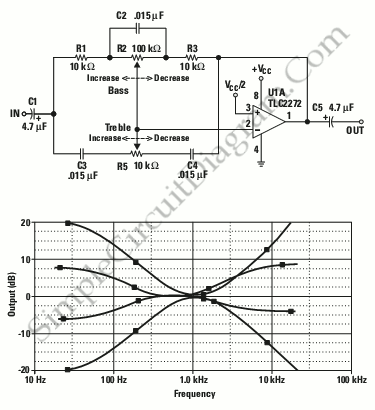
Single Op-Amp Tone Control
This is a single operational amplifier tone control circuit. The circuit functions as a hybrid low-pass, high-pass, and one-pole filter with both attenuation and gain.
The single op-amp tone control circuit utilizes an operational amplifier (op-amp) to manipulate audio signals by...

Inverting Summing Amplifier Circuit
The output of Ul is the sum of Vv, multiplied by the ratio of Rx to Rv, RJRV, and respectively. Resistors R1, R2, and R3 are selected as required for individual gains. Additionally, R4 influences the gain of all these...

op amp How does this OP-AMP offset voltage measuring circuit work
This circuit is constructed using two LT1001 operational amplifiers (OP-AMPs), with the output of the OP-AMP saturating at +5V. The power supplies used are +5V and ground. According to the documentation, applying +1V to the "Servo Input" results in an...
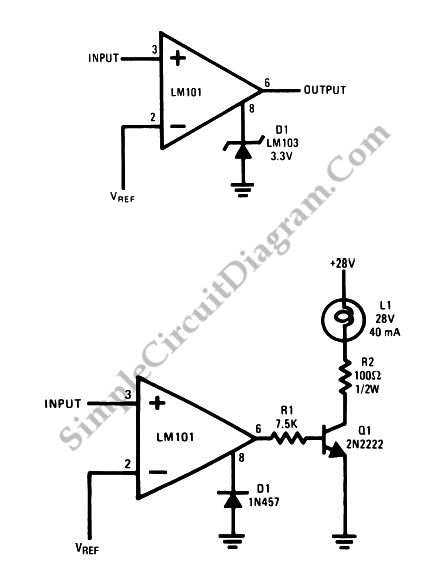
Op-Amp Application: Voltage Comparators
Two reasons why the LM101 is well-suited for comparator applications are its large differential input voltage range and the ease of clamping the output.
The LM101 operational amplifier is particularly advantageous for use in comparator circuits due to its significant differential...