


Bridge-transducer-amplifier
#bridge transducer
#strain gauge
#accelerometer
#thermal sensor
#high impedance
#low bias current
#low drift
#amplifier

Description: In applications involving strain gauges, accelerometers, and thermal sensors, a bridge transducer is often utilized. Typically, the sensor elements are high-resistance units that necessitate an equally high bridge resistance for optimal sensitivity. Consequently, this type of circuit requires an amplifier with high input impedance, low bias current, and minimal drift. The circuit depicted represents a potential solution to these general requirements.
The bridge transducer circuit is commonly employed in various measurement applications, where precise detection of physical changes is crucial. The circuit typically consists of four resistive elements configured in a diamond shape, with the sensor elements forming part of the bridge. When the bridge is balanced, the voltage across the output terminals is zero. Any change in resistance due to strain, acceleration, or temperature will unbalance the bridge, resulting in a measurable output voltage.
To achieve high sensitivity, the bridge circuit must be designed with high resistance components, which can improve the signal-to-noise ratio. The use of high bridge resistance allows for smaller changes in resistance from the sensors to produce a significant output voltage change. This is particularly important when dealing with low-level signals from strain gauges or thermal sensors.
The amplifier used in conjunction with the bridge transducer must possess high input impedance to prevent loading effects that could distort the signal. A low bias current is essential to minimize the offset voltage at the input, ensuring accurate readings. Additionally, low drift characteristics of the amplifier are crucial for maintaining stability over time, especially in applications where temperature fluctuations may occur.
Overall, this bridge transducer circuit configuration, along with a suitable high-performance amplifier, provides an effective solution for accurately measuring physical parameters in various industrial and scientific applications. It is essential to consider the specifications of both the sensor elements and the amplifier to optimize the performance of the circuit for the intended application.In applications involving strain gauges, accelerometers, and thermal sensors, a bridge transducer is often used. Frequently, the sensor elements are high resistance units requiring equally high bridge resistance for good sensitivity.
This type of circuit then demands an amplifier with high input impedance, low bias current and low drift. The circuit shown represents a possible solution to these general requirements.
The bridge transducer circuit is commonly employed in various measurement applications, where precise detection of physical changes is crucial. The circuit typically consists of four resistive elements configured in a diamond shape, with the sensor elements forming part of the bridge. When the bridge is balanced, the voltage across the output terminals is zero. Any change in resistance due to strain, acceleration, or temperature will unbalance the bridge, resulting in a measurable output voltage.
To achieve high sensitivity, the bridge circuit must be designed with high resistance components, which can improve the signal-to-noise ratio. The use of high bridge resistance allows for smaller changes in resistance from the sensors to produce a significant output voltage change. This is particularly important when dealing with low-level signals from strain gauges or thermal sensors.
The amplifier used in conjunction with the bridge transducer must possess high input impedance to prevent loading effects that could distort the signal. A low bias current is essential to minimize the offset voltage at the input, ensuring accurate readings. Additionally, low drift characteristics of the amplifier are crucial for maintaining stability over time, especially in applications where temperature fluctuations may occur.
Overall, this bridge transducer circuit configuration, along with a suitable high-performance amplifier, provides an effective solution for accurately measuring physical parameters in various industrial and scientific applications. It is essential to consider the specifications of both the sensor elements and the amplifier to optimize the performance of the circuit for the intended application.In applications involving strain gauges, accelerometers, and thermal sensors, a bridge transducer is often used. Frequently, the sensor elements are high resistance units requiring equally high bridge resistance for good sensitivity.
This type of circuit then demands an amplifier with high input impedance, low bias current and low drift. The circuit shown represents a possible solution to these general requirements.

5.3W Amplifier With Surround System
The AN7147 Dual 5.3-watt Audio Power Amplifier from Panasonic is categorized as a replacement type, indicating its anticipated availability in the market for an extended period. When combined with additional components, it can be configured to create a simple surround-sound...

task 32 triple axis accelerometer
A circuit diagram illustrating the connection of an accelerometer to an Arduino board and an external power source.
The circuit diagram depicts the integration of an accelerometer with an Arduino microcontroller, providing a clear representation of how these components interact within...
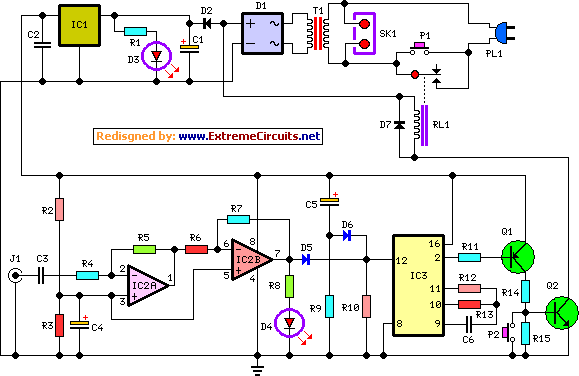
amplifier timer circuit schematic
This circuit deactivates an amplifier or any connected device when a low-level audio signal at its input is absent for at least 15 minutes. By pressing P1, the device is powered on, supplying power to any appliance connected to SK1....

Bassman Modifications
Upgrading to a 3-prong AC cord is a common modification, as is the replacement of filter capacitors. Switching coupling capacitors to brands like Orange Drops or other boutique options is also popular, often enhancing the appeal in online auctions. Additional...

High resistance distribution circuit
The circuit diagram illustrates a high-impedance distribution system characterized by low resistivity distribution. A notable feature is the series resistance of the shunt load current limiting resistor R1, typically valued at five to ten times the internal resistance of the...

A simple and effective short-wave antenna amplifier circuit
This amplifier is designed for outdoor installation and is connected to an indoor power line box. It utilizes either 50-ohm or 75-ohm coaxial cables for the connection between indoor and outdoor units. The amplifier circuit board is depicted in Figures...

thermal flashlight
Public Lab is an open community that collaboratively develops accessible, open-source, Do-It-Yourself technologies for investigating local environmental health and justice issues.
Public Lab focuses on creating tools that empower individuals and communities to engage in environmental monitoring and advocacy. These technologies...

Band decoder circuit diagram
The circuit amplifier and attenuator control video detector consists of a composition for the synchronization channel. The synchronization interval is where the gain circuit is increased.
The described circuit involves an amplifier and an attenuator that work together to control a...

Active-limiting-amplifier
The modified inverting amplifier employs an active clamp to precisely limit the output swing. Consideration must be given to the VBE of the transistors. The output swing is restricted by the base-emitter breakdown of the transistors. A straightforward circuit configuration...