


car parking aid sensor
#parking aid
#distance sensor
#LED indicator
#automotive
#proximity detection
#safety
#garage
#backup sensor
#alert system
#distance measurement

Description: This sensor circuit was designed to assist in parking a car near a garage wall while reversing. LED D7 lights up when the distance from the bumper to the wall is approximately 20 cm. LEDs D7 and D6 illuminate at around 10 cm, and all three LEDs (D7, D6, and D5) activate at about 6 cm. This provides an alert when the vehicle approaches too close to the wall. The distances mentioned can vary in operation, depending on the infrared transmitting and receiving LEDs used, and are significantly influenced by the color of the reflecting surface. Dark surfaces can greatly reduce the device's sensitivity. Additionally, this circuit can be utilized for other applications such as liquid level detection and proximity sensing.
The sensor circuit operates based on the principles of infrared (IR) reflection. It typically consists of an IR LED as the transmitter and a photodiode or phototransistor as the receiver. When the vehicle backs up, the IR LED emits infrared light, which reflects off nearby surfaces, such as the garage wall. The reflected IR light is then detected by the photodiode or phototransistor.
The circuit is designed with a comparator or a microcontroller that interprets the received signals. Based on the intensity of the reflected light, the circuit can determine the distance to the wall. As the vehicle approaches the wall, the intensity of the reflected IR light increases, triggering the appropriate LEDs to light up, providing visual feedback to the driver. The use of multiple LEDs allows for a graduated alert system, where the driver receives increasingly urgent warnings as they get closer to the wall.
The performance of the sensor circuit can be affected by various factors, including the color and texture of the wall. For instance, dark or matte surfaces absorb more infrared light, leading to reduced sensitivity and potentially inaccurate distance measurements. Conversely, smooth and light-colored surfaces reflect IR light more effectively, enhancing the sensor's performance.
In addition to parking assistance, the versatility of this circuit allows it to be adapted for other applications. For example, it can be employed in liquid level detection systems, where the sensor can detect the height of a liquid by measuring the distance to the liquid surface. Similarly, it can serve in proximity sensing applications, where it can detect the presence of objects within a certain range.
Overall, this sensor circuit is a valuable tool for enhancing safety and convenience in parking scenarios and can be adapted for various other applications in the field of electronics.This Sensor circuit was designed as an aid in parking the car near the garage wall when backing up. LED D7 illuminates when bumper-wall distance is about 20 cm. , D7+D6 illuminate at about 10 cm. and D7+D6+D5 at about 6 cm. In this manner you are alerted when approaching too close to the wall. All distances of the sensor mentioned before can vary i n this operation, depending on infra-red transmitting and receiving LEDs used and are mostly affected by the color of the reflecting surface. Black surfaces lower greatly the device sensitivity. Obviously, you can use this circuit in other applications like liquids level detection, proximity devices etc.
The sensor circuit operates based on the principles of infrared (IR) reflection. It typically consists of an IR LED as the transmitter and a photodiode or phototransistor as the receiver. When the vehicle backs up, the IR LED emits infrared light, which reflects off nearby surfaces, such as the garage wall. The reflected IR light is then detected by the photodiode or phototransistor.
The circuit is designed with a comparator or a microcontroller that interprets the received signals. Based on the intensity of the reflected light, the circuit can determine the distance to the wall. As the vehicle approaches the wall, the intensity of the reflected IR light increases, triggering the appropriate LEDs to light up, providing visual feedback to the driver. The use of multiple LEDs allows for a graduated alert system, where the driver receives increasingly urgent warnings as they get closer to the wall.
The performance of the sensor circuit can be affected by various factors, including the color and texture of the wall. For instance, dark or matte surfaces absorb more infrared light, leading to reduced sensitivity and potentially inaccurate distance measurements. Conversely, smooth and light-colored surfaces reflect IR light more effectively, enhancing the sensor's performance.
In addition to parking assistance, the versatility of this circuit allows it to be adapted for other applications. For example, it can be employed in liquid level detection systems, where the sensor can detect the height of a liquid by measuring the distance to the liquid surface. Similarly, it can serve in proximity sensing applications, where it can detect the presence of objects within a certain range.
Overall, this sensor circuit is a valuable tool for enhancing safety and convenience in parking scenarios and can be adapted for various other applications in the field of electronics.This Sensor circuit was designed as an aid in parking the car near the garage wall when backing up. LED D7 illuminates when bumper-wall distance is about 20 cm. , D7+D6 illuminate at about 10 cm. and D7+D6+D5 at about 6 cm. In this manner you are alerted when approaching too close to the wall. All distances of the sensor mentioned before can vary i n this operation, depending on infra-red transmitting and receiving LEDs used and are mostly affected by the color of the reflecting surface. Black surfaces lower greatly the device sensitivity. Obviously, you can use this circuit in other applications like liquids level detection, proximity devices etc.

GP2D12 distance sensor
A distance sensor would be a beneficial addition to Mindstorms robots; however, ultrasonic sensors tend to be bulky and power-intensive. Simple infrared methods, like those used in radar cars, can detect obstacles but do not provide accurate distance measurements. The...

how to build digital step km counter
This circuit measures the distance covered during a walk. The hardware is housed in a small box that fits into a pocket, and the display operates as follows: the leftmost display, D2 (the most significant digit), shows distances from 0...

Automobile Lights-On Reminder
The circuit provides a visible or audible warning when the headlights are on. It utilizes a 2N1305 transistor as a switch to activate either a Sonalert tone generator or a small 12-V lamp. The operating current for the transistor is...

Contactless air range finding method on the basis of P89LPC932
The defect that cannot be overcome exists in certain circumstances with traditional distance measuring methods. For instance, the measurement of liquid levels is a type of range measurement where traditional electrode methods involve the placement of electrodes to measure liquid...

Digital Step-Km Counter Circuit
This circuit measures the distance covered during a walk. The hardware is located in a small box that can be slipped into a pants pocket. The display is designed such that the leftmost display, D2 (the most significant digit), shows...

Digital Step-Km Counter
This circuit measures the distance covered during a walk. The hardware is housed in a small box that can be slipped into a pants pocket, with the display designed as follows: the leftmost display D2 (the most significant digit) shows...

Car Parking helper
A simple but useful circuit for all who have problems with parking a car in spaces without good visibility. The electric circuit appears in picture 1. It is constituted by the IC1 and components around it. When the car bumper...
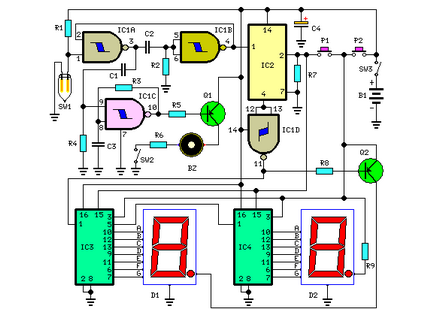
Digital Step-Km Counter Circuit Schematic
This circuit measures the distance covered during a walk. The hardware is housed in a small box that can be placed in a pocket, and the display is designed as follows: the leftmost display D2 (the most significant digit) indicates...

Camshaft Position Sensor
AutoZone Repair Guide for Engine Performance and Emission Control Components and Systems, specifically focusing on the Camshaft Position Sensor.
The Camshaft Position Sensor (CMP) is a critical component in modern internal combustion engines, playing a vital role in the management of...