


control line follower robot controlled
#infrared sensors
#LM324
#comparator
#motor control
#line follower
#black tracking tape
#logic output
#robot
#automation
#educational circuits
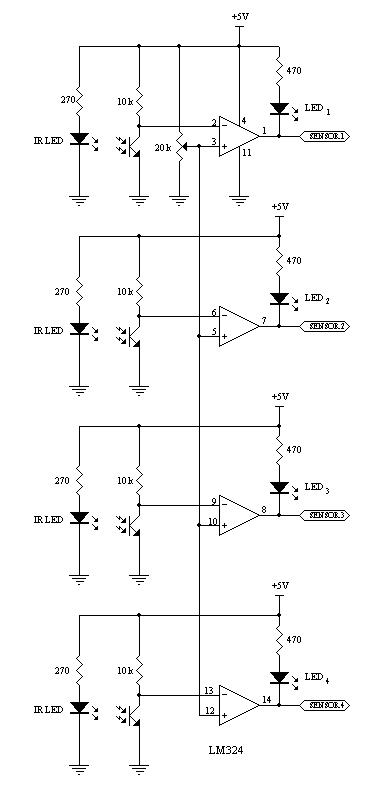
Description: This robot utilizes two motors to control the rear wheels, while the single front wheel is free to move. It is equipped with four infrared sensors located on the underside to detect black tracking tape. When the sensors identify the presence of black color, the output from the comparator, LM324, transitions to a low logic state, while the outputs from the other sensors remain in a high logic state.
The robot's design incorporates a dual-motor system for the rear wheels, allowing for effective maneuverability and control. Each motor can be independently driven, enabling the robot to navigate turns and curves along the tracking tape. The free-rolling front wheel aids in maintaining balance and stability during movement.
The infrared sensors play a crucial role in the robot's tracking capabilities. Positioned strategically to maximize detection, these sensors emit infrared light and measure the reflected light to distinguish between the black tape and the surrounding surface. The LM324 comparator is employed to process the sensor outputs. When a sensor detects the black tape, it generates a low logic signal, while the sensors not detecting black tape produce high logic signals. This differential output is essential for the control logic that adjusts the motor speeds and directions, allowing the robot to follow the tape accurately.
The control system can be implemented using a microcontroller that interprets the sensor outputs and drives the motors accordingly. For instance, if the left sensor detects black tape while the right does not, the microcontroller can reduce the speed of the left motor or even reverse it slightly, causing the robot to turn right and realign itself with the tracking tape. Conversely, if the right sensor detects black tape, the robot will adjust by turning left.
In summary, this robot's operation is characterized by its dual rear motors, a free front wheel for stability, and a sophisticated sensor system that allows it to follow a predefined path effectively. The integration of the LM324 comparator enhances the responsiveness of the robot to changes in its environment, making it suitable for various applications in automated navigation and robotics.This Robot use two motors control rear wheels and the single front wheel is free. It has 4-infrared sensors on the bottom for detect black tracking tape, when the sensors detected black color, output of comparator, LM324 is low logic and the other the output is high.
The robot's design incorporates a dual-motor system for the rear wheels, allowing for effective maneuverability and control. Each motor can be independently driven, enabling the robot to navigate turns and curves along the tracking tape. The free-rolling front wheel aids in maintaining balance and stability during movement.
The infrared sensors play a crucial role in the robot's tracking capabilities. Positioned strategically to maximize detection, these sensors emit infrared light and measure the reflected light to distinguish between the black tape and the surrounding surface. The LM324 comparator is employed to process the sensor outputs. When a sensor detects the black tape, it generates a low logic signal, while the sensors not detecting black tape produce high logic signals. This differential output is essential for the control logic that adjusts the motor speeds and directions, allowing the robot to follow the tape accurately.
The control system can be implemented using a microcontroller that interprets the sensor outputs and drives the motors accordingly. For instance, if the left sensor detects black tape while the right does not, the microcontroller can reduce the speed of the left motor or even reverse it slightly, causing the robot to turn right and realign itself with the tracking tape. Conversely, if the right sensor detects black tape, the robot will adjust by turning left.
In summary, this robot's operation is characterized by its dual rear motors, a free front wheel for stability, and a sophisticated sensor system that allows it to follow a predefined path effectively. The integration of the LM324 comparator enhances the responsiveness of the robot to changes in its environment, making it suitable for various applications in automated navigation and robotics.This Robot use two motors control rear wheels and the single front wheel is free. It has 4-infrared sensors on the bottom for detect black tracking tape, when the sensors detected black color, output of comparator, LM324 is low logic and the other the output is high.
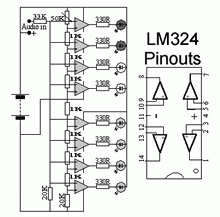
LM324 Based LED VU-Meter
The circuit is conventionally designed with an eight LED audio level meter made from two low-power quad op-amps utilizing the LM324. Volume Unit.
The eight LED audio level meter circuit serves as a visual representation of audio signal levels, providing real-time...

LINUSBot - Line Follower Robot using Arduino
If the robot is positioned on the black line, it will continue moving forward. However, if it veers off the line and enters a white area, it will assess whether to correct its path to the left or right, allowing...

My Motors got me to Tap into Radiant Energy
A new user is seeking to share information about their experiences on this platform.
The user expresses a desire to communicate and engage with the community regarding their experiences. This indicates an interest in exchanging knowledge and possibly seeking assistance or...

Belt conveyor interlock motor operation sequence control circuit
The circuit depicted in Figure 3-86 utilizes a line utilization time relay to control two motors, starting one before the other after an initial stall. The time relay KTi can be adjusted to modify the starting interval of the two...

Simple Analogue Electronic Key
This circuit utilizes two comparators configured as a window comparator. Resistors R2, R5, and R10 establish a voltage window within which the voltage at the junction of D2 and D6 must reside for the outputs of IC2.A and IC2.B to...

Objects in Flux
The Open Source Automation project is a free automation software that operates on Windows and does not require programming for setup. It features a user-friendly graphical interface and includes unique functionalities that are not typically found in high-end security and...

The Hoser Paper
A robot named "Wet Dream" was constructed to roam around, avoid collisions, locate people, and squirt them with an onboard motorized water gun. The robot was designed to maneuver in unstructured environments and react purposefully to various situations. "Wet Dream"...

LM324 For Parking Sensor
The following circuit illustrates the use of the LM324 in a parking sensor circuit diagram. Features: When the obstacle is beyond 25 cm, none of the above LEDs will activate.
The LM324 is a quad operational amplifier that is commonly used...

fun robot line followers
When new to electronics and lacking experience or direction, one book provided guidance on building interesting projects: "Robot Building for Beginners" by David Cook. In this book, Cook outlines the fundamental components and design considerations essential for constructing a simple...