


Day and Night Infrared Detection
#infrared
#phototransistor
#LM339
#voltage comparator
#day and night detection
#model railroading
#light sensing
#train detection

Description: The following is a method to allow day and night detection using Infrared/Visible light sensitive phototransistors and a simple LM339 voltage comparator circuit. A phototransistor is mounted between the rails so that it is covered by the train as it passes. A system widely used in model railroading. For daytime operation the room lights would be on and when the train blocks this light the train is detected. However when the room lights are dimmed or turned off for night operation, under normal conditions the phototransistor would go dark and act as if it was covered by a train and give a false detection.
The proposed circuit utilizes a phototransistor that is sensitive to both infrared and visible light, allowing it to effectively detect the presence of a train by monitoring light levels in its vicinity. The phototransistor is strategically positioned between the rails of the model train track, ensuring that it is shielded from ambient light when a train passes over it. This configuration is particularly advantageous in model railroading applications where accurate detection of train presence is crucial for signaling and control systems.
The LM339 voltage comparator serves as the core component for processing the output from the phototransistor. The comparator is designed to compare the voltage signal generated by the phototransistor with a predefined reference voltage. During daytime operation, when the room lights are on, the phototransistor receives ample light, resulting in a higher output voltage. When a train passes and blocks the light, the output voltage from the phototransistor drops significantly, triggering the LM339 to change its output state and indicating the presence of a train.
For night operation, the challenge arises from the fact that when the room lights are dimmed or turned off, the phototransistor may not receive sufficient light, leading to a condition where it appears to be blocked by a train even in the absence of one. To mitigate this issue, the circuit can incorporate an additional light source or a secondary detection mechanism that maintains a baseline light level, ensuring that the phototransistor does not falsely indicate a train's presence.
In summary, this circuit design effectively integrates a light-sensitive phototransistor with an LM339 voltage comparator to create a robust train detection system that operates reliably under varying lighting conditions, making it an ideal solution for model railroading enthusiasts. Proper calibration of the reference voltage and consideration of ambient light conditions are essential for optimal performance.The following is a method to allow day and night detection using Infrared/Visible light sensitive phototransistors and a simple LM339 voltage comparator circuit. A phototransistor is mounted between the rails so that it is covered by the train as it passes. A system widely used in model railroading. For daytime operation the room lights would be on and when the train blocks this light the train is detected.
However when the room lights are dimmed or turned off for night operation, under normal conditions the phototransistor would go dark and act as if it was covered by a train and give a false detection.
The proposed circuit utilizes a phototransistor that is sensitive to both infrared and visible light, allowing it to effectively detect the presence of a train by monitoring light levels in its vicinity. The phototransistor is strategically positioned between the rails of the model train track, ensuring that it is shielded from ambient light when a train passes over it. This configuration is particularly advantageous in model railroading applications where accurate detection of train presence is crucial for signaling and control systems.
The LM339 voltage comparator serves as the core component for processing the output from the phototransistor. The comparator is designed to compare the voltage signal generated by the phototransistor with a predefined reference voltage. During daytime operation, when the room lights are on, the phototransistor receives ample light, resulting in a higher output voltage. When a train passes and blocks the light, the output voltage from the phototransistor drops significantly, triggering the LM339 to change its output state and indicating the presence of a train.
For night operation, the challenge arises from the fact that when the room lights are dimmed or turned off, the phototransistor may not receive sufficient light, leading to a condition where it appears to be blocked by a train even in the absence of one. To mitigate this issue, the circuit can incorporate an additional light source or a secondary detection mechanism that maintains a baseline light level, ensuring that the phototransistor does not falsely indicate a train's presence.
In summary, this circuit design effectively integrates a light-sensitive phototransistor with an LM339 voltage comparator to create a robust train detection system that operates reliably under varying lighting conditions, making it an ideal solution for model railroading enthusiasts. Proper calibration of the reference voltage and consideration of ambient light conditions are essential for optimal performance.The following is a method to allow day and night detection using Infrared/Visible light sensitive phototransistors and a simple LM339 voltage comparator circuit. A phototransistor is mounted between the rails so that it is covered by the train as it passes. A system widely used in model railroading. For daytime operation the room lights would be on and when the train blocks this light the train is detected.
However when the room lights are dimmed or turned off for night operation, under normal conditions the phototransistor would go dark and act as if it was covered by a train and give a false detection.

Infrared approach detector / sensor
The basic operation of the monitor connected to the circuit is to detect objects (obstacles) at distances ranging from a few millimeters to several centimeters. This type of circuit is utilized in various industries and hospitals. The position sensor IC2...
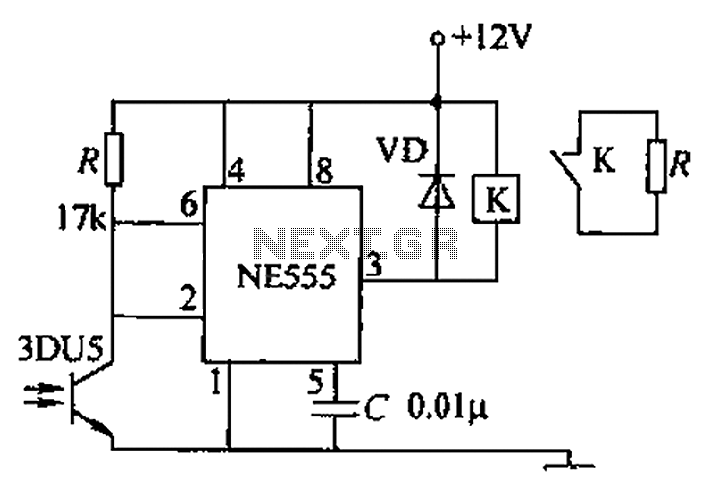
Infrared remote control relay circuit b
A transmitting circuit powered by an infrared light-emitting diode emits light. The receiving circuit, shown in the figure, utilizes a transistor (3DU5) to receive the infrared light and output the received signal. The signal is sent to terminal 3 through...

Infrared automatic faucet circuit diagram
The circuit consists of the following components: (1) An infrared emitter which utilizes a multi-harmonic oscillator based on a 555 timer circuit. The oscillation frequency is determined by the values of RP1, R1, and C1, resulting in a frequency of...

Infrared alarm barrier circuit
This infrared alarm barrier is designed to detect individuals passing through doorways, corridors, and small gates. The transmitter emits a beam of infrared light that is invisible to the human eye. When the light beam is interrupted by a person,...

TX05C-R infrared surveillance alarm circuit
The TX05C-R infrared surveillance alarm circuit is designed for monitoring walls, windows, doors, and various restricted areas. When an intrusion occurs, the alarm activates to enhance security. The circuit comprises a transmitter module, a receiver module, a time-base circuit, a...

Infrared burglar alarm circuit schematic
The schematic for an infrared burglar alarm circuit is depicted in Figure 1. The infrared transmitter operates as a multivibrator with an oscillation frequency of 40 kHz, utilizing the NE555 integrated circuit (IC2), along with resistors R1 and R2 and...

Infrared alarm barrier circuit
This infrared alarm barrier is designed to detect individuals passing through doorways, corridors, and small gates. The transmitter emits a beam of infrared light that remains invisible to the human eye. When a person interrupts the light beam, the buzzer...

P228 infrared remote control with production of energy-saving lighting
The core device is a circuit pyroelectric infrared sensor (BH). When it detects infrared radiation from a body, the sensor element responds to changes in temperature. As a thermoelectric element, its self-ferroelectric polarization value changes, causing a discharge of charge...

Invisible infrared pulsed laser
The device generates an adjustable frequency of low to medium powered infrared (IR) pulses of invisible energy and must be handled with care. The portable battery pack is stepped up to 200 to 300 volts by the inverter circuit, which...