


Driving Strain-Gauge Bridge Sensors with Signal-Conditioning ICs
#strain-gauge
#signal conditioning
#pressure sensor
#weight measurement
#force measurement
#torque measurement
#materials analysis
#electrical signal
#transducer
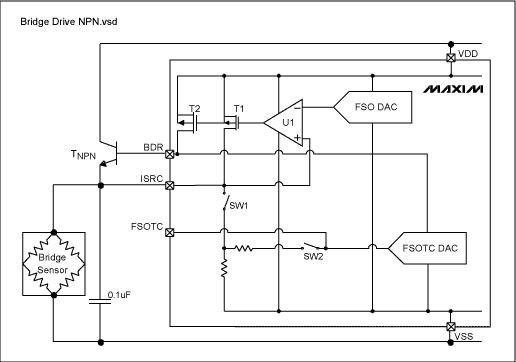
Description: Strain-gauge sensors convert strain into an electrical signal for applications in pressure sensors, weight measurements, force and torque measurements, and materials analysis. A strain gauge functions as a resistor, with its resistance value changing in response to strain.
Strain-gauge sensors are widely utilized in various fields due to their ability to provide precise measurements of mechanical deformation. These sensors operate on the principle of electrical resistance variation, which is directly related to the amount of strain experienced by the material to which they are attached. When a strain gauge is subjected to tensile or compressive forces, it undergoes deformation, resulting in a change in its electrical resistance.
The basic construction of a strain gauge typically consists of a thin wire or a metallic foil arranged in a grid pattern, which is adhered to a backing material. This configuration allows for maximum sensitivity to strain while minimizing the effects of temperature and other environmental factors. The change in resistance can be measured using a Wheatstone bridge circuit, which provides a high degree of accuracy and sensitivity.
In practical applications, strain-gauge sensors are integrated into various devices. For instance, in pressure sensors, they can be used to measure the deformation of a diaphragm under pressure, translating this physical change into an electrical signal that can be processed and displayed. In weighing scales, strain gauges are often employed to detect the minute changes in resistance caused by the weight of an object, enabling precise weight measurements.
Moreover, strain gauges find extensive use in force and torque measurement systems, where they allow for the quantification of forces applied to structures or components. In materials testing and analysis, these sensors can provide critical data on material properties, such as tensile strength and elasticity, by measuring the strain experienced during stress tests.
Overall, the versatility and accuracy of strain-gauge sensors make them essential components in many engineering applications, contributing significantly to advancements in measurement technology and materials science.Strain-gauge sensors transduce (convert) strain into an electrical signal for use in pressure sensors, weight measurements, force and torque measurements, and materials analysis. A strain gauge is simply a resistor, whose value varies with strain in..
Strain-gauge sensors are widely utilized in various fields due to their ability to provide precise measurements of mechanical deformation. These sensors operate on the principle of electrical resistance variation, which is directly related to the amount of strain experienced by the material to which they are attached. When a strain gauge is subjected to tensile or compressive forces, it undergoes deformation, resulting in a change in its electrical resistance.
The basic construction of a strain gauge typically consists of a thin wire or a metallic foil arranged in a grid pattern, which is adhered to a backing material. This configuration allows for maximum sensitivity to strain while minimizing the effects of temperature and other environmental factors. The change in resistance can be measured using a Wheatstone bridge circuit, which provides a high degree of accuracy and sensitivity.
In practical applications, strain-gauge sensors are integrated into various devices. For instance, in pressure sensors, they can be used to measure the deformation of a diaphragm under pressure, translating this physical change into an electrical signal that can be processed and displayed. In weighing scales, strain gauges are often employed to detect the minute changes in resistance caused by the weight of an object, enabling precise weight measurements.
Moreover, strain gauges find extensive use in force and torque measurement systems, where they allow for the quantification of forces applied to structures or components. In materials testing and analysis, these sensors can provide critical data on material properties, such as tensile strength and elasticity, by measuring the strain experienced during stress tests.
Overall, the versatility and accuracy of strain-gauge sensors make them essential components in many engineering applications, contributing significantly to advancements in measurement technology and materials science.Strain-gauge sensors transduce (convert) strain into an electrical signal for use in pressure sensors, weight measurements, force and torque measurements, and materials analysis. A strain gauge is simply a resistor, whose value varies with strain in..

Digital Pressure Gauge Circuit
This electronic pressure gauge utilizes a Wheatstone bridge-type pressure sensor to drive a 3 A digit A/D converter and a display. IC1 is a quad op-amp that interfaces the bridge sensor to the A/D converter. R16 allows for zero adjustment,...

Error Compensation Circuit for Pressure Sensor
To obtain an accurate pressure value, it is essential to eliminate offset errors. Numerous basic circuit designs are employed to remove these offset errors.
Offset errors in pressure measurement systems can lead to inaccuracies in the readings, which may affect the...

Signal Conditioners Information
Signal conditioning involves a series of operations applied to a signal to make it compatible for interfacing with other devices or systems. Signal conditioners are the devices that execute this operation, featuring both an input and an output. Typically, the...

pressure sensor circuit
A dance pad consists of four pressure sensors (up, down, left, right). A USB controller has already been created for the dance pad, and the next step involves connecting the actual sensors. The intention is to pull the input down...

Pressure Sensor Alarm
The general-purpose circuit of the simple pressure sensor alarm is constructed using a few easily accessible and inexpensive components. The operation of this circuit is straightforward.
The simple pressure sensor alarm circuit typically includes a pressure sensor, an operational amplifier (op-amp),...

Pressure sensor circuit with a filtering and amplification circuit diagrams
The filtering and amplifying circuit consists of two main components. The MAXIM MAX267 filter is an integrated circuit that can function as a low-pass, band-pass, high-pass filter, and other configurations, offering superior performance compared to traditional op-amp filters. The MAXIM...

1B32 bridge sensor signal conditioner with multi-channel application circuit when the pressure sensor
The 1B32 application circuit features multiple pressure sensors as illustrated in the figure. Excitation power is supplied through the AD542, which is followed by a TIP32 transistor that drives multiple bridge sensors. The AD542 operates as a Bi-FET in the...

Bridge integrated pressure signal conditioner MAX1450 drive circuit diagram
The circuit diagram for the bridge integrated pressure signal conditioner MAX1450 is composed of various components.
The MAX1450 is a high-performance integrated circuit designed for signal conditioning in pressure sensing applications. It is particularly suited for use with resistive bridge sensors,...

Pressure Sensor Signal Conditioning Circuit with Single Op-Amp
This is a pressure sensor signal conditioning circuit. It is a simple and inexpensive circuit due to its small geometry and the use of a straightforward pressure sensor.
The pressure sensor signal conditioning circuit is designed to convert the raw output...