


Dual-liquid-level-detector
#liquid level detector
#CA3410
#BiMOS op amp
#current sensing
#low current
#sensor
#op amp
#measurement

Description: Utilizes the CA3410 quad BiMOS operational amplifier to detect small currents. Due to the low input current of the op-amp, a current as small as 1 pA flowing through the sensor will cause the converter's output to vary by approximately 10 to 12 V.
The circuit employs the CA3410, which is known for its high input impedance and low bias current characteristics, making it particularly suitable for applications involving the measurement of minute currents. The configuration of the op-amp in this setup is typically as a differential amplifier or as part of a transimpedance amplifier, which converts the sensed current into a voltage output.
In this circuit, the small current is sensed through a resistor or a specialized sensor that translates the current flow into a voltage drop. The CA3410 amplifies this voltage drop, leveraging its high gain to output a significant voltage change. The output voltage range of 10 to 12 V in response to a 1 pA input current indicates a high sensitivity and gain factor, which is crucial for applications in precision measurements, such as in biomedical instrumentation or sensitive environmental monitoring.
The circuit design should also include appropriate feedback mechanisms to stabilize the gain and prevent oscillations. Additionally, filtering components may be integrated to eliminate noise and enhance the signal integrity. Overall, the CA3410-based circuit provides an effective solution for sensing and amplifying ultra-low currents, making it an essential component in various electronic measurement systems.Uses CA3410 quad BiMOS op amp to sense small currents. Because the op amp"s input current is low, a current of only 1 p.A passing through the sensor will change the converter"s output by as much as 10 to 12 V.
The circuit employs the CA3410, which is known for its high input impedance and low bias current characteristics, making it particularly suitable for applications involving the measurement of minute currents. The configuration of the op-amp in this setup is typically as a differential amplifier or as part of a transimpedance amplifier, which converts the sensed current into a voltage output.
In this circuit, the small current is sensed through a resistor or a specialized sensor that translates the current flow into a voltage drop. The CA3410 amplifies this voltage drop, leveraging its high gain to output a significant voltage change. The output voltage range of 10 to 12 V in response to a 1 pA input current indicates a high sensitivity and gain factor, which is crucial for applications in precision measurements, such as in biomedical instrumentation or sensitive environmental monitoring.
The circuit design should also include appropriate feedback mechanisms to stabilize the gain and prevent oscillations. Additionally, filtering components may be integrated to eliminate noise and enhance the signal integrity. Overall, the CA3410-based circuit provides an effective solution for sensing and amplifying ultra-low currents, making it an essential component in various electronic measurement systems.Uses CA3410 quad BiMOS op amp to sense small currents. Because the op amp"s input current is low, a current of only 1 p.A passing through the sensor will change the converter"s output by as much as 10 to 12 V.

Sine-Wave/Square-Wave Converter
An operational amplifier (op amp) configured as a comparator generates a 10-V peak-to-peak square wave output with a 100-mV input signal at a frequency of up to 15 kHz. The resistor R5 can be adjusted to achieve symmetry in the...

THERMOMETER ADAPTER
A simple operational amplifier and silicon diode form the core of a temperature-to-voltage converter, allowing the use of a standard voltmeter—either analog or digital—to measure temperature. User adjustments enable readings of either 10 mV or 100 mV to correspond to...
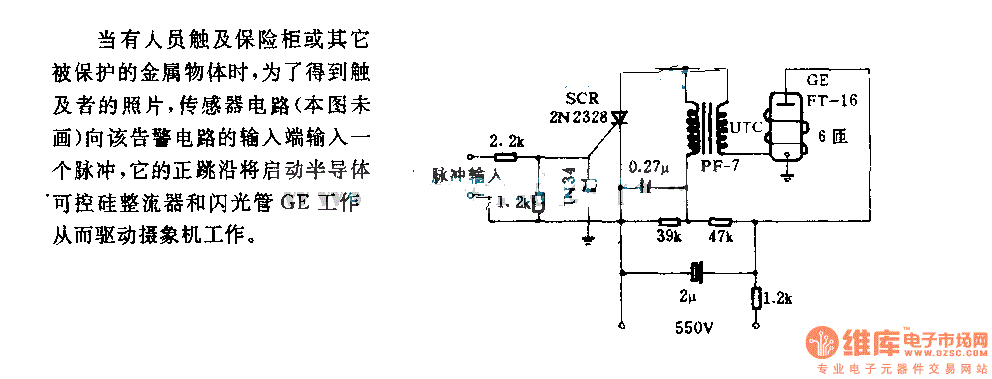
The alarm circuit diagram for safety box and other metal objects
When an individual touches the safety box or other protected metal objects, the sensor circuit generates a pulse to the alarm circuit. The positive edge of this pulse activates the semiconductor and thyristor flash GE, subsequently triggering the camera to...
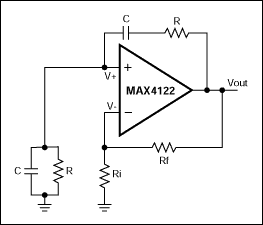
Nodal Analysis of Op Amp Circuits
This application note explains how the transfer function of most operational amplifier circuits can be derived through a straightforward process of nodal analysis.
The transfer function of operational amplifier (op amp) circuits is a critical aspect for understanding their behavior in...

Current sensing relay
It operates by PWM (Pulse Width Modulation) - well, actually by PFM - Pulse Frequency Modulation. At power up, C1 charges up via D1 and R1. R2 will conduct, pulling the base of the emitter follower, Tr2, up and feeding...

Current sense schematic question
Exploring various methods for current sensing using standard operational amplifiers instead of specialized chips like the MAX4073T/F/H, which perform well but are relatively expensive. An article by Bob Pease discussing "error budgets" caught attention, particularly Figure Two of the schematic,...

Extended-play-circuit
A single operational amplifier, one of four included in the widely used LM324, is functioning within a variable pulse-width, free-running square wave oscillator circuit. Its output drives two transistors that manage the on/off cycle of the tape-drive motor. The oscillator's...

Design Of Op Amp Sine Wave Oscillators
The HV732 is a complete, high-speed, high-voltage ultrasound transmitter pulser. This high-performance CMOS integrated circuit (IC) is housed in a single 7x7x0.9 mm 44-lead multi-die QFN package. The HV732 can deliver up to ±2A source and sink current to the...

Simple Radio Circuit using Op Amp
A low-cost, simple radio circuit schematic using an operational amplifier. This radio circuit diagram consists of a sensitive audio amplifier that receives strong signals.
The presented radio circuit schematic utilizes an operational amplifier (op-amp) to create a cost-effective and straightforward radio...