


EMF sensor circuit diagram
#EMF sensor
#electromagnetic radiation
#1mH inductor
#electric field
#hidden wiring
#detection circuit
#simple circuit
#sensor

Description: This is a simple circuit designed to detect electromagnetic radiation, including hidden wiring. It utilizes a 1mH inductor to sense the electric field. The induced voltage from the inductor is amplified by an operational amplifier (op-amp). An audio headset is connected to the output of the op-amp to provide audio feedback of the detected electric field. For instance, the 50 Hz hum from a power transformer can be heard. A variable resistor (potentiometer) labeled R4 is used to adjust the gain of the amplifier. By positioning the inductance sensor near a telephone line, it is possible to overhear conversations. The circuit can be powered by a 9V PP3 battery, which is preferable for the radial inductor L1. A sliding switch (S1) is included for turning the circuit on and off. It is recommended to install a holder for the integrated circuit (IC1), and all electrolytic capacitors should be rated for at least 15V.
This electromagnetic radiation detection circuit operates by utilizing the principles of inductance and amplification. The core component, the 1mH inductor, acts as a sensor that detects variations in the electric field caused by nearby electrical devices or wiring. When the inductor is exposed to an electric field, it induces a voltage proportional to the strength of that field. This induced voltage is typically very small, necessitating amplification for practical audio output.
The operational amplifier serves as the main amplification stage, where the induced voltage is increased to a level suitable for audio output. The gain of this amplifier can be finely adjusted using the potentiometer R4, allowing the user to tailor the sensitivity of the circuit based on the surrounding electromagnetic environment. This feature is particularly useful when trying to detect weak signals or when the circuit is used in environments with varying levels of electromagnetic noise.
The audio output is connected to a headset, enabling real-time monitoring of the detected signals. The circuit is capable of picking up low-frequency hums, such as the 50 Hz from power transformers, which can be heard as a distinct sound through the headset. Additionally, when the sensor is placed close to telephone lines, it can pick up and amplify the audio signals from conversations, demonstrating its potential for both educational and practical applications.
Powering the circuit with a 9V PP3 battery ensures portability and ease of use. The inclusion of a sliding switch (S1) allows the user to easily turn the device on and off, conserving battery life when the circuit is not in use. It is essential to ensure that the integrated circuit (IC1) is securely mounted in its holder for reliable operation. Furthermore, all electrolytic capacitors in the circuit should be rated for at least 15V to prevent failure under operational conditions. Proper assembly and adherence to these guidelines will result in a functional and effective electromagnetic radiation detection circuit.This is a very simple circuit that can detect electromagnetic radiation. The circuit can even detect hidden wrings. A 1mH inductor is used to sense the electric field. Induces a small electric field sensor inductance voltage, this induced voltage amplification opamp.The headset connected to the output of the operational amplifier audio instruction field. For example, the electric field around the power transformer 50 Hz hum can be heard. R4 pot can be used to adjust the gain of the amplifier. By keeping inductance sensor near a telephone line, you can even hear the telephone conversation. Circuit diagram and parts list Precautions In general PCB assembly circuit. The circuit can be powered from a 9V PP3 battery. This is better for the radial inductor L1. R4 pot can be used to adjust the gain. A switch S1 to ON / OFF switch sliding. You must install IC1 holders. All electrolytic capacitors must be rated for at least 15V.
This electromagnetic radiation detection circuit operates by utilizing the principles of inductance and amplification. The core component, the 1mH inductor, acts as a sensor that detects variations in the electric field caused by nearby electrical devices or wiring. When the inductor is exposed to an electric field, it induces a voltage proportional to the strength of that field. This induced voltage is typically very small, necessitating amplification for practical audio output.
The operational amplifier serves as the main amplification stage, where the induced voltage is increased to a level suitable for audio output. The gain of this amplifier can be finely adjusted using the potentiometer R4, allowing the user to tailor the sensitivity of the circuit based on the surrounding electromagnetic environment. This feature is particularly useful when trying to detect weak signals or when the circuit is used in environments with varying levels of electromagnetic noise.
The audio output is connected to a headset, enabling real-time monitoring of the detected signals. The circuit is capable of picking up low-frequency hums, such as the 50 Hz from power transformers, which can be heard as a distinct sound through the headset. Additionally, when the sensor is placed close to telephone lines, it can pick up and amplify the audio signals from conversations, demonstrating its potential for both educational and practical applications.
Powering the circuit with a 9V PP3 battery ensures portability and ease of use. The inclusion of a sliding switch (S1) allows the user to easily turn the device on and off, conserving battery life when the circuit is not in use. It is essential to ensure that the integrated circuit (IC1) is securely mounted in its holder for reliable operation. Furthermore, all electrolytic capacitors in the circuit should be rated for at least 15V to prevent failure under operational conditions. Proper assembly and adherence to these guidelines will result in a functional and effective electromagnetic radiation detection circuit.This is a very simple circuit that can detect electromagnetic radiation. The circuit can even detect hidden wrings. A 1mH inductor is used to sense the electric field. Induces a small electric field sensor inductance voltage, this induced voltage amplification opamp.The headset connected to the output of the operational amplifier audio instruction field. For example, the electric field around the power transformer 50 Hz hum can be heard. R4 pot can be used to adjust the gain of the amplifier. By keeping inductance sensor near a telephone line, you can even hear the telephone conversation. Circuit diagram and parts list Precautions In general PCB assembly circuit. The circuit can be powered from a 9V PP3 battery. This is better for the radial inductor L1. R4 pot can be used to adjust the gain. A switch S1 to ON / OFF switch sliding. You must install IC1 holders. All electrolytic capacitors must be rated for at least 15V.

Field disturbance sensor-alarm
The change in ambient light triggers the alarm by changing the resistance of LDR1 and LDR2.
The circuit utilizes two light-dependent resistors (LDR1 and LDR2) to detect variations in ambient light levels. LDRs are passive components that exhibit a change in...

Gate automatic lamp circuit
The circuit utilizes multiple integrated circuits to form an automatic lighting device that is activated by door and window sensors. It includes CD4093 digital integrated circuits, a relay, and a power supply circuit. The system typically remains closed when a...
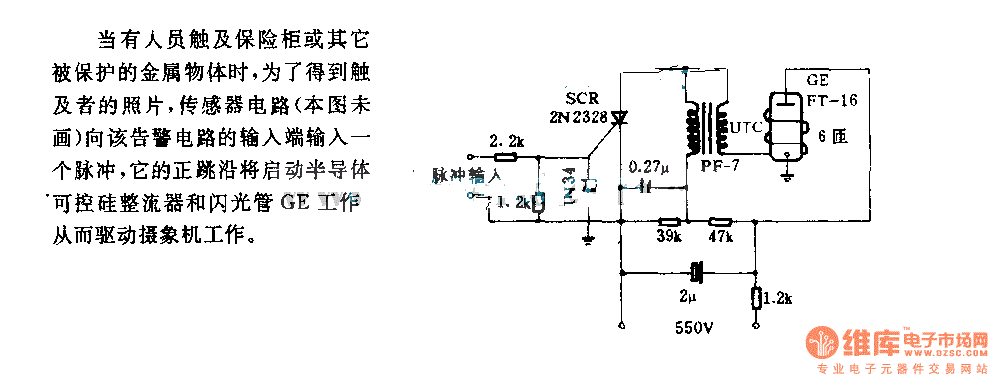
The alarm circuit diagram for safety box and other metal objects
When an individual touches the safety box or other protected metal objects, the sensor circuit generates a pulse to the alarm circuit. The positive edge of this pulse activates the semiconductor and thyristor flash GE, subsequently triggering the camera to...

Add a sensor to a board and measure something with it
This week's plan is to build a device that warns of the potential for a knockdown, which is the process by which an over-canvassed ship is laid over on her beam-ends. The risk of sinking is high during this event,...

Automatic plant waterer
The unit consists of a sensor, timer, and electric water pump. The sensor is embedded in the soil, and when dry, the electronics operate the water pump for a preset time. The circuit is composed of a level-sensitive Schmitt trigger,...
The alarm circuit diagram for safety box and other metal objects
When an individual touches the safety box or other protected metal objects, the sensor circuit generates a pulse to the alarm circuit. The positive edge of this pulse activates the semiconductor and thyristor flash GE, subsequently triggering the camera to...

Simple Oscillator / Pipe Locator
Occasionally, there is a requirement to create a very basic oscillator. The circuit illustrated here is remarkably straightforward, utilizing only three components.
The described oscillator circuit typically consists of a resistor, a capacitor, and a single transistor. The operation of this...

Electric Field Mill Fabrication
This page outlines the construction of an electric field mill, a device used to measure the electric field strength on Earth due to static electric fields and the charge of clouds overhead. It can also investigate the effects of static...

Wire Break Sensor Alarm Circuit Schematic
The circuit of a loop sensor-based simple security alarm is described here. The sensor loop consists of a short length of thin enamelled copper wire.
The loop sensor security alarm operates on the principle of detecting interruptions in the circuit formed...