


Flame-monitor
#flame monitoring
#light sensor
#120V load
#L14G1
#L14C1
#point source
#illumination
#switching
#safety

Description: Monitoring a flame and directly switching a 120-V load can be efficiently achieved using the L14G1 for point sources of light. For light sources that subtend over 10 degrees of arc, the L14C1 should be utilized, and the illumination levels should be increased by a factor of 5. This circuit offers zero voltage switching to eliminate phase control.
The circuit design for flame monitoring and load switching incorporates the L14G1 phototransistor for point light sources, which is well-suited for applications requiring precise flame detection. When the flame is detected, the L14G1 activates a relay or a solid-state switch, allowing a 120-V AC load to be powered on or off based on the presence of the flame. This functionality is crucial in safety systems, where the immediate response to flame detection is necessary to prevent hazards.
In scenarios where the light source subtends an angle greater than 10 degrees, the use of the L14C1 phototransistor is recommended. This component is designed to handle broader light sources effectively. The circuit must be adjusted to increase the illumination levels by a factor of 5, ensuring that the phototransistor receives adequate light intensity to function correctly. This adjustment may involve modifying the sensitivity settings or incorporating additional optical elements to focus the light onto the sensor.
The implementation of zero voltage switching in this circuit significantly enhances performance by minimizing electrical noise and reducing the risk of arcing during the switching process. This technique ensures that the load is switched on or off at the point where the voltage crosses zero, thus avoiding the complications associated with phase control methods, such as flickering or delayed response times.
Overall, this circuit design is robust for flame detection and load control applications, ensuring safety and reliability in various environments. Proper selection of components and configuration of the circuit parameters is essential to optimize performance and meet specific operational requirements.Monitoring a flame and directly switching a 120-V load is easily accomplished using the Ll4G1 for point sources of light. For light sources which subtend over 10° of arc, the L14C1 should be used and the illumination levels raised by a factor of 5.
This circuit provides zero voltage switching to eliminate phase controlling.
The circuit design for flame monitoring and load switching incorporates the L14G1 phototransistor for point light sources, which is well-suited for applications requiring precise flame detection. When the flame is detected, the L14G1 activates a relay or a solid-state switch, allowing a 120-V AC load to be powered on or off based on the presence of the flame. This functionality is crucial in safety systems, where the immediate response to flame detection is necessary to prevent hazards.
In scenarios where the light source subtends an angle greater than 10 degrees, the use of the L14C1 phototransistor is recommended. This component is designed to handle broader light sources effectively. The circuit must be adjusted to increase the illumination levels by a factor of 5, ensuring that the phototransistor receives adequate light intensity to function correctly. This adjustment may involve modifying the sensitivity settings or incorporating additional optical elements to focus the light onto the sensor.
The implementation of zero voltage switching in this circuit significantly enhances performance by minimizing electrical noise and reducing the risk of arcing during the switching process. This technique ensures that the load is switched on or off at the point where the voltage crosses zero, thus avoiding the complications associated with phase control methods, such as flickering or delayed response times.
Overall, this circuit design is robust for flame detection and load control applications, ensuring safety and reliability in various environments. Proper selection of components and configuration of the circuit parameters is essential to optimize performance and meet specific operational requirements.Monitoring a flame and directly switching a 120-V load is easily accomplished using the Ll4G1 for point sources of light. For light sources which subtend over 10° of arc, the L14C1 should be used and the illumination levels raised by a factor of 5.
This circuit provides zero voltage switching to eliminate phase controlling.

Light/Dark Detector relay
This handy little circuit can tell the difference between darkness and light, making it very useful for switching on and off signs, porch lights or other things when it gets dark or light. More: R1 Adjusts sensitivity
The circuit described is...

Light-level-detector
If R, the sensor matching resistor, is equal to the "dark" resistance of the cadmium sulfide cell, the amplifier output will range from 0 to 2 as the light level varies from "dark" to "bright." The circuit operates similarly, but...
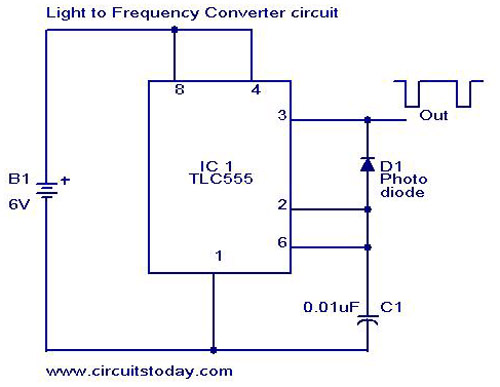
Light to Frequency converter
A simple light-to-frequency converter circuit with a diagram and schematic. It is used as a light intensity measurement circuit. The design utilizes the TLC555, a CMOS version of the NE555 timer IC.
The light-to-frequency converter circuit is designed to convert varying...

Light Sensor Switch
Light Sensitive Switch is a simple project which operates a relay when the light falling on the LDR goes below a set point. More: Input - 12 V @ 55 mA
Relay output - NC-C-NO
Onboard preset to set the level
Power-On LED...

Light Sensor including Photocell and LDR Sensor
Electronics tutorial about light sensors including photocells, LDR, photodiodes, phototransistors, photovoltaic cells, and light-dependent resistors.
Light sensors are crucial components in various electronic applications, enabling devices to respond to changes in ambient light levels. This tutorial covers several types of light...

light activated switch
The brightness of the surrounding light controls the function of this circuit. The light sensor used in this circuit is a light-dependent resistor (LDR). This LDR is connected to the non-inverting input of the 741 op-amp IC. Once the intensity...

Light to Frequency Converter TSL220
A large area photodiode and current-to-frequency converter integrated into a clear plastic 8-pin DIL package. The output generates a pulse train whose frequency is directly proportional to the light intensity. It is CMOS compatible (a 3.3kΩ pulldown resistor is recommended...

Light Sensor Circuits
Dark Activated Switch or Porch Light Switch. This circuit activates a relay when the light level drops below a preset threshold. The light sensitivity can be adjusted using variable resistor VR1, and the relay contacts can control an external light...

sun up alarm schematics
The Up Alarm is designed to provide an audible alert when sunlight is detected or when a light source is activated in a dark environment. It can also be utilized to sense various light sources such as beams or headlights....