


Four quadrant photo-conductive detector amplifier
#photoconductive detector
#light sensor
#amplifier
#motion detection
#quadrant detection
#optical sensor
#signal conditioning
#precision measurement

Description: This circuit is designed to detect four-quadrant motion of a light source. By appropriately summing the signals from the X and Y axes, the resulting four-quadrant output can be utilized with an X-Y plotter, oscilloscope, or computer for simulation purposes. The integrated circuit used in this application is the NE/SE5514.
The circuit operates by utilizing photodetectors aligned along the X and Y axes to capture the intensity of light. Each photodetector generates a voltage proportional to the light intensity it detects. The NE/SE5514 integrated circuit is essential for processing these signals, as it features differential inputs that allow for precise summation of the X and Y signals.
In a typical configuration, two photodiodes are positioned to face the light source, one aligned horizontally (X-axis) and the other vertically (Y-axis). The output voltages from these photodiodes are fed into the NE/SE5514, which performs the necessary signal conditioning and amplification. The output from the IC reflects the position of the light source in a four-quadrant coordinate system, enabling accurate tracking of its motion.
The summed output can be connected to an X-Y plotter, which graphically represents the light source's movement across a two-dimensional plane. Alternatively, the output can be directed to an oscilloscope to visualize the changes in voltage over time, or to a computer for further analysis and simulation. This versatility makes the circuit suitable for various applications, including robotic vision systems, light tracking mechanisms, and experimental setups in optics research.
In summary, this circuit provides a compact and efficient solution for sensing and visualizing the motion of a light source in a four-quadrant space, leveraging the capabilities of the NE/SE5514 integrated circuit for optimal performance.Use this circuit to sense four quadrant motion of a light source By proper summing of the signals from the X and Y axes, four quadrant output may be fed to an X-Y plotter, oscilloscope, or computer for simulation. IC = NE/SE5514.
The circuit operates by utilizing photodetectors aligned along the X and Y axes to capture the intensity of light. Each photodetector generates a voltage proportional to the light intensity it detects. The NE/SE5514 integrated circuit is essential for processing these signals, as it features differential inputs that allow for precise summation of the X and Y signals.
In a typical configuration, two photodiodes are positioned to face the light source, one aligned horizontally (X-axis) and the other vertically (Y-axis). The output voltages from these photodiodes are fed into the NE/SE5514, which performs the necessary signal conditioning and amplification. The output from the IC reflects the position of the light source in a four-quadrant coordinate system, enabling accurate tracking of its motion.
The summed output can be connected to an X-Y plotter, which graphically represents the light source's movement across a two-dimensional plane. Alternatively, the output can be directed to an oscilloscope to visualize the changes in voltage over time, or to a computer for further analysis and simulation. This versatility makes the circuit suitable for various applications, including robotic vision systems, light tracking mechanisms, and experimental setups in optics research.
In summary, this circuit provides a compact and efficient solution for sensing and visualizing the motion of a light source in a four-quadrant space, leveraging the capabilities of the NE/SE5514 integrated circuit for optimal performance.Use this circuit to sense four quadrant motion of a light source By proper summing of the signals from the X and Y axes, four quadrant output may be fed to an X-Y plotter, oscilloscope, or computer for simulation. IC = NE/SE5514.

Light Sensor Circuit
An ambient light sensor circuit is a circuit that utilizes light intensity to perform various applications.
An ambient light sensor circuit typically consists of a light-dependent resistor (LDR) or phototransistor that detects the intensity of ambient light. The sensor converts the...

Comparator light sensor
The circuit is designed to sense ambient light levels and activate lights when it is dark. A prototype was successfully built on a breadboard using an LM324 comparator, various resistors, a trimmer resistor, and a photocell. Subsequently, a PCB was...

Light Sensor
The report provides information related to light sensors, photoresistors, comparators, and associated circuits. It contains extensive details regarding detection.
Light sensors are devices that detect and respond to light levels in the environment. A common type of light sensor is the...

Amplifier circuit
An amplifier is a device that accepts a varying input signal and produces an output signal that varies in the same way as the input but has a larger amplitude. The input signal may be a current, voltage, mechanical motion,...
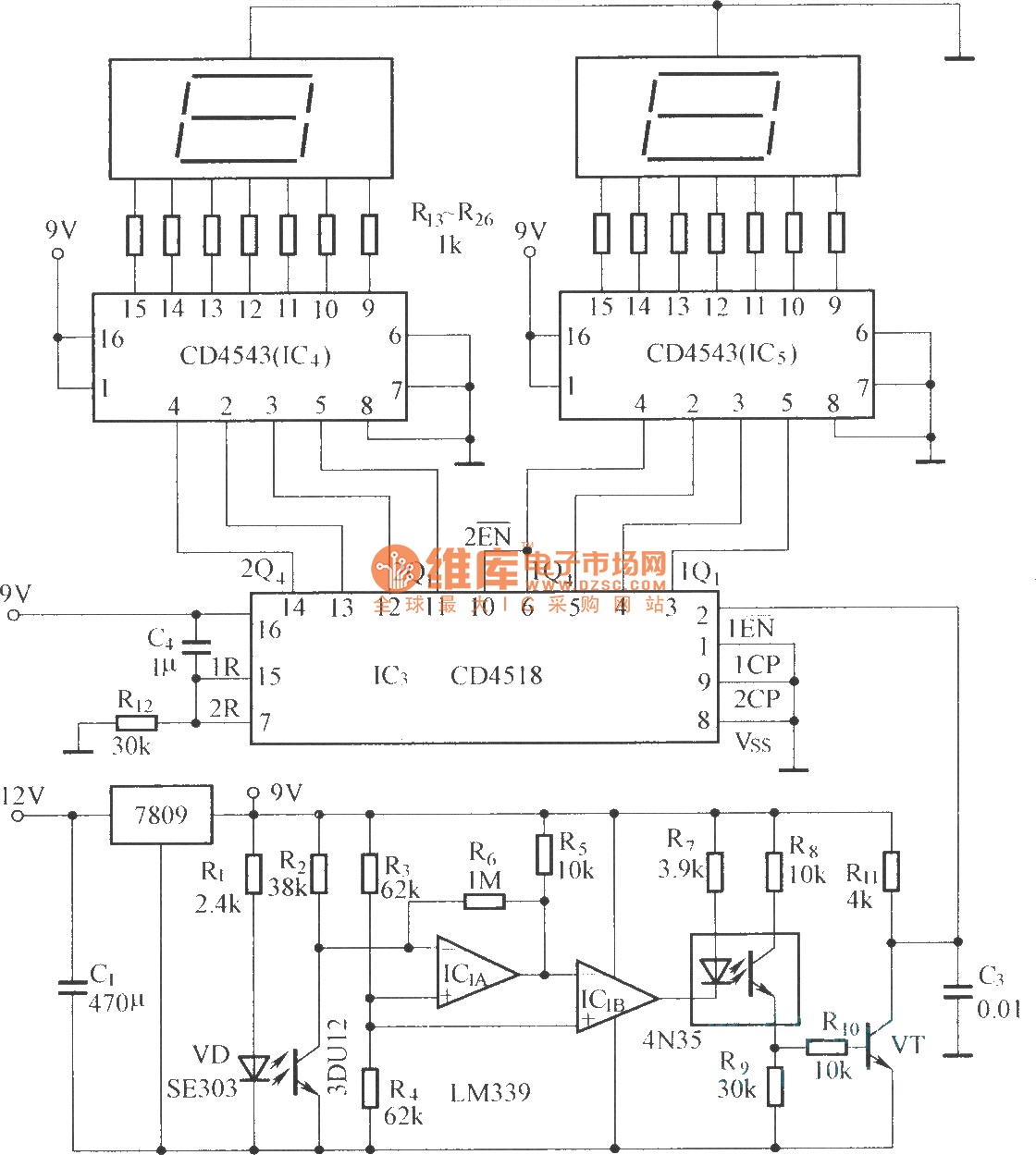
Digital displaying photoelectric counter circuit diagram
The circuit includes an optical input circuit (VD, 3DU12), a pulse forming circuit (IC1A, IC1B functioning as a voltage comparator; optical coupler; transistor switching circuit), and a counting and display circuit.
The circuit architecture consists of several key components that work...

iPod/MP3 Mini Speaker System
Listen and share music wherever you go with the mini speaker system project. This project allows for music playback in various locations such as dorms, cubicles, or the beach. It serves as an excellent introduction to circuit systems, featuring an...

Light-level-detector
If R, the sensor matching resistor, is equal to the "dark" resistance of the cadmium sulfide cell, the amplifier output will range from 0 to 2 as the light level varies from "dark" to "bright." The circuit operates similarly, but...

Ears and Speakers Protector
Occasionally, the output volume of an amplifier can be excessively high, leading to discomfort and potential damage to both the listener's ears and the loudspeaker. The circuit...
Amplifiers are crucial components in audio systems, responsible for boosting audio signals to drive...

pcb Help identifying and finding shematics/datasheets for circuit board
The chip in the center with small bullet holes is likely proprietary. It is possible to salvage a few components from it, although understanding the circuit is not necessary for this purpose. Additionally, it is confirmed that the device is...