


Fully Linear Diode SensorCircuit Based On The A748 IC
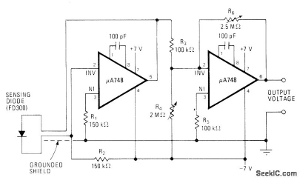
Description: The following circuit illustrates a fully linear diode sensor circuit diagram. This circuit is based on the A748 integrated circuit (IC). Features include the use of an operational amplifier (op-amp).
The fully linear diode sensor circuit utilizes the A748 IC to achieve precise measurements in various applications. The A748 is a high-performance op-amp known for its low offset voltage and high gain bandwidth product, which makes it suitable for sensor applications requiring linearity and accuracy.
In this circuit, the operational amplifier is configured in a feedback loop to maintain linearity across a specified range of input signals. The diode acts as the sensing element, converting physical phenomena—such as temperature, light intensity, or pressure—into an electrical signal. The output of the diode is fed into the op-amp, which amplifies the signal while minimizing distortion.
The circuit typically includes additional components such as resistors and capacitors to set the gain of the op-amp and filter out noise, ensuring that the output remains stable and reliable. The configuration may also incorporate a reference voltage to enhance the linearity of the response.
This sensor circuit can be applied in various fields, including industrial automation, environmental monitoring, and consumer electronics, where accurate sensing and measurement are critical. The design emphasizes simplicity and efficiency, allowing for easy integration into broader electronic systems.The following circuit shows about Fully Linear Diode Sensor Circuit Diagram. This circuit based on the A748 IC. Features: opamp as ..
The fully linear diode sensor circuit utilizes the A748 IC to achieve precise measurements in various applications. The A748 is a high-performance op-amp known for its low offset voltage and high gain bandwidth product, which makes it suitable for sensor applications requiring linearity and accuracy.
In this circuit, the operational amplifier is configured in a feedback loop to maintain linearity across a specified range of input signals. The diode acts as the sensing element, converting physical phenomena—such as temperature, light intensity, or pressure—into an electrical signal. The output of the diode is fed into the op-amp, which amplifies the signal while minimizing distortion.
The circuit typically includes additional components such as resistors and capacitors to set the gain of the op-amp and filter out noise, ensuring that the output remains stable and reliable. The configuration may also incorporate a reference voltage to enhance the linearity of the response.
This sensor circuit can be applied in various fields, including industrial automation, environmental monitoring, and consumer electronics, where accurate sensing and measurement are critical. The design emphasizes simplicity and efficiency, allowing for easy integration into broader electronic systems.The following circuit shows about Fully Linear Diode Sensor Circuit Diagram. This circuit based on the A748 IC. Features: opamp as ..

Fun with Filters!
A simple 1 kHz, 6 Vpp sine wave generator was constructed using a few operational amplifiers and passive components. The goal was to evaluate the quality of the generated sine wave, which is fundamentally a wave-shaped triangle wave. The assessment...
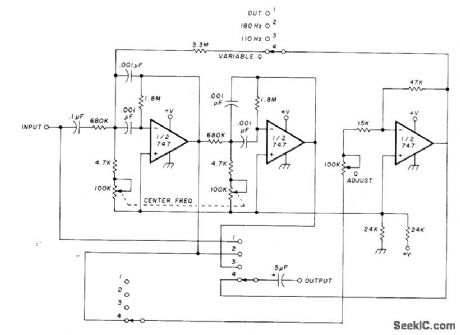
Filter Circuit
The circuit utilizing Optical Electronics 9803 operational amplifiers separates an audio frequency (AF) input signal into two outputs. The low-pass output allows frequencies from DC up to 10 Hz, while the high-pass output encompasses frequency content above 10 Hz, reaching...

Triangular Wave Generator
A triangular wave generator utilizing an operational amplifier (op-amp) is presented. The theoretical foundation and operation of the circuit diagram are discussed. The integration of a square wave signal results in the generation of a triangular wave. A practical circuit...

OPTICALLY COUPLED V F
The input voltage range of 0-10 V is converted to a proportional frequency at the output of an optoisolator using the RM4151 converter. This converter is paired with the RC3403A quad op-amp, which serves multiple functions including inverter, integrator, regulator,...
Filter Circuit
The circuit utilizing Optical Electronics 9803 operational amplifiers separates an audio frequency (AF) input signal into two outputs. The low-pass output allows frequencies from DC up to 10 Hz, while the high-pass output encompasses frequency content above 10 Hz, reaching...

Opamp Design and Test Board
This project is basically what I use for a quick prototype, or for just mucking about with an idea. It is easy to make, and only needs a medium size sheet of un-etched printed circuit board (or possibly two). This...
Opamp Design and Test Board
This project is basically what I use for a quick prototype, or for just mucking about with an idea. It is easy to make, and only needs a medium size sheet of un-etched printed circuit board (or possibly two). This...

Opamp Based Power Amplifier
The amplifier is based on the commonly used class-AB complementary power amplifier with compound pair output transistors. The system uses a TL074 quad opamp to drive the output transistors. As can be seen from figure 1, A2 is used to...
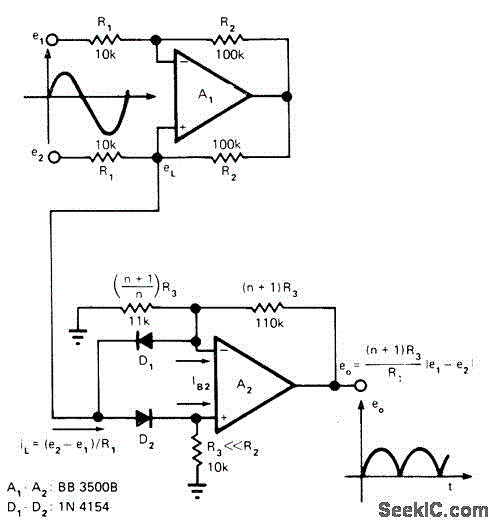
DIFFERENTIAL AC SIGNALS
Precision full-wave rectification of differential voltage is achieved by converting voltage to current for rectification and then reconverting to output voltage. One operational amplifier functions as a voltage-to-current converter, while the other serves as a current-to-current rectifier. This circuit is...