


Heat Sensor Circuit using LM741
#heat sensor
#LM741
#operational amplifier
#temperature sensing
#analog circuit
#sensor design
#circuit design

Description: The following page outlines detail information on how to step by step design a Simple Heat Sensor Circuit. This circuit design utilized LM741 as the operational amplifier. More: Circuit Parts/Components List: Re1 = 12V relay R1 = 47K R2 = 150 390K R3 = 1K8, R4, R5 = 2K2 P1 = 50K Trimmer Pot IC1 = LM741, LM741CN-ND, LM741CN, NE741, μA741, etc. Q1 = 2N2222 2N2222 2N3904-ND D1 = 1N4148 Th1 = 10K
The Simple Heat Sensor Circuit is designed to detect temperature changes and can activate a relay when a specific temperature threshold is exceeded. The circuit primarily employs the LM741 operational amplifier, which serves as a comparator to process the input signals from the temperature sensor.
The components used in the circuit include:
- **Re1 (Relay 12V)**: This relay acts as a switch that is controlled by the output of the LM741. When the temperature exceeds the set point, the relay will close, allowing current to flow through connected devices, such as a fan or alarm system.
- **R1 (47K ohm resistor)**: This resistor is part of the input stage of the circuit and helps set the gain of the operational amplifier.
- **R2 (150K and 390K ohm resistors)**: These resistors are used to form a voltage divider or to set reference voltages for the operational amplifier, ensuring that it operates within the desired voltage range.
- **R3 (1.8K ohm resistor)**: This resistor may be used in conjunction with the other resistors to stabilize the circuit and control the feedback loop of the operational amplifier.
- **R4 and R5 (2.2K ohm resistors)**: These resistors are likely used for biasing purposes or as part of the feedback network for the operational amplifier.
- **P1 (50K Trimmer Potentiometer)**: This adjustable resistor allows for fine-tuning of the circuit's sensitivity, enabling the user to set the temperature threshold at which the relay will activate.
- **IC1 (LM741)**: The LM741 operational amplifier is the core of the circuit, functioning as a comparator. It compares the voltage from the temperature sensor (Th1) with a reference voltage set by the resistors. When the input voltage exceeds the reference voltage, the output of the LM741 changes state, triggering the relay.
- **Q1 (2N2222 or 2N3904 Transistor)**: This transistor acts as a switch that can amplify the current driving the relay, ensuring that it operates effectively without being overloaded.
- **D1 (1N4148 Diode)**: This diode is used for flyback protection across the relay coil, preventing voltage spikes that could damage other components when the relay is de-energized.
- **Th1 (10K Thermistor)**: This temperature sensor changes its resistance with temperature variations. It is the primary component that detects changes in heat, providing the input signal to the operational amplifier.
The design of the circuit allows for a straightforward assembly and tuning process, making it suitable for various applications such as temperature monitoring systems, HVAC controls, or safety alarms. Proper attention should be given to the power supply requirements and the layout of the components to ensure optimal performance and reliability of the heat sensor circuit.The following page outlines detail information on how to step by step design a Simple Heat Sensor Circuit. This circuit design utilized LM741 as the operational amplifier. Circuit Parts/Components List: Re1 = 12V relay R1 = 47K R2 = 150 390K R3 = 1K8, R4, R5 = 2K2 P1 = 50K Trimmer Pot IC1 = LM741, LM741CN-ND, LM741CN, NE741, μA741, etc. Q1 = 2N2222 2N2222 2N3904-ND D1 = 1N4148 Th1 = 10K
The Simple Heat Sensor Circuit is designed to detect temperature changes and can activate a relay when a specific temperature threshold is exceeded. The circuit primarily employs the LM741 operational amplifier, which serves as a comparator to process the input signals from the temperature sensor.
The components used in the circuit include:
- **Re1 (Relay 12V)**: This relay acts as a switch that is controlled by the output of the LM741. When the temperature exceeds the set point, the relay will close, allowing current to flow through connected devices, such as a fan or alarm system.
- **R1 (47K ohm resistor)**: This resistor is part of the input stage of the circuit and helps set the gain of the operational amplifier.
- **R2 (150K and 390K ohm resistors)**: These resistors are used to form a voltage divider or to set reference voltages for the operational amplifier, ensuring that it operates within the desired voltage range.
- **R3 (1.8K ohm resistor)**: This resistor may be used in conjunction with the other resistors to stabilize the circuit and control the feedback loop of the operational amplifier.
- **R4 and R5 (2.2K ohm resistors)**: These resistors are likely used for biasing purposes or as part of the feedback network for the operational amplifier.
- **P1 (50K Trimmer Potentiometer)**: This adjustable resistor allows for fine-tuning of the circuit's sensitivity, enabling the user to set the temperature threshold at which the relay will activate.
- **IC1 (LM741)**: The LM741 operational amplifier is the core of the circuit, functioning as a comparator. It compares the voltage from the temperature sensor (Th1) with a reference voltage set by the resistors. When the input voltage exceeds the reference voltage, the output of the LM741 changes state, triggering the relay.
- **Q1 (2N2222 or 2N3904 Transistor)**: This transistor acts as a switch that can amplify the current driving the relay, ensuring that it operates effectively without being overloaded.
- **D1 (1N4148 Diode)**: This diode is used for flyback protection across the relay coil, preventing voltage spikes that could damage other components when the relay is de-energized.
- **Th1 (10K Thermistor)**: This temperature sensor changes its resistance with temperature variations. It is the primary component that detects changes in heat, providing the input signal to the operational amplifier.
The design of the circuit allows for a straightforward assembly and tuning process, making it suitable for various applications such as temperature monitoring systems, HVAC controls, or safety alarms. Proper attention should be given to the power supply requirements and the layout of the components to ensure optimal performance and reliability of the heat sensor circuit.The following page outlines detail information on how to step by step design a Simple Heat Sensor Circuit. This circuit design utilized LM741 as the operational amplifier. Circuit Parts/Components List: Re1 = 12V relay R1 = 47K R2 = 150 390K R3 = 1K8, R4, R5 = 2K2 P1 = 50K Trimmer Pot IC1 = LM741, LM741CN-ND, LM741CN, NE741, μA741, etc. Q1 = 2N2222 2N2222 2N3904-ND D1 = 1N4148 Th1 = 10K

OP AMP SINE WAVE GENERATOR CIRCUIT
An operational amplifier-based sine wave generator circuit, commonly known as a Wien bridge oscillator, is recognized for its simplicity and stability. The Wien bridge oscillator connects the Wien bridge circuit between the amplifier's input and output terminals. The bridge features...

Operational Amplifier (Op-Amp) Oscillator
This is an operational amplifier (Op-Amp) oscillator circuit. This circuit has several advantages, including its ability to operate at low frequencies.
The operational amplifier oscillator circuit is designed to generate a periodic waveform output, typically a sine or square wave, using...

Analog circuit enforces slow servo response
The all-analog circuit presented controls the rate at which a miniature turbojet engine can be throttled. Increasing or decreasing the throttle too quickly on a miniature turbojet engine, or any jet engine, can lead to quick failure in flight, causing...
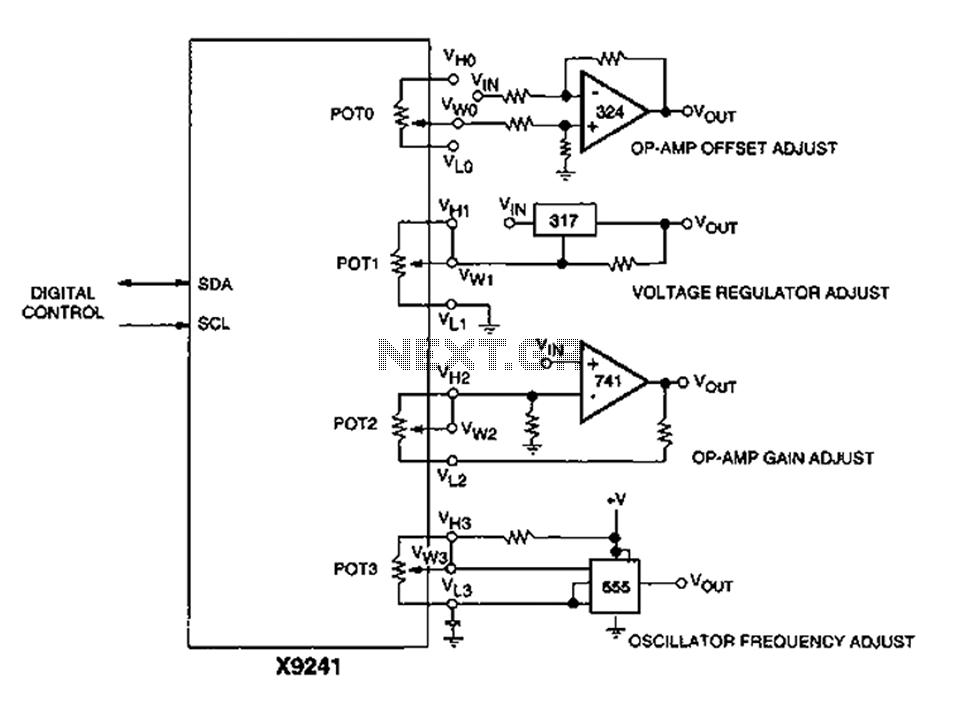
Corrector circuit diagram of an analog circuit
A XICOR X9241 POT IC module can be utilized to modify the four digital analog circuits, as depicted in the schematic.
The XICOR X9241 is a digital potentiometer integrated circuit designed for precise adjustment of analog signal levels in various electronic...

lowvoltage ac voltmeter
The primary component of this circuit is an operational amplifier (such as the 741 or 351), configured as an amplifier with a feedback circuit that consists of a diode bridge full-wave rectifier. An ammeter is connected to the rectifier circuit,...

A delay circuit using an operational amplifier
A delay circuit utilizing an operational amplifier functions as a comparator, providing high timing accuracy. The timer's delay range is from 1 to 30 seconds. The delay time is determined by resistors Ri, RP, and capacitor C. By adjusting RP,...

Heat Sensor Circuit
Two heat sensor circuits are presented. The first circuit is constructed using a 4060 integrated circuit (IC), while the second circuit is simpler and contains fewer components. This serves as a conceptual idea.
The first heat sensor circuit utilizing the 4060...

Class A Modular Preamplifier with Single Integrated Circuit
The circuit is based on a single operational amplifier integrated circuit designed to produce a modular preamplifier that operates in Class A configuration.
The modular preamplifier circuit utilizes a single operational amplifier (op-amp) integrated circuit, which serves as the primary amplification...

LM741 Ham Radio
This circuit illustrates the LM741 Ham Radio Circuit Diagram. Features include AM, FM, 7 MHz SSB Transceiver, FSM, dummy load, and DSB transmitters.
The LM741 operational amplifier is a versatile component widely used in various analog applications, including ham radio circuits....