


How to Design a Blood Pressure Monitor BPM Using the Flexis QE128 Family from Freescale
#blood pressure monitor
#Flexis QE128
#Freescale
#medical sensors
#arterial pressure measurement
#health monitoring
#biomedical circuits
#sensor interface
#pressure sensor
#medical instrumentation

Description: This article demonstrates the implementation of a system capable of measuring arterial blood pressure values.
The arterial blood pressure measurement system typically consists of several key components, including sensors, signal processing units, and display interfaces. The primary sensor used in such systems is a pressure transducer, which converts the mechanical pressure exerted by blood flow into an electrical signal. Common types of pressure transducers include piezoelectric and capacitive sensors, each with specific characteristics suitable for medical applications.
Once the pressure transducer captures the blood pressure data, the signal is often weak and requires amplification. An operational amplifier (op-amp) circuit can be employed for this purpose, enhancing the signal strength while maintaining accuracy. The output from the op-amp is then subjected to analog-to-digital conversion (ADC) to facilitate digital processing.
Microcontrollers or digital signal processors (DSPs) play a crucial role in interpreting the digital signal. They can implement algorithms to calculate systolic and diastolic blood pressure values based on the detected waveforms. These algorithms may also include filtering techniques to eliminate noise and improve measurement reliability.
The processed data can then be displayed on a user interface, which may consist of an LCD or LED display. Additionally, the system can be designed to log data for further analysis or transmit it wirelessly to a connected device, such as a smartphone or computer, for remote monitoring.
Power management is also an essential aspect of the design, ensuring that the system operates efficiently, especially in portable applications. Battery management circuits may be incorporated to provide adequate power supply while optimizing energy consumption.
Overall, the design and implementation of an arterial blood pressure measurement system involve a multidisciplinary approach, integrating principles from electronics, signal processing, and biomedical engineering to achieve accurate and reliable measurements.This article shows how to implement a system that can measure arterial blood pressure values
The arterial blood pressure measurement system typically consists of several key components, including sensors, signal processing units, and display interfaces. The primary sensor used in such systems is a pressure transducer, which converts the mechanical pressure exerted by blood flow into an electrical signal. Common types of pressure transducers include piezoelectric and capacitive sensors, each with specific characteristics suitable for medical applications.
Once the pressure transducer captures the blood pressure data, the signal is often weak and requires amplification. An operational amplifier (op-amp) circuit can be employed for this purpose, enhancing the signal strength while maintaining accuracy. The output from the op-amp is then subjected to analog-to-digital conversion (ADC) to facilitate digital processing.
Microcontrollers or digital signal processors (DSPs) play a crucial role in interpreting the digital signal. They can implement algorithms to calculate systolic and diastolic blood pressure values based on the detected waveforms. These algorithms may also include filtering techniques to eliminate noise and improve measurement reliability.
The processed data can then be displayed on a user interface, which may consist of an LCD or LED display. Additionally, the system can be designed to log data for further analysis or transmit it wirelessly to a connected device, such as a smartphone or computer, for remote monitoring.
Power management is also an essential aspect of the design, ensuring that the system operates efficiently, especially in portable applications. Battery management circuits may be incorporated to provide adequate power supply while optimizing energy consumption.
Overall, the design and implementation of an arterial blood pressure measurement system involve a multidisciplinary approach, integrating principles from electronics, signal processing, and biomedical engineering to achieve accurate and reliable measurements.This article shows how to implement a system that can measure arterial blood pressure values

Bridge integrated pressure signal conditioner MAX1450 drive circuit diagram
The circuit diagram for the bridge integrated pressure signal conditioner MAX1450 is composed of various components.
The MAX1450 is a high-performance integrated circuit designed for signal conditioning in pressure sensing applications. It is particularly suited for use with resistive bridge sensors,...

pressure sensor circuit
A dance pad consists of four pressure sensors (up, down, left, right). A USB controller has already been created for the dance pad, and the next step involves connecting the actual sensors. The intention is to pull the input down...

Digital Altimeter Circuit
A pressure sensor (IC4) is utilized in conjunction with a DC amplifier to convert the bridge output from IC4 into a single-ended voltage. IC1 provides a reference voltage for setting the barometric pressure. IC3 is an A/D converter produced by...
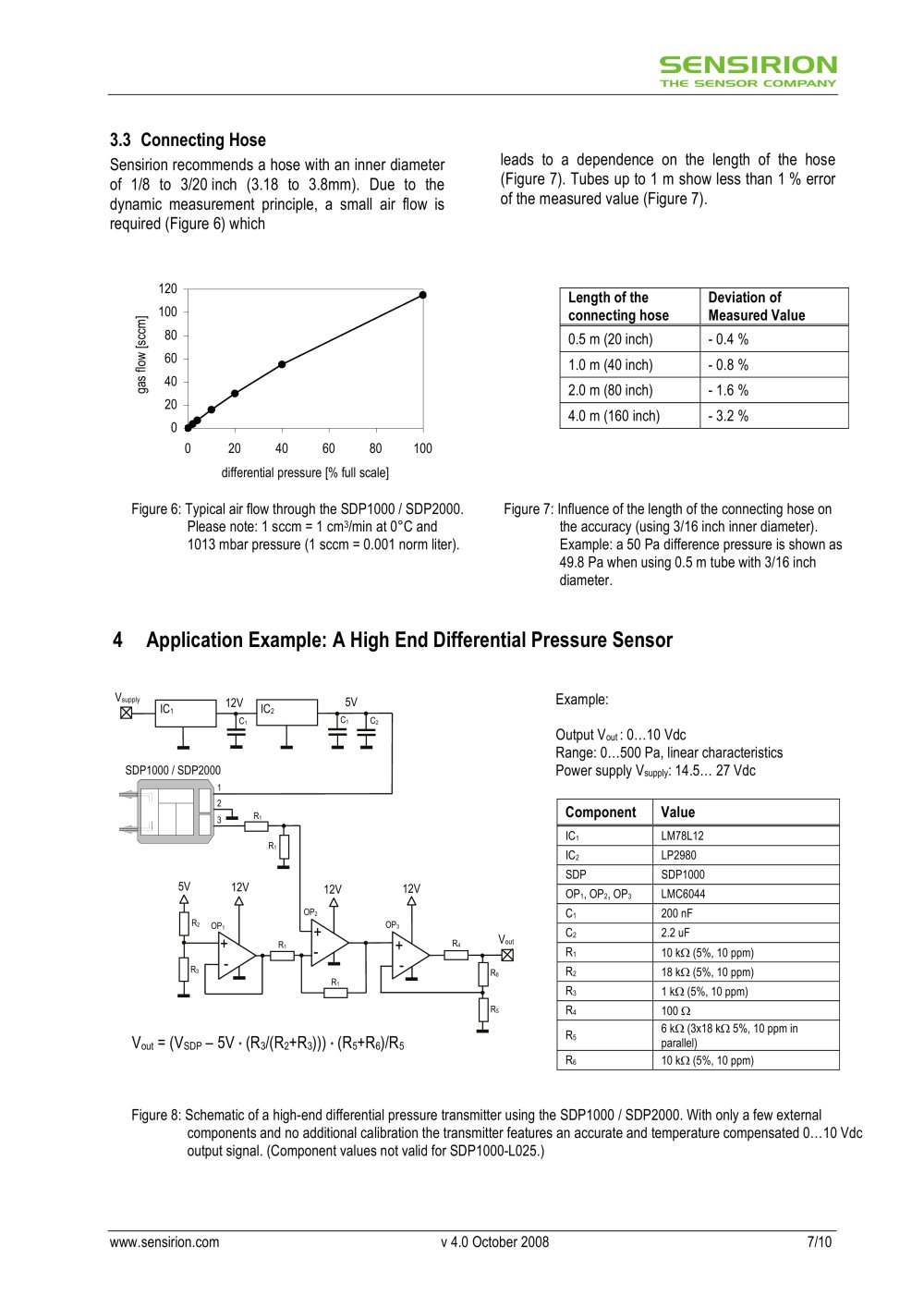
differential pressure sensor sdp1000
Consult Sensirion's entire datasheet for the Differential Pressure Sensor SDP1000/2000 catalogue on DirectIndustry. Page: 7/10.
The Sensirion SDP1000/2000 series of differential pressure sensors are designed for precise measurement of pressure differences in various applications. These sensors utilize a MEMS (Micro-Electro-Mechanical Systems)...

Pressure Sensor Alarm
The general-purpose circuit of the simple pressure sensor alarm is constructed using a few easily accessible and inexpensive components. The operation of this circuit is straightforward.
The simple pressure sensor alarm circuit typically includes a pressure sensor, an operational amplifier (op-amp),...

Digital Pressure Gauge
This gauge utilizes an Intersil ICL 7106 A/D converter chip along with an LED display module. It incorporates a Sensym Corp. pressure transducer SX100pn (100 psi full scale) arranged in a Wheatstone bridge configuration, which drives an operational amplifier (IC1A,...

Digital pressure measuring circuit
Digital pressure measuring circuit using AD7710/7715/7730 multifunction digital sensor signal conditioning ICs. These ICs integrate a digital interface with the control port, a clock generator, a digital filter, amplitude modulation, a programmable gain amplifier, an A/D converter, and other electronic...

Pressure measurement circuit diagram
This is a measurement circuit designed to measure forces ranging from 0 to 1500 grams, producing an output voltage of 0 to 1500 millivolts (mV) with a sensitivity of 1 mV per gram. The circuit is powered by a 12V...

Error Compensation Circuit for Pressure Sensor
To obtain an accurate pressure value, it is essential to eliminate offset errors. Numerous basic circuit designs are employed to remove these offset errors.
Offset errors in pressure measurement systems can lead to inaccuracies in the readings, which may affect the...