


Lego Double Rotation Sensor
#Lego
#opto-interrupter
#rotation sensor
#pulley wheel
#axle
#DIY
#optical sensor
#mechanical sensor
#educational
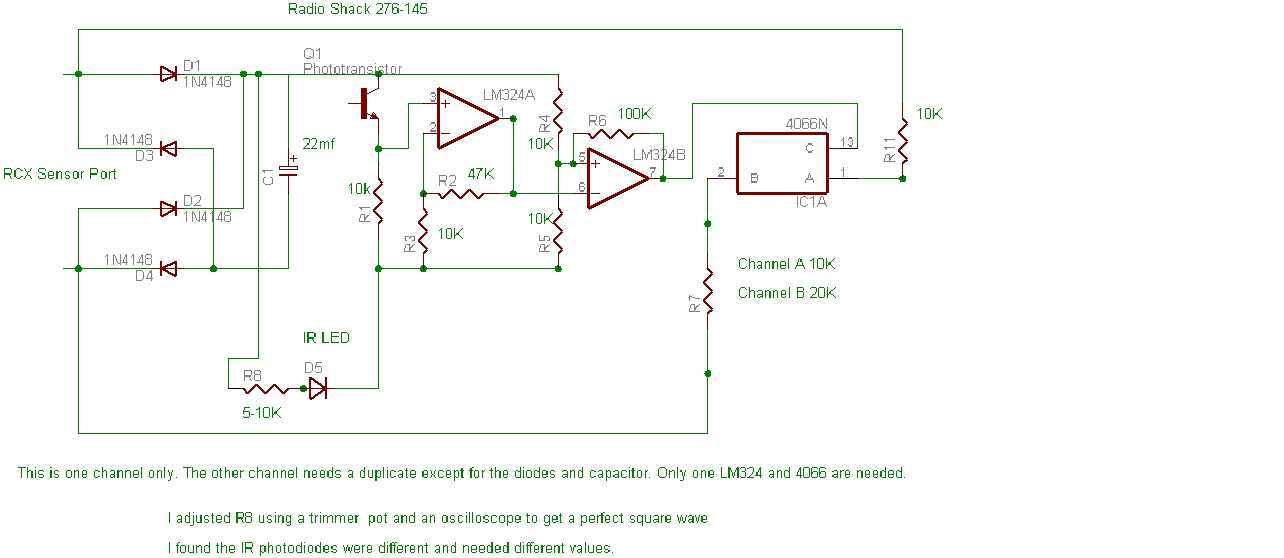
Description: An opto-interrupter made with Lego beams, regular parts, a 6 hole pulley wheel and an axle. More: I started out with Michael Gasperi's idea with the 6 whole pulley installed in a Lego enclosure with axle and beams so it could move. I used phototransistors and infrared LED's because I thought they would use less power than visible light LED's and CdS p
The described opto-interrupter circuit utilizes a combination of Lego components and electronic elements to create a functional light-sensing device. The core of the design features a 6-hole pulley wheel mounted within a Lego enclosure, which serves as the mechanical structure for the opto-interrupter. The pulley wheel is connected to an axle, allowing for rotational movement, which can be used to interrupt the light path.
At the heart of the opto-interrupter are phototransistors and infrared LEDs. The infrared LEDs emit light that, when unobstructed, is detected by the phototransistors. The choice of infrared LEDs over visible light LEDs is significant, as infrared components generally consume less power and are less susceptible to interference from ambient light conditions. This makes the circuit more efficient and reliable in various lighting environments.
In operation, as the pulley wheel rotates, it can obstruct the light path between the infrared LED and the phototransistor. When the light is interrupted, the phototransistor detects this change and can trigger an output signal. This output can be used to control other devices or systems, such as motors or alarms, depending on the application.
The circuit can be further enhanced by incorporating additional components such as resistors to limit current through the LEDs and phototransistors, capacitors for noise filtering, and possibly a microcontroller for more advanced processing of the signals. The design's modularity, due to the use of Lego parts, allows for easy adjustments and modifications to the setup, enabling experimentation with different configurations and components.
Overall, this opto-interrupter design exemplifies a creative integration of mechanical and electronic systems, showcasing the versatility of Lego as a platform for prototyping electronic circuits.An opto-interrupter made with Lego beams, regular parts, a 6 hole pulley wheel and an axle. I started out with Michael Gasperi's idea with the 6 whole pulley installed in a Lego enclosure with axle and beams so it could move. I used phototransistors and infrared LED's because I thought they would use less power than visible light LED's and CdS p
The described opto-interrupter circuit utilizes a combination of Lego components and electronic elements to create a functional light-sensing device. The core of the design features a 6-hole pulley wheel mounted within a Lego enclosure, which serves as the mechanical structure for the opto-interrupter. The pulley wheel is connected to an axle, allowing for rotational movement, which can be used to interrupt the light path.
At the heart of the opto-interrupter are phototransistors and infrared LEDs. The infrared LEDs emit light that, when unobstructed, is detected by the phototransistors. The choice of infrared LEDs over visible light LEDs is significant, as infrared components generally consume less power and are less susceptible to interference from ambient light conditions. This makes the circuit more efficient and reliable in various lighting environments.
In operation, as the pulley wheel rotates, it can obstruct the light path between the infrared LED and the phototransistor. When the light is interrupted, the phototransistor detects this change and can trigger an output signal. This output can be used to control other devices or systems, such as motors or alarms, depending on the application.
The circuit can be further enhanced by incorporating additional components such as resistors to limit current through the LEDs and phototransistors, capacitors for noise filtering, and possibly a microcontroller for more advanced processing of the signals. The design's modularity, due to the use of Lego parts, allows for easy adjustments and modifications to the setup, enabling experimentation with different configurations and components.
Overall, this opto-interrupter design exemplifies a creative integration of mechanical and electronic systems, showcasing the versatility of Lego as a platform for prototyping electronic circuits.An opto-interrupter made with Lego beams, regular parts, a 6 hole pulley wheel and an axle. I started out with Michael Gasperi's idea with the 6 whole pulley installed in a Lego enclosure with axle and beams so it could move. I used phototransistors and infrared LED's because I thought they would use less power than visible light LED's and CdS p

pcb Help identifying and finding shematics/datasheets for circuit board
The chip in the center with small bullet holes is likely proprietary. It is possible to salvage a few components from it, although understanding the circuit is not necessary for this purpose. Additionally, it is confirmed that the device is...

Homemade Metal Detector Kit
A simple home project can quickly become problematic if it encounters electric cables, gas, or water pipes, or the central heating system. Using a metal detector allows one to check for metal objects within walls, ceilings, or floors beforehand. An...

A contact-less digital tachometer based on optical sensors
The circuit for the Digital Tachometer/RPM Counter consists of only a few devices. Wire them up according to the following circuit diagram. The PIC used is on a demonstration board, which means the clock, power, and ground pins are already...

Lego Rotation Sensor Internals
The Lego rotation sensor is a compact device that allows the RCX to measure the rotation of an axle with a resolution of 16 steps per turn. However, it experiences issues at low rotation speeds, where the read values can...

LEGO robotics
A dual-RCX, six-motor robotic system. The protocol for the serial interface between the computer and the Dacta Control Lab has been discussed, which may or may not relate to the protocol used by the RCX. This information is likely of...

Crescendo ampilifier elektor1982
The Elector Crescendo was the first DIY amplifier that was not a kit. The design was sourced from the Elector magazines available at a local library.
The Elector Crescendo is an innovative audio amplifier designed for DIY enthusiasts. It features a...

turret diy
For maximum mini-security, this RC Tupperware Turret delivers a formidable deterrent against food theft. While it lacks motion sensors, potential food thieves will think twice before attempting to swipe baked goods. This 11-hour project, designed by Chris of PyroElectro, emphasizes...
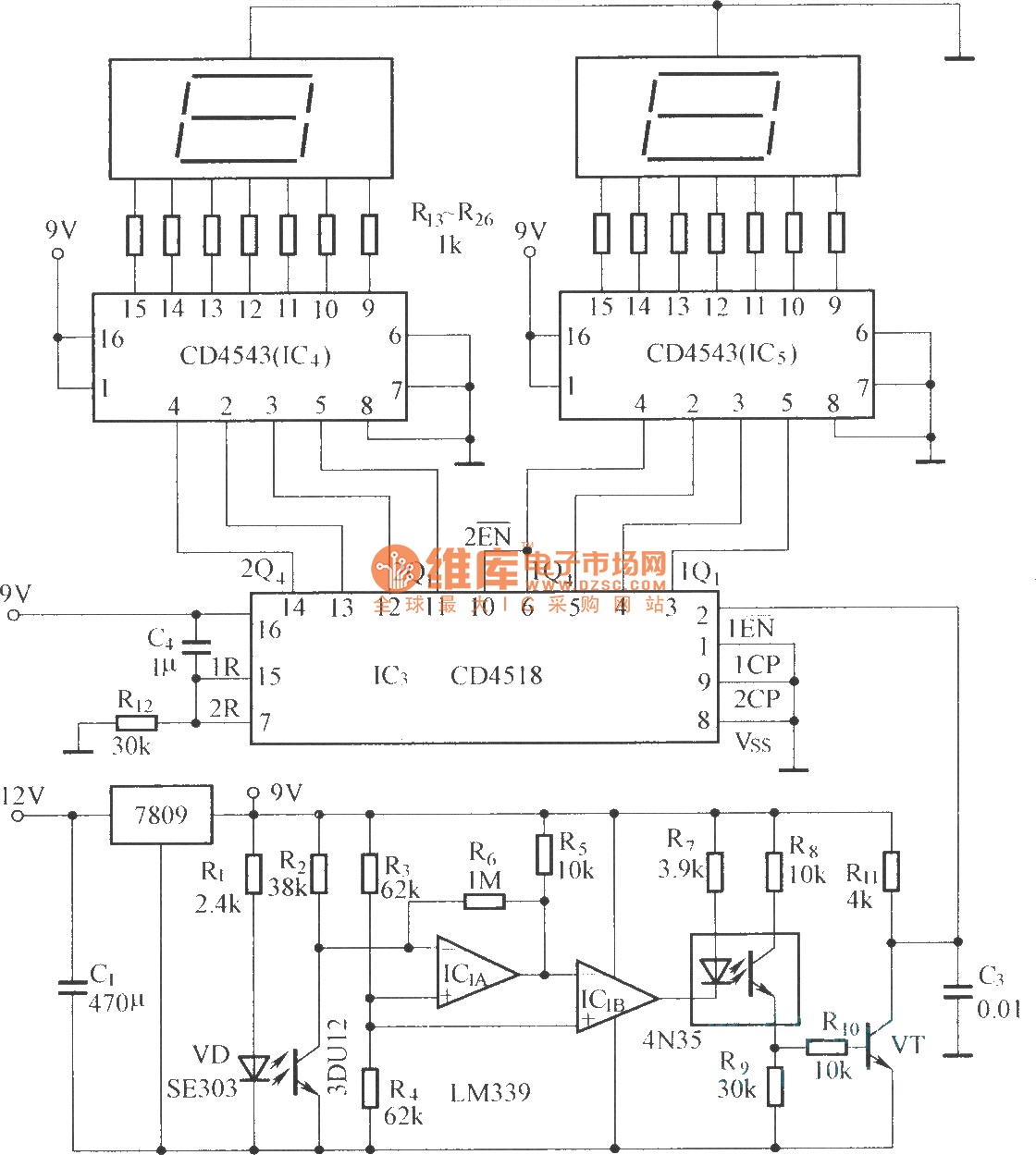
Digital displaying photoelectric counter circuit diagram
The circuit includes an optical input circuit (VD, 3DU12), a pulse forming circuit (IC1A, IC1B functioning as a voltage comparator; optical coupler; transistor switching circuit), and a counting and display circuit.
The circuit architecture consists of several key components that work...

MePADS
If you are considering building the Desert Ratt 2, it is advisable to read all the accompanying text, as it contains relevant construction details. Engaging with the comments and replies can also provide additional insights, as previous blog posts have...