


Live line Detector
#live line detector
#capacitive coupling
#4017 IC
#LED indicator
#mains frequency
#safety
#non-contact detection
#50Hz
#home automation
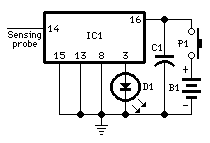
Description: Detects the presence of a live mains conductor. Minimum parts counting. If the unit is brought close to a live conductor (insulated, and even buried in plaster) capacitive coupling between the live conductor and the probe clocks the counter, and causes the LED to flash 5 times per second, because the 4017 IC divides the mains 50Hz frequency by 10. More: * Sensitivity can be varied using a more or less long sensing probe. * Due to 3V operation, the LED's current limiting resistor can be omitted. When remote from a live line, the unit stops counting, the LED resulting permanently off.
The circuit described operates as a capacitive proximity sensor for detecting live mains conductors, utilizing minimal components to achieve its functionality. The core of the circuit is based on a CD4017 decade counter IC, which is designed to count pulses and has a built-in frequency division capability.
When the sensing probe approaches a live conductor, capacitive coupling occurs between the probe and the live wire. This coupling generates a small AC voltage that is detected by the circuit. The input stage of the circuit is designed to be sensitive enough to detect this small voltage, which is then used to trigger the CD4017 counter. The counter is configured to divide the mains frequency (typically 50Hz) by 10, resulting in an output pulse rate of 5Hz. This output is used to drive an LED, which flashes at a rate of five times per second to indicate the presence of the live conductor.
The sensitivity of the circuit can be adjusted by changing the length of the sensing probe. A longer probe will increase the capacitive coupling effect, making the circuit more sensitive to the presence of live conductors. Conversely, a shorter probe will decrease sensitivity.
The circuit operates at a low voltage of 3V. Due to this low voltage operation, it is possible to omit the current limiting resistor typically used with LEDs. This simplification reduces the number of components required and makes the circuit more compact.
In the absence of a nearby live conductor, the capacitive coupling effect diminishes, and the CD4017 stops counting. Consequently, the LED remains off, indicating that no live conductor is detected. This behavior enhances the circuit's efficiency, as it conserves power when not in use. The overall design is suitable for various applications where detecting the presence of live mains conductors is necessary, particularly in environments where safety and minimal component count are priorities.Detects the presence of a live mains conductor. Minimum parts counting. If the unit is brought close to a live conductor (insulated, and even buried in plaster) capacitive coupling between the live conductor and the probe clocks the counter, and causes the LED to flash 5 times per second, because the 4017 IC divides the mains 50Hz frequency by 10. * Sensitivity can be varied using a more or less long sensing probe. * Due to 3V operation, the LED`s current limiting resistor can be omitted. When remote from a live line, the unit stops counting, the LED resulting permanently off.
The circuit described operates as a capacitive proximity sensor for detecting live mains conductors, utilizing minimal components to achieve its functionality. The core of the circuit is based on a CD4017 decade counter IC, which is designed to count pulses and has a built-in frequency division capability.
When the sensing probe approaches a live conductor, capacitive coupling occurs between the probe and the live wire. This coupling generates a small AC voltage that is detected by the circuit. The input stage of the circuit is designed to be sensitive enough to detect this small voltage, which is then used to trigger the CD4017 counter. The counter is configured to divide the mains frequency (typically 50Hz) by 10, resulting in an output pulse rate of 5Hz. This output is used to drive an LED, which flashes at a rate of five times per second to indicate the presence of the live conductor.
The sensitivity of the circuit can be adjusted by changing the length of the sensing probe. A longer probe will increase the capacitive coupling effect, making the circuit more sensitive to the presence of live conductors. Conversely, a shorter probe will decrease sensitivity.
The circuit operates at a low voltage of 3V. Due to this low voltage operation, it is possible to omit the current limiting resistor typically used with LEDs. This simplification reduces the number of components required and makes the circuit more compact.
In the absence of a nearby live conductor, the capacitive coupling effect diminishes, and the CD4017 stops counting. Consequently, the LED remains off, indicating that no live conductor is detected. This behavior enhances the circuit's efficiency, as it conserves power when not in use. The overall design is suitable for various applications where detecting the presence of live mains conductors is necessary, particularly in environments where safety and minimal component count are priorities.Detects the presence of a live mains conductor. Minimum parts counting. If the unit is brought close to a live conductor (insulated, and even buried in plaster) capacitive coupling between the live conductor and the probe clocks the counter, and causes the LED to flash 5 times per second, because the 4017 IC divides the mains 50Hz frequency by 10. * Sensitivity can be varied using a more or less long sensing probe. * Due to 3V operation, the LED`s current limiting resistor can be omitted. When remote from a live line, the unit stops counting, the LED resulting permanently off.
Audio Peak / Beat LED indicator
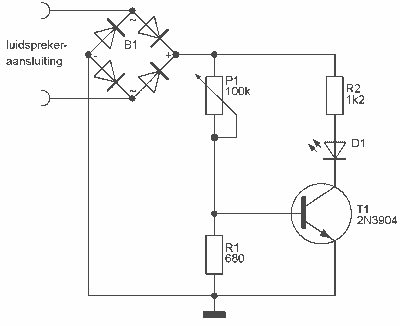
This indicator can be used, or see if your speakers can be damaged by the noise power. With P1 you can set the limit to which D1 LED lights. The pot is 100k here, you can even experiment with other...

50hz Calibration aid for Multimeters
The purpose of this prototype unit is to eliminate the need for an oscillator. It provides a mains-derived and fully variable 50 Hz AC voltage, adjustable down to millivolts for comparison and accuracy testing of two or more parallel-connected multimeters....

Computerize Your Room/House
You have read about computerized rooms or seen home automation products advertised in electronics magazines. You have decided to try it yourself. However, it is important to note that this project is not inexpensive. A computer is required, which is...

4017 IC For Three Hour Timer
The circuit is designed for battery charging with a specified time limit of three hours. After the charging period is complete, the battery will be automatically disconnected from the charger. Key components include a 4017 integrated circuit (IC).
The circuit utilizes...

Contactless Live Line Detector
A live-line detector is a circuit designed to identify the presence of a live mains conductor through capacitive coupling between the live conductor and the detection circuit.
The live-line detector operates on the principle of capacitive coupling, which allows it to...

50hz accurate oscillator circuit
The ELM446 is an 8-pin digital divider integrated circuit that generates both 50Hz and 1Hz outputs from a common 3.58MHz NTSC colorburst crystal. The designer needs to supply only the crystal and two suitable loading capacitors, along with a properly...
home automation Installation
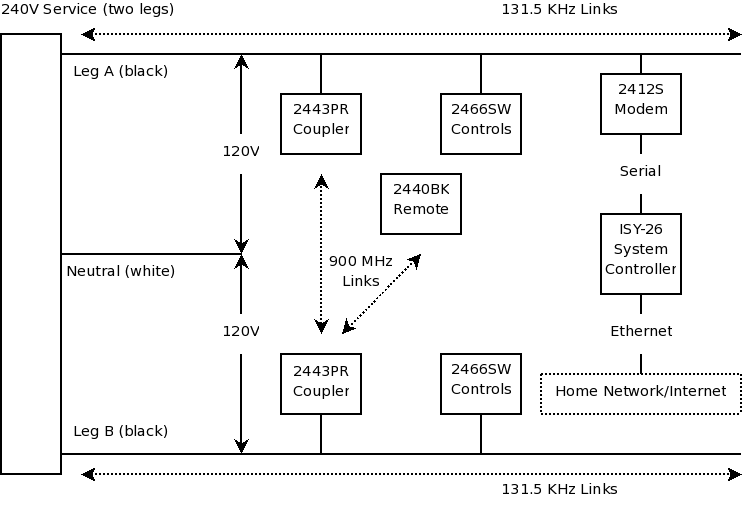
First and foremost, if one is not skilled with tools and electrical systems, it is advisable to hire a qualified electrician rather than attempting to undertake this task independently. The electrician should review this page for specific cautions and advice....

Night Safety Light For Autos
This circuit activates the brake lights of a parked car when headlights from an approaching vehicle are detected, alerting the driver of the oncoming vehicle about the stationary car. LDR4 serves as the sensor, while LDR1 deactivates the circuit by...

4017 IC For Flip-Flop Timer Circuit DIagram
This circuit illustrates a flip-flop timer circuit diagram utilizing the 4017 integrated circuit (IC). The key feature includes a push-button switch (S1) that discharges capacitor (C1) through resistor (R2).
The 4017 decade counter IC is commonly used in timer and counting...