


LM339D Simple Capacitive Touch Sensor
#LM339D
#capacitive touch
#proximity detection
#touch control
#switching
#resistor
#capacitor
#diode

Description: This circuit is utilized for proximity detection and touch-controlled switching. When a finger approaches the sensor, it generates a capacitance to ground with a value ranging from 30 to 100 pF. Components involved include a resistor, capacitor, diode, and the LM339D integrated circuit.
The proximity detection circuit operates by measuring variations in capacitance caused by the presence of nearby objects, such as a human finger. The LM339D, which is a quad comparator, plays a crucial role in processing the signals generated by the sensor. The capacitive sensing mechanism works by detecting changes in the capacitance between the sensor and the ground, which occurs when a conductive object, like a finger, comes close.
In this configuration, the capacitor is typically connected in parallel with the sensor to stabilize the readings and filter out noise. The resistor is used to set the sensitivity of the circuit; it can be adjusted to change the threshold at which the comparator triggers. The diode is included to protect the circuit from voltage spikes that may occur during operation.
When the capacitance exceeds a predefined threshold, the LM339D outputs a high signal, which can be used to drive a load or activate another circuit. This makes the design suitable for applications such as touch-sensitive switches, where the user can control devices by simply bringing their finger close to the sensor without making physical contact. Overall, this circuit provides an efficient and reliable method for proximity detection and touch control, leveraging the properties of capacitive sensing technology.Used for proximity detection and touch-controlled switching. for example, a finger comes close to the sensor, it creates a capacitance to Earth with a value of 30 to 100 pF. Component: Resistor, Capacitor, Diode, LM339D IC
The proximity detection circuit operates by measuring variations in capacitance caused by the presence of nearby objects, such as a human finger. The LM339D, which is a quad comparator, plays a crucial role in processing the signals generated by the sensor. The capacitive sensing mechanism works by detecting changes in the capacitance between the sensor and the ground, which occurs when a conductive object, like a finger, comes close.
In this configuration, the capacitor is typically connected in parallel with the sensor to stabilize the readings and filter out noise. The resistor is used to set the sensitivity of the circuit; it can be adjusted to change the threshold at which the comparator triggers. The diode is included to protect the circuit from voltage spikes that may occur during operation.
When the capacitance exceeds a predefined threshold, the LM339D outputs a high signal, which can be used to drive a load or activate another circuit. This makes the design suitable for applications such as touch-sensitive switches, where the user can control devices by simply bringing their finger close to the sensor without making physical contact. Overall, this circuit provides an efficient and reliable method for proximity detection and touch control, leveraging the properties of capacitive sensing technology.Used for proximity detection and touch-controlled switching. for example, a finger comes close to the sensor, it creates a capacitance to Earth with a value of 30 to 100 pF. Component: Resistor, Capacitor, Diode, LM339D IC

Output by the CS3843 and CS5101 composed of 5V 3.3V switching DC power supply circuit
The CS3843 and CS5101 are components of a 5V/3.3V switching DC power supply circuit. The CS3843 is a fixed frequency PWM controller characterized by a set oscillator that precisely controls the duty cycle. It features a temperature-compensated reference voltage, a...

Capacitor Esr Measurer
The equivalent series resistance (ESR) of a capacitor can be measured using this circuit and an AC voltmeter. It functions as a 50-kHz square-wave generator, driving a current waveform of approximately ±180 mA through the capacitor-under-test via resistors R1 and...
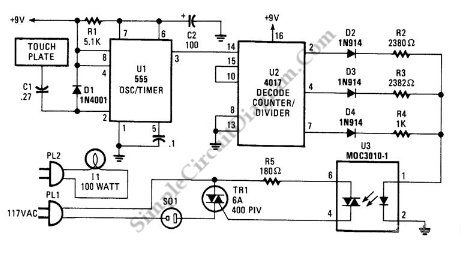
Touch-Controlled Lamp Dimmer
This is a three-mode lamp dimmer circuit with touch control. This circuit can be used to control a lamp in three operation modes: dim, off, and bright. It utilizes a NE555 timer.
The three-mode lamp dimmer circuit designed with touch control...

Diode Tube
The diode tube under examination is essentially Edison’s early incandescent bulb containing a plate. The term "diode" refers to the two elements or electrodes within the glass container that constitute the tube. Shortly after the discovery of the Edison effect,...

Help me Understand this Circuit Schematic
The roles of capacitors C1, C4, and C5 in a circuit may not be immediately clear. Capacitors on the power rail help to smooth out the signal by reducing current ripple, which can be observed using an oscilloscope. Resistors R6...
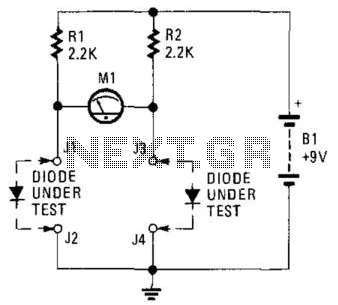
Diode Matching Circuit
This circuit can be utilized to match diodes for applications where balance is essential, such as in a balanced modulator. The diode matching circuit will display the forward voltage drop of the two diodes in millivolts.
The diode matching circuit is...

Car Large capacitor charge controllers
One-farad capacitors require some care. It's common knowledge that they must be pre-charged with a current-limiting resistor before plugging in. It is less common knowledge that those fifty-dollar smart cap controllers are in fact very simple devices, two dollars for...
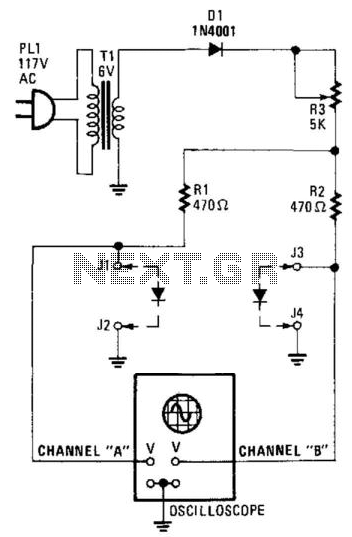
Simple Diode Curve Tracer
Suitable for matching diodes or examining the VI characteristics of two-terminal devices (such as diodes), this circuit is designed for laboratory use. Resistors R1 and R2 can be increased in value, and a higher voltage transformer can be utilized for...

13.8V 40A Switching Power Supply By LM3524 and LM324 PCB
This article was originally published in a slightly modified form in the QST magazine, December 1998 and January 1999, and in the Radio Amateur's Handbook, 1999. Visit the American Radio Relay League for information on these publications and a world...