


Magnetic field sensors circuit and serial interface application HMC1002
#magnetic field sensor
#HMC1002
#AMP04
#serial interface
#biaxial sensor
#measurement
#X-axis
#instrumentation
#sensor circuit

Description: An application circuit for a biaxial magnetic field sensor is presented. This circuit utilizes the HMC1002 biaxial magnetic sensor along with two AMP04 amplifiers (A1, A2) to simultaneously measure magnetic fields in both the X-axis and Y-axis directions. The HMC1002 outputs two voltage signals, which are amplified by A1 and A2. These amplified signals are then fed into a 12-bit A/D converter, TLC2543, which connects through an interface circuit. The MAX662A serves as a highly efficient DC/DC converter, raising the power supply from +5V to +10V, which powers the IRF7105 driver. A pulse current driver provides input signals to the P terminal, with the output sent to the HMC1002 S/R+ terminal (pin 16). Tantalum capacitors should be utilized in the circuit.
The application circuit for the biaxial magnetic field sensor is designed to accurately capture and process magnetic field measurements in two dimensions. The HMC1002 sensor is the central component, capable of detecting magnetic fields along the X and Y axes. The integration of two AMP04 operational amplifiers allows for the amplification of the sensor's output signals, ensuring that the signals are strong enough for further processing.
The amplified signals from the AMP04 devices are directed to a 12-bit analog-to-digital converter (ADC), specifically the TLC2543. This ADC converts the analog voltage signals into digital data, which can then be processed by a microcontroller or other digital processing unit. The interface circuit ensures proper communication between the ADC and the processing unit, facilitating seamless data transfer.
Power management in the circuit is handled by the MAX662A DC/DC converter, which efficiently steps up the input voltage from +5V to +10V. This increased voltage is crucial for powering the IRF7105, a pulse current driver that is responsible for generating the necessary input signals for the HMC1002 sensor. The pulse current driver operates by sending specific signals to the sensor, which are essential for its operation and performance.
The design also emphasizes the importance of using tantalum capacitors in the circuit. These capacitors are known for their stability and reliability, making them suitable for applications requiring precise voltage regulation and filtering. Their inclusion in the circuit contributes to the overall performance and accuracy of the sensor system.
Overall, this application circuit offers a robust solution for measuring magnetic fields in two dimensions, utilizing advanced components and careful design considerations to achieve high performance and reliability in various applications.Application Circuit biaxial magnetic field sensor shown. Using a biaxial magnetic sensor HMC1002, two AMP04 (A1, A2), the magnetic field can simultaneously measure the X-axis d irection and the Y-axis direction. HMC1002 two voltage signals outputted respectively after A1 and A2 amplification, then the analog input and the reference terminal 12 bit A/D converter TLC2543, and then connected via the interface circuit P. MAX662A is a highly efficient DC/DC converter can be raised to + 5V power supply + 10V, as the drive power IRF7105.
Pulse current driver input signal from the P, the output is sent to the HMC1002 S/R + terminal (pin 16). Figure C3 tantalum capacitors should be used.
The application circuit for the biaxial magnetic field sensor is designed to accurately capture and process magnetic field measurements in two dimensions. The HMC1002 sensor is the central component, capable of detecting magnetic fields along the X and Y axes. The integration of two AMP04 operational amplifiers allows for the amplification of the sensor's output signals, ensuring that the signals are strong enough for further processing.
The amplified signals from the AMP04 devices are directed to a 12-bit analog-to-digital converter (ADC), specifically the TLC2543. This ADC converts the analog voltage signals into digital data, which can then be processed by a microcontroller or other digital processing unit. The interface circuit ensures proper communication between the ADC and the processing unit, facilitating seamless data transfer.
Power management in the circuit is handled by the MAX662A DC/DC converter, which efficiently steps up the input voltage from +5V to +10V. This increased voltage is crucial for powering the IRF7105, a pulse current driver that is responsible for generating the necessary input signals for the HMC1002 sensor. The pulse current driver operates by sending specific signals to the sensor, which are essential for its operation and performance.
The design also emphasizes the importance of using tantalum capacitors in the circuit. These capacitors are known for their stability and reliability, making them suitable for applications requiring precise voltage regulation and filtering. Their inclusion in the circuit contributes to the overall performance and accuracy of the sensor system.
Overall, this application circuit offers a robust solution for measuring magnetic fields in two dimensions, utilizing advanced components and careful design considerations to achieve high performance and reliability in various applications.Application Circuit biaxial magnetic field sensor shown. Using a biaxial magnetic sensor HMC1002, two AMP04 (A1, A2), the magnetic field can simultaneously measure the X-axis d irection and the Y-axis direction. HMC1002 two voltage signals outputted respectively after A1 and A2 amplification, then the analog input and the reference terminal 12 bit A/D converter TLC2543, and then connected via the interface circuit P. MAX662A is a highly efficient DC/DC converter can be raised to + 5V power supply + 10V, as the drive power IRF7105.
Pulse current driver input signal from the P, the output is sent to the HMC1002 S/R + terminal (pin 16). Figure C3 tantalum capacitors should be used.

Instrumentation circuit
The mechanical chassis prototype, as illustrated in the accompanying image, was constructed using two materials: foam and aluminum. Foam was selected for its ease of manipulation, while aluminum was chosen for its excellent strength-to-weight ratio. The prototype features a rotary...

Digital-ProfiLab 4.0
Digital-ProfiLab was designed for measurement and control applications, combining features like circuit and logic simulation, front panel design, and hardware control to one powerful tool. Incoming signals from external devices may be processed and displayed. A circuit editor is used...

Advances in Measurement & Sensor Tech
This issue features articles on various measurement and sensor-related embedded design projects. Readers are encouraged to attempt similar projects and share their results. Starting on page 14, Petre Tzvetanov Petrov describes a multilevel audible logical probe design. Petrov notes that...
RealView 2.0
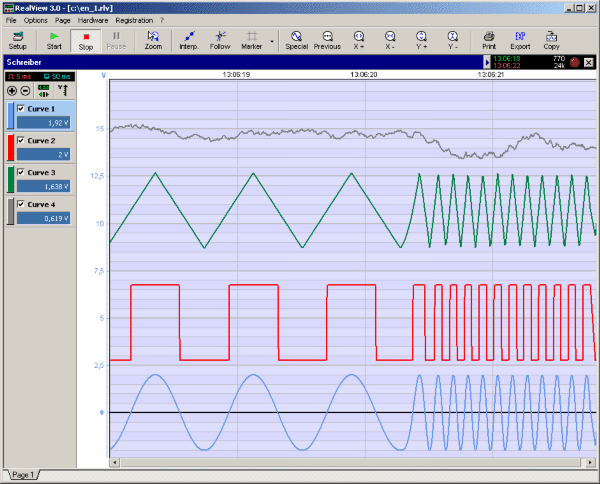
RealView is a measurement application, which records and plots measured values from analogue hardware devices in real-time. Several curves can be plotted into a single diagram. Several diagrams can be arranged on one or more pages if necessary. Plot options...
RealView 2.0
RealView is a measurement application, which records and plots measured values from analogue hardware devices in real-time. Several curves can be plotted into a single diagram. Several diagrams can be arranged on one or more pages if necessary. Plot options...

ProfiLab-Expert 4.0
The ProfiLab-Expert software allows you to develop your own digital or analogue measuring technology projects. It doesn't matter if you want to create analogue measurements or digital controls - you can realize it all. And for all this you don't...
Digital-ProfiLab 4.0
Digital-ProfiLab was designed for measurement and control applications, combining features like circuit and logic simulation, front panel design, and hardware control to one powerful tool. Incoming signals from external devices may be processed and displayed. A circuit editor is used...
Serial Remote Control for the RIG RX-2 Receiver
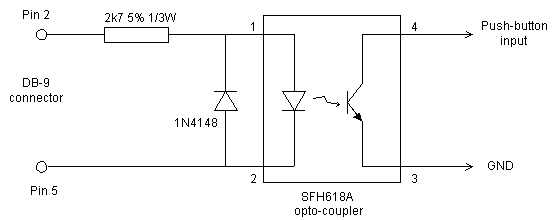
This document outlines modifications made to the RIG RX-2 receiver, enabling remote control via a computer using an RS-232 serial interface. The modifications consist of two components: additional hardware and a new firmware program for the PIC16C84 microcontroller. In manual...

The computer Z RS-23 serial interface current loop circuit diagram
This circuitry facilitates the connection between the computer's Z RS-23 serial interface and the current ring circuitry. It converts the voltage signal of the transmission into a current signal of 20 mA, achieving a maximum speed of 1200 bits. The...